


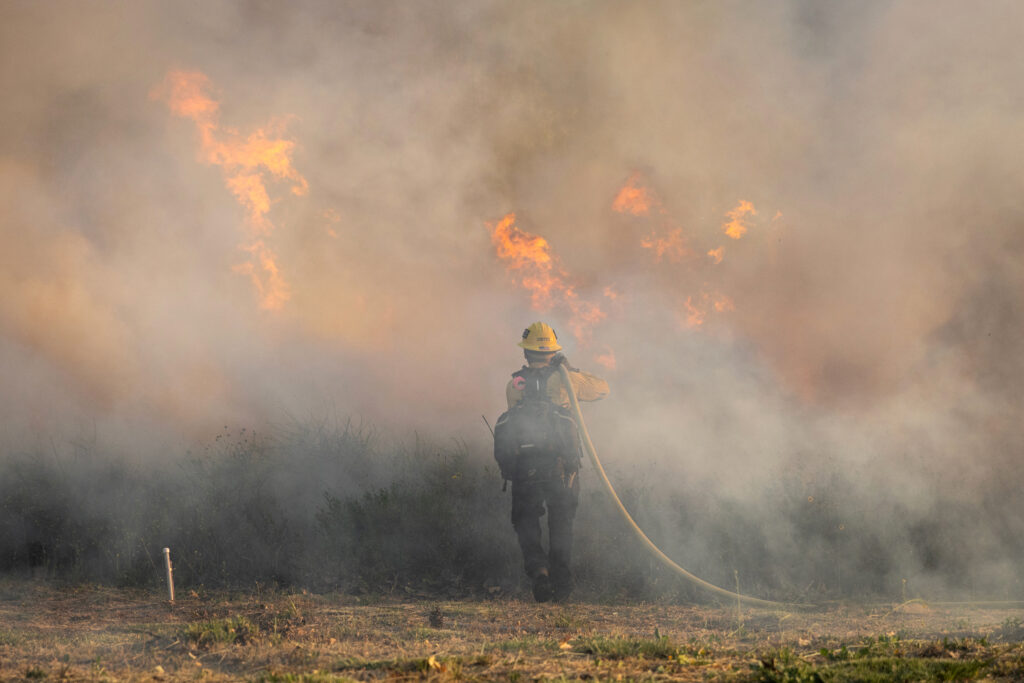
As a wildfire in May approached the site of one of the worst nuclear meltdowns in U.S. history, state and local officials scrambled to respond to the blaze and to establish proper real-time radiation and air monitoring to protect Southern California families, internal emails show.
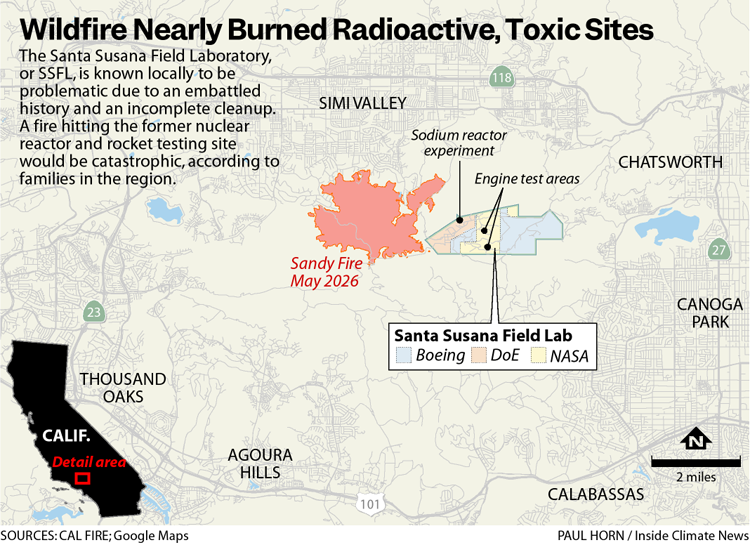
The 2,183-acre “Sandy Fire,” which began south of Simi Valley on the morning of May 18 and was active for nine days before being fully contained, did not result in any deaths or injuries.
One structure was destroyed in the blaze and two others burned. More than 33,000 people in the valley and nearby communities were placed under evacuation orders as plumes of smoke overtook the area.
The aftermath of Southern California’s first major wildfire of the season put residents on high alert again about the implications of a fire burning at the site of the former Santa Susana Field Laboratory, or SSFL. Memories of the massive 2018 Woolsey Fire reignited concerns that toxic contaminants from the site could spread throughout the region along with smoke and ash.
Based on interviews and dozens of emails obtained by Inside Climate News via a public records request, California officials were unable to coordinate assistance from their federal counterparts to begin testing the area for real-time radiation impacts until at least two days after the Sandy Fire began, following urgent calls for such monitoring from the state’s Department of Toxic Substances Control (DTSC).
During the response, Ventura County relied on the DTSC, which in turn reached out to the EPA and the U.S. Department of Energy (DOE), which ultimately began radiological monitoring two or three days after the fire began. It’s not clear from the emails precisely when the radiation testing began.
Boeing, which now owns SSFL, had its own air and radiation monitors in place but the report outlining those results has yet to be released. Emails appear to show that state officials struggled to obtain access to the crucial data from that monitoring in real time. The company deferred test result inquiries to the state.
The Department of Toxic Substances Control oversees the SSFL cleanup and is the authority on the site’s conditions. In 1959, an experimental reactor at the site, then run by the Atomic Energy Commission, suffered a partial meltdown. The extent of the incident was kept secret for years, and scientists would eventually estimate that more radiation was released there than at the Three Mile Island nuclear accident. The site has never been fully cleaned up.
One particularly dedicated group of community activists, Parents Against Santa Susana Field Lab, believes the latest wildfire threat should be a wakeup call for both the community and regulators, demonstrating the need for additional safeguards for the surrounding communities and the urgent need to push forward a well-resourced and comprehensive site cleanup.
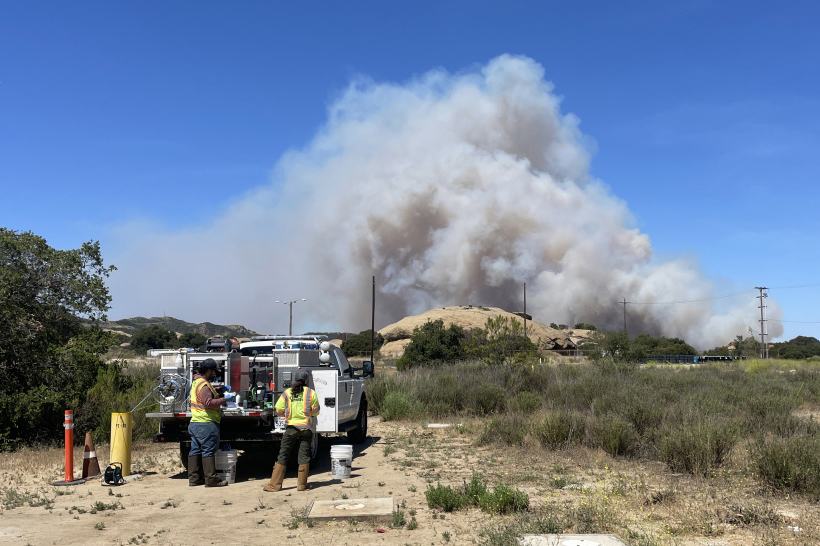
Simi Valley residents have feared for years that the radioactive contamination peppering SSFL would inevitably—or may have already—spread throughout the area, with serious health implications. They worry that fires have only disseminated the radioactive particles even further and a lack of real-time monitoring when wildfires approach often leaves families in the dark about how much risk they face.
Their fears have grown with climate change, when weather whiplash and hotter temperatures are driving the increased size and frequency of wildfires.
The consequences of wildfires incinerating decades-old hazardous pollution will inevitably put people at further risk in other ways communities may not be ready for, according to several experts who reviewed the latest incident and the response.
“The Santa Susana Field Laboratory site is one among many toxic sites that are vulnerable in the face of climate destabilization and the disasters that come with it,” said Emily Diamond, a researcher at the Wright Institute, who specializes in geospatial mapping of toxic exposure and is currently studying the biopsychosocial impacts of natural disasters at a community level.
She said in addition to radiation, other chemicals—such as TCE (trichloroethylene) which is listed as a contaminant on the official site report—are very toxic as well.
Diamond, considering contaminated sites nationwide and beyond, said she “cannot point to a place where there has been toxic pollution that has been cleaned up and the site has been effectively hardened against disaster.”
A spokesman for Boeing said in an email that the company’s priority during any wildfire event is the safety of people onsite. An emergency plan ensures personnel can exit the site safely, he noted before discussing monitoring.
“While the Sandy Fire did not reach SSFL, Boeing operates six air monitoring stations around the perimeter of the site as part of our ongoing California Department of Toxic Substances Control-approved monitoring program for particulate matter and radionuclides,” the Boeing spokesman said.
A Boeing report that includes the period when the Sandy Fire took place in May will not be released until the fourth quarter of this year, the Boeing official said. He did not provide more specifics on the release date.
Inside Climate News reported on the dangers present amid the Sandy Fire after nearby residents—including at least one family in West Hills—fled when the wildfire got around a quarter mile from SSFL.
The Ventura County Fire Department said it was mindful of the contamination on-site at SSFL from the moment the wildfire first began on May 18, taking measures to ensure radiation or other pollutants did not harm families.
Ventura County Fire Department spokesman said Thursday seven “air sampling radiological monitoring locations” were established around the incident.
However, it is not clear if these monitors could test for radiation and agencies provided conflicting information on the nature of real-time radiation testing early on.
Karin Grennan, a spokeswoman for the Ventura County Air Pollution Control District, said the agency does not regularly conduct radioactivity monitoring. She said monitors to measure PM2.5, PM10, ozone and oxides of nitrogen were in place amid the Sandy Fire.
Andy VanSciver, a firefighter and spokesman for the Ventura County Fire Department, deferred questions regarding radiation testing to state and federal agencies, Simi Valley’s emergency services office and to Boeing. A Department of Energy spokesperson also did not clarify.
Inside Climate News was only able to confirm radiation monitoring was underway by May 21.
A Long History and New Concerns
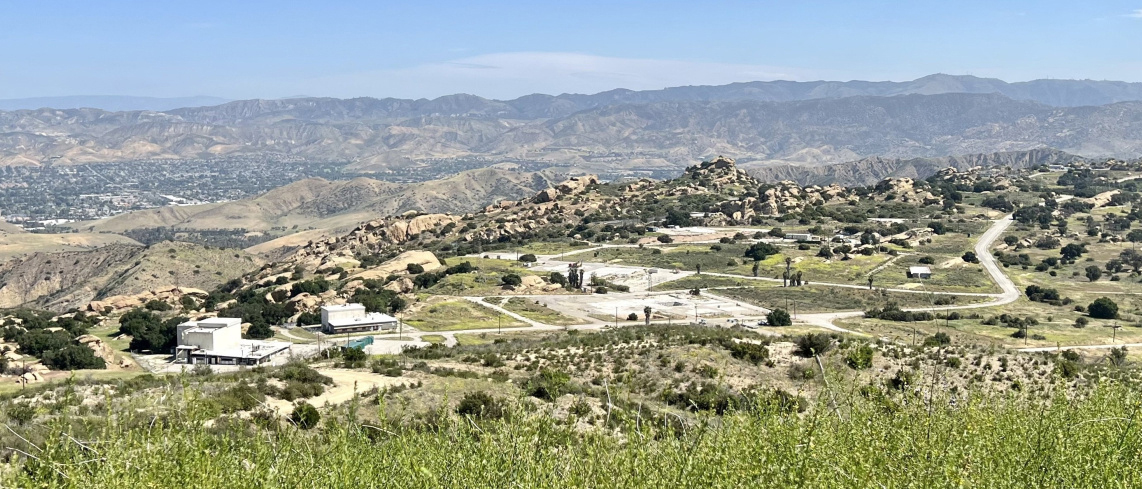
Today, the Santa Susana Field Laboratory is an unassuming expanse of land in the Simi Hills that’s largely blocked off by fencing.
But its history is long and the place was once bustling, acting for decades as a proving ground for rocket scientists and experimental physicists.
Nuclear research ended at SSFL in 1988 and rocket testing stopped in 2006.
The now-defunct, 2,800-acre federal research complex—once jointly occupied by NASA, the Department of Energy (DOE) and Boeing—has been owned by Boeing since 1996.
At the time of the recent wildfire in May, the aerospace corporation evacuated all personnel who were not involved with fire control.
A somewhat chaotic exchange between agency officials ensued as the Sandy Fire grew larger and got closer to SSFL, according to a review of over 100 pages of emails between the DTSC, the EPA, the DOE, the California Environmental Protection Agency (CalEPA), officials with Los Angeles County, NASA, and Boeing.
“The Sandy Fire is close to the Santa Suzanna [sic] Field Lab Site and the State Department of Toxic Substances Control is concerned about contamination leaving the site and threatening local communities. We need air monitoring in select locations to establish that the site contamination has not (or has) left the site and reached local communities,” Thanne Berg, the deputy director of the DTSC’s site mitigation and restoration program, wrote in a May 19 email, the day after the fire began, to the EPA’s Emergency Response Technical Group and other agency officials.
The Sandy Fire may have started when someone driving a tractor on their property struck a rock and ignited a spark, as was reported this past spring. The fire’s official cause remains under investigation.
Janet Sudnik, a NASA spokesperson said the agency, which oversees less than one sixth of the SSFL land, detected no radiological contamination in the areas it oversees.
The DOE, which did not specify when radiation testing began nor address any delays in starting the testing, said “there was no radiological danger to the public” amid the Sandy Fire.
Local and state officials were firm at the time that air monitors detected no SSFL-specific chemical or radiation signatures as the Sandy Fire neared the site.
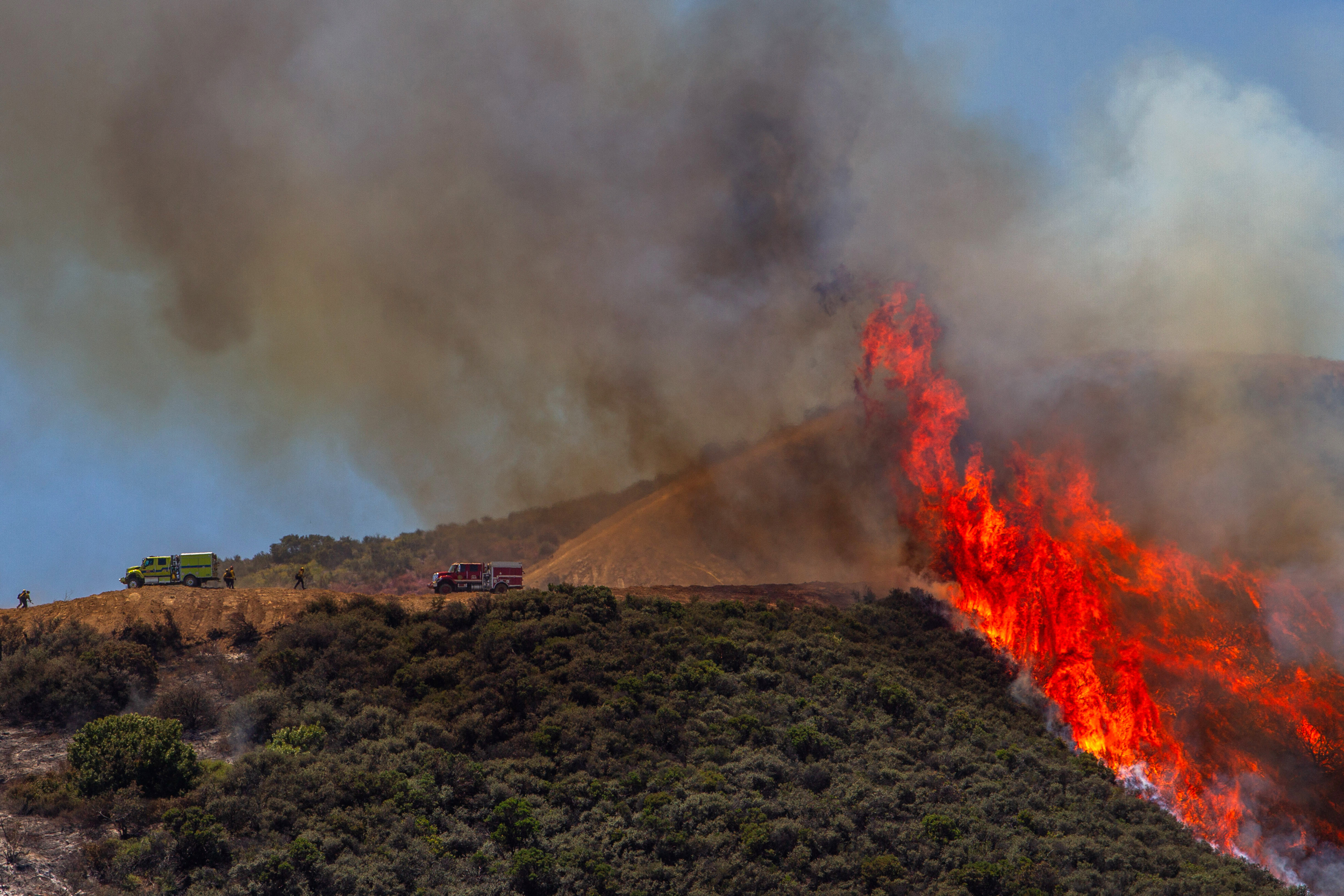
But internally, state regulators were not shy about the need to get a handle on the Sandy Fire and expressed worries about the threat it posed.
According to the correspondence, it took time to bolster air monitoring around the site and to get radiation measurement capabilities in place and operational.
Three months after the fire, families still have questions.
An Urgent Call for Air Monitoring
A flurry of emails went back and forth between state and federal officials as the Sandy Fire erupted and inched closer to the Santa Susana Field Laboratory.
In the emails, state officials make increasingly urgent calls to implement emergency air monitoring and enact emergency protocols, given years of controversy and activism by nearby residents over the health implications of the toxic site.
Contamination at the site, formerly known as Rocketdyne, has historically been treated as an urban legend by everyone but locals. It was that way for decades.
In the 1950s and 1960s, crews at SSFL routinely burned toxic waste, including radioactive materials, in open pits as part of regular operations. Engines and launch pads were also regularly cleaned on-site with solvents, such as TCE, a known carcinogen, later found to have contaminated groundwater. In 1959, a partial meltdown of one of the ten unshielded experimental nuclear reactors that dot the site released radioactive sodium isotopes and possibly cesium and iodine in “appreciable amounts” that may have surpassed the amount of radiation that escaped containment during the 1979 Three Mile Island accident, according to an advisory panel funded by the California State Legislature and commissioned for independent analysis of potential offsite impacts from SSFL.
Boeing in 2005 agreed to pay $30 million as part of a legal settlement that alleged pollutants from the lab were linked to various cancers and autoimmune disorders diagnosed in nearby residents.
A 2007 study, led by Hal Morgenstern for the Agency for Toxic Substances and Disease Registry and the Centers for Disease Control and Prevention, found California residents within two miles of SSFL face a 60 percent higher rate of certain cancer diagnoses than those living five miles away. Morgenstern, an epidemiologist at the University of Michigan, previously noted in his analysis that—although not enough to label SSFL as the cause of the higher cancer rate—there was a strong correlation between proximity to the site and cancers triggered by radiation exposure.
The Director of Radiation Management at the Los Angeles County Department of Public Health wrote to the DTSC on May 19 amid the wildfire that the agency wanted to ensure with air monitoring “that no radioactive contaminates become air born [sic] from the Sandy Fire.”
On the morning of May 19, Valerie Mitchell Hanley, a senior toxicologist for the state’s Department of Toxic Substances Control, said she was informed by NASA and DOE officials “that no one from either [responsible party] is onsite and they don’t have any specific emergency procedures other than following evac orders. There are some air monitoring stations that are up and running but they don’t have remote access to the data so they can’t look at it.”
This story is funded by readers like you.
Our nonprofit newsroom provides award-winning climate coverage free of charge and advertising. We rely on donations from readers like you to keep going. Please donate now to support our work.
In an email on the night of May 19, a DTSC official wrote to others working on the response that she entrusted “that your organizations are taking this seriously and understand the ramifications.”
“Fire officials stated in their nightly operational briefing on 5/19 that they are aiming to ‘keep the fire out of Rocketdyne,’” a NASA official wrote to the state’s Department of Toxic Substances Control in an email update, using the former name of SSFL.
May 19 was the first day records show DTSC officials reaching out to the DOE Radiological Assistance Program for deploying radiation air monitoring.
At the end of the day, Berg, the deputy director of the DTSC’s site mitigation and restoration program, wrote to several officials at Boeing, DOE and NASA. She said officials in her agency had “scrambled” to find a way to deliver off-site sampling to confirm contamination was not leaving the site because of the fire.
Berg noted late the night of May 19 that she was told by a Boeing official at that point that it was the company’s position that “it was unnecessary” and put its staff “at risk.”
“We all hope that contamination does not migrate off-site and threaten communities. Without monitoring, that is impossible to confirm with complete certainty,” Berg wrote.
Then Berg implored, “if DOE has the capability for rad air monitoring, we require it ASAP. If NASA or Boeing have the ability to expedite the need in real time, we require it.”
Real-time samples, Berg wrote, were crucial to determine whether the fire caused SSFL contaminants to be released.
When Did Radiation Monitoring Begin?
The California DTSC appeared initially to run into delays procuring help from partner agencies conducting radiation surveillance.
By late afternoon on May 20, two days into the fire, DTSC had secured the help of the DOE Radiological Assistance Program, and teams from both Las Vegas and the Lawrence Livermore National Laboratory were en-route to handle radiation monitoring.
Emails do not clarify if radiation monitors were live by May 20 or May 21.
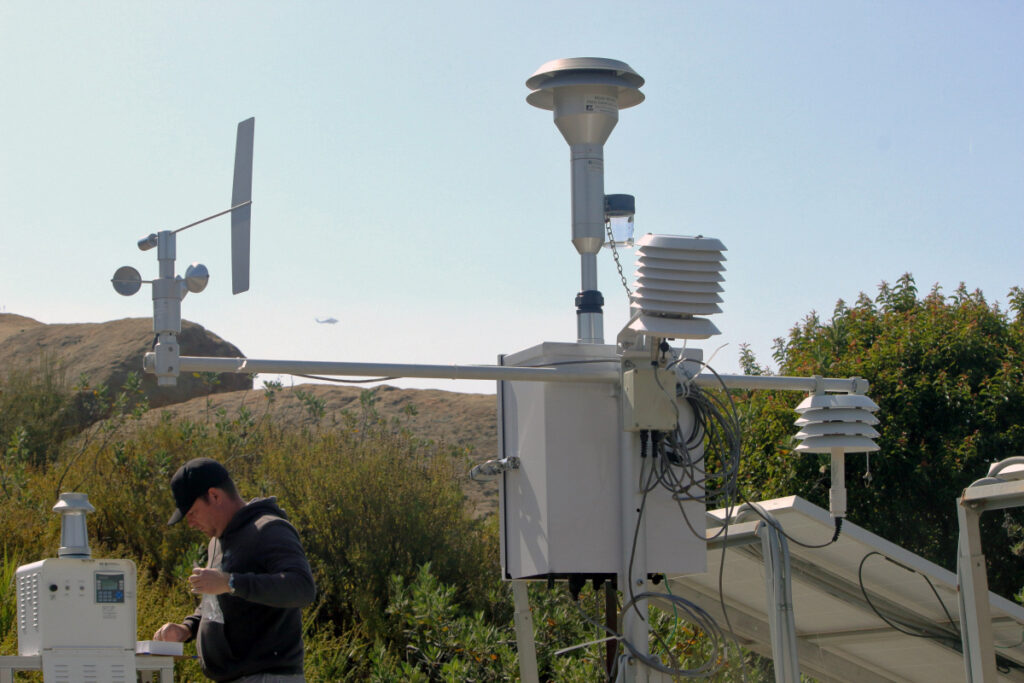
Nicholas Spada, who specializes in nuclear analysis of air samples at University of California, Davis, said he was pleased by the monitoring that was eventually put in place, “since fires can both transport existing toxics from the soil as well as create toxics from otherwise benign materials. I look forward to seeing the results of their monitoring.”
In 2018, the Woolsey Fire burned through 80 percent of SSFL. Initially, the DTSC assured the community that there was no risk of radioactive contamination, an assertion that the agency seemingly confirmed in a 2020 report on the wildfire.
But an independent study looking at 360 samples from the area surrounding the burn zone found that 3 percent contained radioactive particles that could be traced to SSFL. The report, conducted by a doctoral student at Worcester Polytechnic Institute and the co-founders of nuclear watchdog group Fairewinds Energy Education, analyzed more than ten times the samples taken by the state for monitoring.
When the study was first released in 2021, Boeing had no immediate comment. Later the same year, Boeing issued a statement to NBC4 in Los Angeles that said: “Cleanup at Santa Susana will continue to follow California law … The transformation of Boeing’s land at Santa Susana from a field laboratory to open space is well underway.”
Two years later, Risk Assessment Corporation (RAC) released the results of a study funded by Boeing.
“Based on the soil sampling, we found no evidence of SSFL impact in off-site soils as a result of the Woolsey fire,” that study said. “Moreover, we found no radionuclide impact on the off-site soils we sampled from past operations of SSFL.”
Nearby residents in Simi Valley and some experts have been dubious that toxins have not already been pushed out and point to both the Woolsey and Sandy Fires as worrisome litmus tests for the regulators in charge of the site. Concerns remain over how haphazard the response has been. Many highlight the specific testing and monitoring needs to ensure families are not at risk.
Regardless, Melissa Bumstead, founder and co-director of Parents Against Santa Susana Field Lab, said she was somewhat relieved that the DTSC took the measures it did to test the air amid the Sandy Fire, in light of contamination and radiation concerns.
“Even if it wasn’t done the way that I would have done it myself,” said Bumstead. “I still want to say that we’re grateful. We’re glad and we want to see more responsive measures.”
California regulators and managers were clearly mindful of the controversy after the Woolsey fire as they urgently requested air monitoring during the Sandy Fire.
“As a reminder after the Woolsey Fire DTSC was publicly criticized by not proactively monitoring for off-site migration of radiological substances,” Berg wrote to other state officials handling the May response.
State regulators also acknowledged in emails using the Woolsey Fire as a baseline for what to test for.
In response to questions about their emergency protocols and air and radiation monitoring procedures for the site, Albert Lundeen, a spokesperson for DTSC, said the agency understands “the fear and uncertainty that nearby residents and businesses feel when wildfires approach SSFL,” reiterating that the fire was stopped a quarter mile from the western boundary of the site.
California officials did not immediately clarify what day radiation monitoring began and if real-time air data was remotely accessible from the day the fire first began.
“During the event, DTSC worked closely with local partners and federal radiological experts to prepare for and respond to any impacts if the fire reached the site,” Lundeen said. “The DOE’s Nuclear Emergency Support Team (NEST) and its Radiological Assistance Program deployed to the incident command post and conducted a mobile radiation survey across accessible SSFL roads to document background radiation conditions.”
The results of those tests have yet to be released.
The Department of Energy announced that they will be addressing their role in the May wildfire response at SSFL at the next CONNECT Series Community Update Meeting on Aug. 12.
There, Bumstead, founder and co-director of Parents Against Santa Susana Field Lab, expects the DOE may release the air and radiation monitoring results from the Sandy Fire, although she said she doubts federal officials will release raw data.
“There’s no magic keeping the contamination on one side of the fence,” said Bumstead. “So it’s entirely possible that they may have detected some radiation.”
She hopes the DOE will be transparent and release more than just their own analysis of the samples.
Is she concerned radiation may have been detected despite the Sandy Fire not reaching the site in May?
“We really don’t know. We hope not,” Bumstead said, “but if it did, we want to know … But I am not anticipating a full disclosure.”
About This Story
Perhaps you noticed: This story, like all the news we publish, is free to read. That’s because Inside Climate News is a 501c3 nonprofit organization. We do not charge a subscription fee, lock our news behind a paywall, or clutter our website with ads. We make our news on climate and the environment freely available to you and anyone who wants it.
That’s not all. We also share our news for free with scores of other media organizations around the country. Many of them can’t afford to do environmental journalism of their own. We’ve built bureaus from coast to coast to report local stories, collaborate with local newsrooms and co-publish articles so that this vital work is shared as widely as possible.
Two of us launched ICN in 2007. Six years later we earned a Pulitzer Prize for National Reporting, and now we run the oldest and largest dedicated climate newsroom in the nation. We tell the story in all its complexity. We hold polluters accountable. We expose environmental injustice. We debunk misinformation. We scrutinize solutions and inspire action.
Donations from readers like you fund every aspect of what we do. If you don’t already, will you support our ongoing work, our reporting on the biggest crisis facing our planet, and help us reach even more readers in more places?
Please take a moment to make a tax-deductible donation. Every one of them makes a difference.
Thank you,

Reporter, California
Steven Rodas covers water, wildfires and agriculture throughout California for Inside Climate News. Based in Los Angeles, he previously reported on the environment in New Jersey, covering energy, pollution, wildlife and development. Steven’s work has appeared in the San Francisco Chronicle, NJ.com/The Star Ledger and Grist. He worked as a copywriter at Google. Steven has a master’s degree from Syracuse University’s S.I. Newhouse School Of Public Communications. He is fluent in English and Spanish (and welcomes your tips).

Contributor
Nina Dietz is a freelance journalist covering climate change, the environment, and both human and planetary health. Her work has appeared in New Lines Magazine, City Limits, and Science Friday among others.
