


- The bird flu outbreak at Nepal’s only zoo killed or led to the culling of at least 63 animals, including birds, wild cats, civets, two leopards, a jackal and a bear, an inquiry has found.
- The inquiry’s report says contaminated feed and water in open bird enclosures, along with failures in animal-food handling, likely helped the virus spread.
- The zoo remained open for five days after a rapid test indicated bird flu, despite receiving an earlier warning about infections among crows in Kathmandu.
- Less than two weeks after reopening following the bird flu outbreak, the zoo recorded another disease outbreak that killed three wild boars from African swine fever.
KATHMANDU — Delayed reporting, poor communication and weak biosecurity allowed bird flu to spread through Nepal’s Central Zoo in June and July killing or prompting the culling of at least 65 birds and animals, according to an internal inquiry report obtained by Mongabay.
The investigation by the nonprofit National Trust for Nature Conservation (NTNC), the autonomous body that manages the zoo and frequently partners with the government, found that officials failed to act adequately on a warning about avian influenza among crows (Corvus splendens) in Kathmandu. The facility also remained open for five days after a rapid test indicated the virus was present.
“The investigation found serious negligence and weaknesses at the management level,” according to the report, a copy of which was provided to Mongabay following a right to information application.
The inquiry was led by Rachana Shah, the NTNC’s spokesperson and programs manager, raising questions about a conflict of interest. Shah rejected concerns about a potential conflict of interest, saying the goal was to identify institutional failures and draw lessons from the outbreak.
“We treated it as an opportunity to draw lessons from the incident, rather than as a formal investigation into the bird flu outbreak at the zoo,” she told Mongabay. “If a similar incident occurs in the future, we will bring in an external expert.”
According to the report, bird flu killed 27 birds and 14 mammals between June 12 and July 2, 2026. Authorities also culled 21 birds on suspicion of bird flu to contain the outbreak. Three additional animals (a barn owl, a golden jackal and an Asiatic black bear) died during the same period, bringing the total recorded deaths to 65.
The mammals included common leopards (Panthera pardus), jungle cats (Felis chaus), leopard cats (Prionailurus bengalensis), civets, a golden jackal (Canis aureus) and an Asiatic black bear (Ursus thibetanus). The birds included barn owls (Tyto alba), Indian pond herons (Ardeola grayii), Himalayan griffons (Gyps himalayensis), kalij pheasants (Lophura leucomelanos), black-headed ibises (Threskiornis melanocephalus), a sarus crane (Antigone antigone), greylag geese (Anser anser), a spotted owlet (Athene brama) and a Eurasian eagle owl (Bubo bubo).
The confirmed toll is higher than previously known. In a June 25 report on the zoo’s delayed closure and conflicting official accounts, two zoo sources told Mongabay at least 40 animals had died. Zoo officials declined at the time to publicly confirm the number.
The outbreak timeline
The inquiry report dates the outbreak to June 12, when a barn owl died under unusual circumstances. Two more barn owls died the following day. On June 14, another five birds died, including four Indian pond herons and a Himalayan griffon.
A rapid test conducted that day indicated bird flu, according to the report. Samples were sent to the Central Veterinary Laboratory to confirm the bird flu. The zoo remained open until June 19.
“Most seriously, even after bird flu had been confirmed by a rapid test on June 14, the zoo administration concealed the information for five days, kept the zoo open and formally informed the NTNC central office only on June 19,” the report says.
Senior employees had already discussed the outbreak and possible biosecurity measures before the closure, the report says, but the response was fragmented, and information did not move effectively through the zoo’s chain of command.
Satya Narayan Shah, the zoo chief at the time, was transferred to NTNC’s central office after news reports raised questions about the response to the outbreak. Shah disputed the suggestion that the zoo could have closed immediately after the rapid test, saying it required official laboratory confirmation.
“We cannot shut down the zoo without official confirmation of the virus,” Shah told Mongabay. “So, we waited for confirmation from the Central Veterinary Laboratory.”
Shah told Mongabay that he learned of the bird deaths on June 15 and informed NTNC’s secretary-general by phone the same day. The report, however, states that the secretary-general first learned of the deaths during an informal visit to the zoo on June 17.
Spokesperson Rachana Shah disputes the former zoo chief’s account. “We have no record of receiving such a call,” she told Mongabay. “We also asked our staff about the call, but none of them reported receiving it.”
“On June 18, a team from the Department of Livestock Services presented the laboratory report at a meeting,” Satya Narayan Shah told Mongabay. “We decided to shut the zoo the next day.”
That account differs from the written statement attributed to Shah in the report, which says he claimed to have known nothing about the outbreak before the laboratory report arrived on June 18.
The report, however, finds that the zoo had received an explicit warning nearly three months before the first animal deaths. NTNC’s central office emailed Shah on March 24 — after bird flu was detected among crows in the Kathmandu Valley — and instructed the zoo to remain alert.
“Although the NTNC’s central office had instructed the zoo chief by email on March 24 to remain alert because bird flu had been detected among crows in the Kathmandu Valley, no precautionary measures were found to have been taken,” the report says.

What fueled the spread?
Investigators identified two factors that likely contributed to the spread.
Firstly, some bird enclosures were located beneath tall trees and covered only with open netting. Infected crows could perch above them, allowing droppings to contaminate feed and water inside.
“The bird enclosures were located beneath trees and consisted of open wire mesh without roofs,” the report says. “Zoo staff said droppings from crows resting in the trees could have fallen into the feed and water inside the enclosures, allowing the virus to infect the birds when they consumed them.”
Secondly, laboratory evidence pointed to serious weaknesses in animal-food preparation and handling.
Environmental samples from the food-preparation area detected avian influenza material on a chopping log or implement used to cut meat. Samples of buffalo meat tested negative.
Investigators concluded that contaminated food-handling equipment, rather than the buffalo meat itself, may have helped transmit the virus among carnivores. The report also raises concerns about the continued use of chicken as feed after bird flu was suspected.
Although an internal meeting on June 14 reportedly decided to strengthen biosecurity and review animal diets, chicken appears to have been removed from the animals’ feed only on June 16, according to the report.
Former zoo chief Shah said responsibility for daily food procurement and preparation rested with a five-member team. He said he did not know who supplied the chicken fed to the animals.
“We cannot test every batch of chicken or meat because we need to feed the animals every day,” Shah said. “The chief oversees 75 employees and cannot keep track of every department within the zoo.” NTNC’s Rachana Shah said the zoo began serving boiled meat as a precaution against infection, adding that captive animals could adapt to such dietary changes.
The inquiry concluded that crows and contaminated food-handling practices contributed to the spread. Laboratory results showed different influenza subtypes among birds and mammals. Birds tested positive for H5, while samples from jungle cats, leopard cats and a common palm civet (Paradoxurus hermaphroditus) tested positive for H9.
The Central Zoo reopened to the public on July 17.
Less than two weeks after the Central Zoo reopened following the bird flu outbreak, three wild boars (Sus scrofa) died of African swine fever in a separate disease outbreak. Laboratory tests confirmed the infection, while zoo officials said the animals may have contracted the virus after crows dropped contaminated meat or bones into their open enclosure, raising further questions about biosecurity at the facility.

Report outlines institutional failures
The report also identifies wider institutional failures. The zoo lacked approved biosecurity guidelines, an emergency reporting system and a contingency plan defining who could close the facility, restrict visitors, isolate animals or notify veterinary and public-health authorities.
It also finds insufficient technical expertise among senior managers responsible for animal health, wildlife husbandry, nutrition and emergency response. Zoo keepers and other workers lacked adequate training, protective equipment and clear instructions for dealing with an infectious disease outbreak.
Criticism was also directed at the Zoo chief’s qualifications. While Shah, an engineer, has a master’s degree in natural resource management, his immediate successor Babu Lal Tiruwa is a botanist. Rachana Shah said the chief position is primarily managerial and administrative and does not formally require zoological training. She acknowledged, however, that such expertise would help in running the institution. The NTNC recently appointed Ambika Khatiwada, a zoologist, to replace Tiruwa as the new zoo chief.
The inquiry linked the recent crisis to the failure to implement reforms recommended after an investigation into the theft attempt of a red panda (Ailurus fulgens) from the zoo in May 2025.
“The communication breakdown and loss might not have occurred if the zoo had implemented the recommendations of the inquiry after the earlier theft of a red panda,” the report says.
The report recommends mandatory reporting of unexplained animal illness or deaths within 24 hours and immediate precautions after a positive rapid test, rather than waiting for final laboratory confirmation.
It also calls for formal biosecurity guidelines and an emergency plan, secure roofs over open bird enclosures, stronger controls against crows and rodents, safer food storage and preparation, regular environmental testing, staff training and adequate protective equipment.
“Because no official documents on epidemic control currently exist, such documents and guidelines should be prepared,” it says.
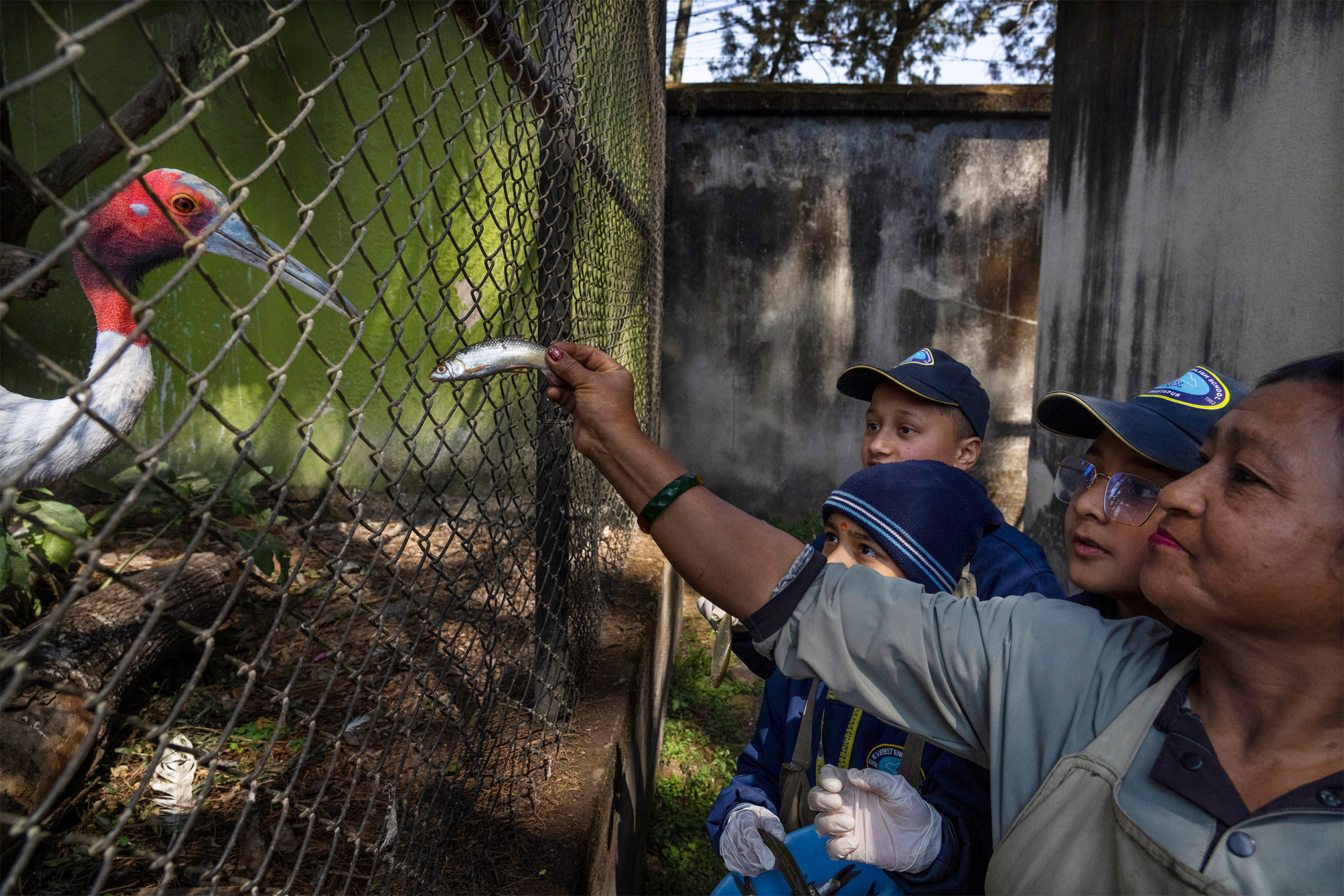
Banner image: A zookeeper feeds a sarus crane at the Central Zoo in Lalitpur, Nepal, 2024. Image by AP Photos/Niranjan Shrestha.
Nepal’s Central Zoo faces questions over its bird flu response
Cite this article
Deepak Adhikari (2026). Delays, biosecurity failures worsened flu outbreak at Nepal zoo, probe finds. Mongabay Conservation news. DOI: https://doi.org/10.66709/news-325997

