


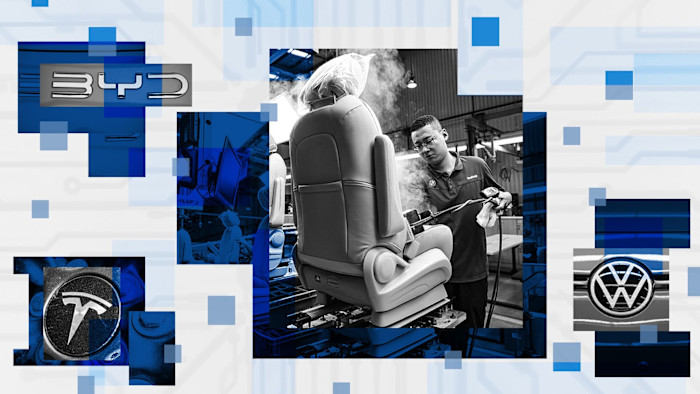
China’s car parts makers have quietly amassed greater control of Europe’s automotive supply chains, snapping up local suppliers as Beijing seeks to expand its footprint on the continent amid growing resistance to its exports.
Since the mid-2000s, Chinese companies have invested in more than 130 European automotive parts makers, mainly in key car manufacturing hubs in Germany and France, according to consultancy Rhodium.
The acquisitions of European parts suppliers have alarmed EU policymakers and auto executives. Both parties fear that China could soon redraw the industry map for car components on the back of explosive growth in vehicle exports.
“It will not be surprising if in the near future, two or three of the top 10 suppliers are Chinese, which is not the case yet,” said Sébastien Frendo, chief executive of Paris-based consultancy Do Well Do Good.
The early acquisitions were backed by Beijing’s “go global” strategy, which encouraged Chinese companies to globalise their operations and acquire foreign technology through investments — increasingly in European manufacturers.
Rhodium’s data shows the volume of those Chinese automotive deals in Europe peaked in the mid-2010s with Geely’s $1.8bn acquisition of Swedish carmaker Volvo Cars.
But Beijing’s outbound investment restrictions and rise in trade barriers meant many of the deals over the past decade have been below €100mn — too small to trigger intervention from Europe’s regulators.
In 2024, the EU imposed additional duties on Chinese EV manufacturers including BYD on top of its existing 10 per cent tariff on car imports after probing the impact of state subsidies on the companies.
Farley Mesko, chief executive of corporate intelligence firm Sayari, told the FT that the true scale of Chinese ownership may go further than has been recognised.
Of the Chinese-controlled automotive assets the firm has mapped across Germany to date, “roughly four in five are held through at least one offshore intermediary or involve a German-registered holding company carrying a local name”, he said.
Policymakers have been concerned about ongoing Chinese investments in the continent’s automotive supply chain, with one EU official describing the China threat to the region’s car sector as “the challenge of the decade for Europe”.

Chinese companies had taken a four-pronged approach to expanding in Europe, the official noted. They boosted exports, took stakes in local companies, entered joint ventures and built factories themselves — both in the EU and nearby countries such as Serbia, Turkey and Morocco.
The Chinese deals may have largely been below the radar, but “we will still see a continuity of small-value acquisitions — and that worries a lot of [European] policymakers”, said Armand Meyer, senior research analyst at Rhodium.
The latest plans by Brussels to impose stringent local-content rules that require the use of Europe-made car parts and labour have also given the Chinese an added impetus for investing in the bloc.
“For Chinese suppliers, acquiring [European] companies is a highly effective way to rapidly obtain production bases” and gain “made in EU” status without building it all from scratch, said a senior executive at a leading Japanese car parts supplier.
There are only a few Chinese car parts suppliers big enough to compete on the global stage, such as battery maker CATL and Yanfeng, part of MG owner SAIC. However, the ongoing financial struggles of European parts makers have made them attractive targets for other Chinese players.
Analysis by Sayari of a sample of 62 Chinese-owned entities in the German supply chain showed how they had built up clusters in the country’s key carmaking hubs.

European parts makers were not household names, but “provide a lot of jobs at the local level”, the EU official said, adding that measures restricting Chinese companies’ market access and controls on strategic investments were needed to complement tighter local-content rules.
The sector directly employs about 1.7mn people in Europe, and parts makers including Bosch, Valeo and Forvia have already shed more than 100,000 jobs in the past two years, according to European trade body Clepa.
The region’s carmakers, meanwhile, were scrutinising the Chinese acquisitions closely since the change in ownership could pose supply-chain risks if the purchased manufacturer was a single supplier for important parts, said Benjamin Bulander, partner at Porsche Consulting.
Sayari identified acquisitions by 23 Chinese groups inside Germany, which have bought up high-tech parts makers in the supply chain. These include manufacturers of gaskets for high-end car engines, self-driving systems and antennas for wireless connectivity.
Each car company now had a list of Chinese-owned parts makers in Europe to ensure they had alternative suppliers, said a European industry executive.
US restrictions on Chinese-backed hardware and software used in cars further complicate supplier ownership issues.
Pirelli is a case in point, with the Italian government, along with the tyremaker’s shareholders, looking for ways to end Sinochem’s involvement. It could also be banned from the US due to the Chinese chemical group’s stake.
Even as concerns over the presence of Chinese suppliers in Europe mount, some analysts see their success rate as mixed. Many operate on thin margins, while exporting local engineering talent and service capabilities has been a struggle.
“We do see some suppliers expanding overseas, but genuinely successful cases are still very rare,” said Chris Liu, a Shanghai-based EV analyst with Omdia.
Among the country’s prominent parts makers, some first expanded overseas at the urging of western carmakers, a trend that has accelerated as more manufacturers look to cut costs by buying from cheaper Chinese suppliers.
Among them, Yanfeng, which originally formed a joint venture in China with Ford in 1994, learnt the ropes from its key client Volkswagen. Its business ties with GM in China then paved the way for production in the US, where it also supplied Tesla.

“All the major global companies including Mercedes-Benz and BMW were encouraging Yanfeng to expand overseas,” said a former Yanfeng executive.
The Shanghai-based group became embedded in European supply chains for everything from seats to steering wheels after forming a $7.5bn auto interiors joint venture with US group Johnson Controls, which Yanfeng now owns.
As western car brands’ sales in China waned, it won orders from BYD and emerging local players. Yanfeng was in “the best position of any supplier to support Chinese carmakers in Europe”, the former executive said.
While some Chinese suppliers have spent decades building their way into global supply chains, others have more recently found ready backing from European carmakers eager for the latest Chinese technological expertise, casting aside takeover-risk concerns.
When Chinese electronics group Luxshare last year agreed to buy Germany’s Leoni for €525mn, the deal received “active support” from the struggling German car cable group’s European clients before the transaction closed.
Far from opposing the acquisition of the supplier undergoing heavy restructuring, car executives were keen to learn from China’s development cycle, Leoni chief executive Klaus Rinnerberger told the FT.

For the Chinese, Leoni offered the opportunity “to establish a foothold with European original equipment manufacturers” through its relationships and product portfolio, he said.
Meanwhile, other western groups are hopeful that, rather than an acquisition, collaboration with established European partners will offer a path for Chinese suppliers as they venture overseas.
“I would say we are half a Chinese company really integrated into the [Chinese] ecosystem for a very long time,” said Christoph Hartung, a board member at Bosch Mobility. “We are now discussing with all our partners here on how to help them grow and go global.”
Ultimately, European parts makers that fail to adapt to the speed required by the likes of BYD and Geely will be overtaken by Chinese rivals in competitiveness, Rinnerberger warned.
“What I firmly believe is that many [European] suppliers will increasingly run into difficulties, because if you are not willing to work with the Chinese instead of against them, you will not be able to keep up with the pace of change that is coming,” he said.
Additional reporting by Edward White in Shanghai, Sarah White in Paris and Chris Cook in London. Data visualisation by Clara Murray in London
