


When we spoke in April with a woman who had survived a Rapid Support Forces (RSF) massacre on the border of Sudan, she did not ask for revenge. For more than two years, the RSF has carried out attacks in the country that amount to crimes against humanity. But instead, the woman asked whether anyone would write down what had happened to her—whether it would be believed, and whether it would matter.
That question, repeated to both of us for decades across war zones, is the reason for the International Criminal Court (ICC), established by the Rome Statute in 2002. It is also the reason that our organization, the Reckoning Project, trains citizens to turn what they have survived into evidence that a court can use. And it is precisely the thing that the United States under President Donald Trump has set out to dismantle.
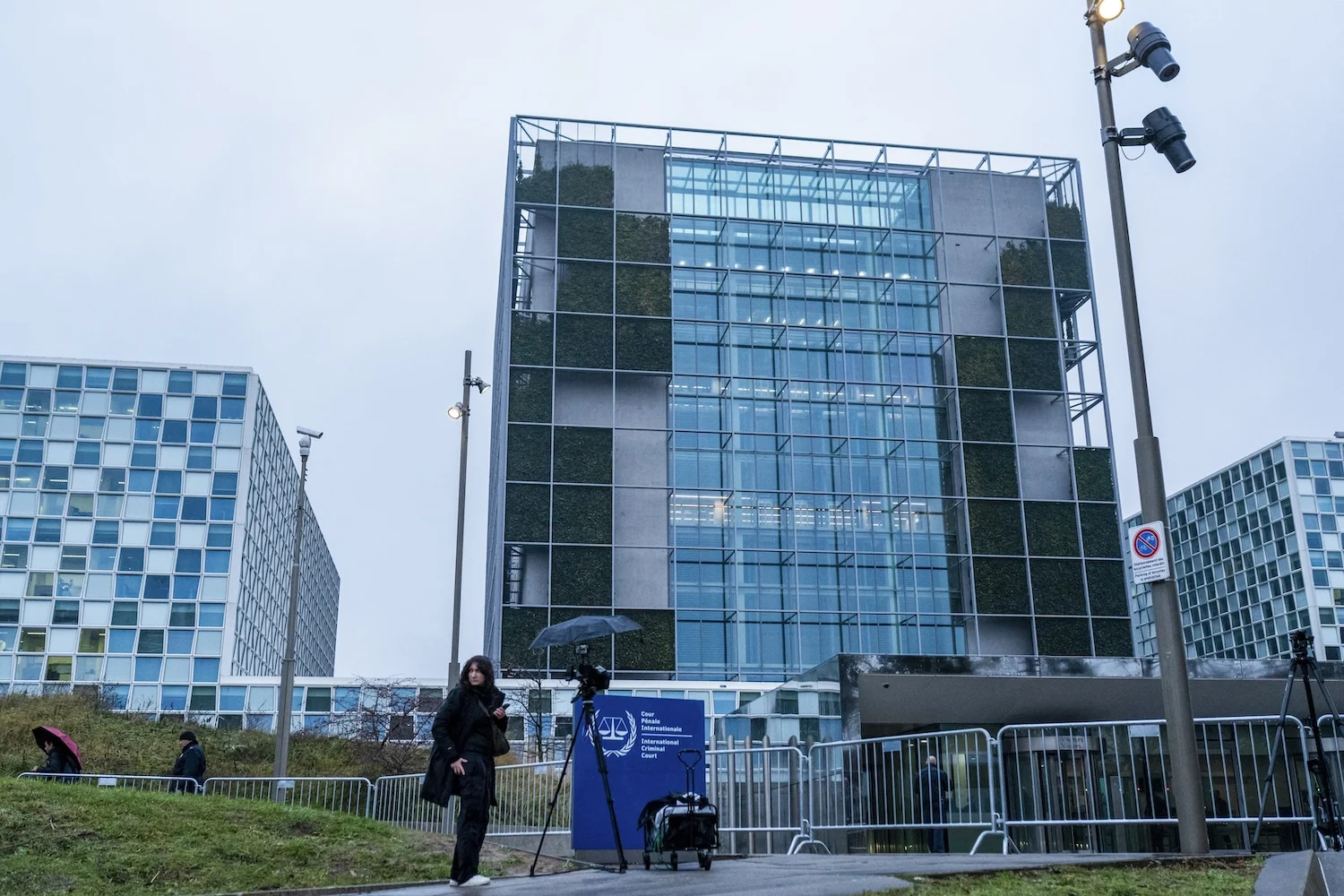
A few days before International Criminal Justice Day on July 17, U.S. Secretary of State Marco Rubio announced a campaign to “systematically disable” the ICC. In Rubio’s words, this is the Trump administration’s attempt to demolish the court “brick by brick,” supposedly seeking to stop the court from “threatening U.S. sovereignty or targeting Americans.”
The Trump administration’s plan promises expanded sanctions against the ICC and any organization or people affiliated with it; visa revocations and travel bans on court staff, which could extend to perceived supporters; and a diplomatic push to pressure other countries to stop cooperating with the court. What is new about this campaign is its stated ambition. The White House’s goal is no longer to shield particular defendants—it is to end the institution unless it cows to U.S. demands.
This is not a first strike but an escalation: Last year, after the ICC issued arrest warrants for Israeli Prime Minister Benjamin Netanyahu and his former defense minister, the Trump administration sanctioned ICC judges and prosecutors outright. The United States also sanctioned the United Nations special rapporteur on the occupied Palestinian territories, Francesca Albanese, for expressing her opinion in support of the ICC’s work in Palestine.
During Trump’s first term, his administration also leveled sanctions against ICC personnel, most acutely the ICC prosecutor, Fatou Bensouda. (Bensouda sits on the board of the Reckoning Project.)
The latest campaign arrives at a genuinely difficult moment for the ICC. On July 24, Chief Prosecutor Karim Khan was ousted after an overwhelming majority of the Assembly of States Parties (ASP)—the body of 125 member states that oversees the court—voted to remove him after a two-year investigation into allegations of sexual misconduct. (He had been formally suspended in June by an ASP executive committee.)
However, the Rome Statute system is larger than its prosecutor; it is underpinned by 125 states and a quarter-century of hard-won jurisprudence. That distinction matters, because Washington is deliberately blurring it—seizing on a moment of institutional strain to advance a project that has nothing to do with legitimate concerns or calls for reform. There should be no illusion about the fact that Israel is working with the United States on this campaign, using this unfortunate episode at the ICC to cast the institution as compromised.
Netanyahu’s government did not wait for the ASP session or the outcome of any investigation before declaring the court irredeemable, yet it’s clear that the leadership of a country facing an active ICC warrant is not a credible arbiter of the court’s legitimacy.
The Trump administration’s rhetoric about international justice depends on short memories. For most of human history, those who ordered mass killings faced political inconvenience at most. The architecture built after Nuremberg—the ad hoc tribunals for the former Yugoslavia and Rwanda, the hybrid courts in Sierra Leone and Cambodia, and the permanent ICC in The Hague—rests on one stubborn proposition: that some crimes are so grave that no border, uniform, or office should place their authors beyond the law’s reach.
In the middle of a conflict, the court’s work, and that of civil society organizations such as the Reckoning Project, is about the record—capturing evidence before it can be bombed, buried, or denied. This work signals to those in power and still making decisions that a file is being opened with their name on it. Accountability is one of the few forces that can alter the calculus of a perpetrator mid-atrocity.
After the guns fall silent, the function of international criminal law shifts. An authoritative judicial record allows a community to grieve, to establish who is owed what, and to deny the killers the victory of rewriting history. The record shows that accountability fosters more durable peace and engenders more stable, democratic societies that tend to protect fundamental human rights. Germany and Japan are the best illustrations of such societies, along with Rwanda, Sierra Leone, and to some extent, Bosnia and Croatia.
None of the above is delivered cleanly or quickly. Anyone who has practiced in this field intimately knows its limits. The ICC is wildly under-resourced, its processes can be manipulated by some people acting in bad faith, and critical parts of its function depend on states that too often do not cooperate fully. Even the court’s most vocal supporters admit that it can be its own worst enemy and more internal reforms are needed.
Yet the ICC is the only permanent body that the world has for the gravest crimes, and its existence has changed what tyrants can assume about their future. That reflects the slow accumulation of a principle that the United States once led the world in promoting.
The current campaign against the ICC is familiar. U.S. President George W. Bush ran a strikingly similar one during his first term. The Bush administration “unsigned” the Rome Statute in 2002; pushed through a law that authorized the president to use military force to free any U.S. or allied national held by the Court; and pressured around 100 countries into bilateral agreements to never surrender U.S. personnel to The Hague.
The stated rationale then was similar to Rubio’s now: the protection of U.S. sovereignty and U.S. troops.
The Bush-era campaign failed on its own terms. The ICC did not collapse, and its membership accelerated in the years that the United States was working hardest against it. More telling, the Bush administration reversed course. Faced with the slaughter in Darfur in 2005, the United States did not veto the U.N. Security Council’s referral of Sudan to the ICC—the first in history—but abstained and let the court do its work, even supporting it tacitly.
Ultimately, U.S. policymakers realized that its national interests in peace and stability in Sudan and the region were served by the ICC’s involvement. Observers and insiders mark that vote as the beginning of a pragmatic shift toward the ad hoc cooperation that continued through Bush’s second term, as the administration discovered that a world with the ICC served U.S. interests more often than it threatened them. The maximalist campaign was abandoned; U.S. Secretary of State Condoleezza Rice aptly described it as akin to “shooting ourselves in the foot.”
The problem with the claim that the ICC threatens U.S. sovereignty is that it does not survive contact with how the court functions. Under the principle of complementarity—written into the Rome Statute at the insistence of the United States—the ICC may act only where a state is demonstrably unwilling or unable to investigate credible allegations itself. It is a court of last resort; a nation that genuinely polices its own conduct renders its jurisdiction moot.
The sovereignty claim also falls flat when examining the ICC’s current docket. In one of Khan’s first moves as prosecutor in 2021, he announced that his office would no longer examine allegations against U.S. and allied personnel in Afghanistan, citing resource constraints and the lesser gravity of these allegations. This about-face drew immediate criticism from many observers, who concluded that Khan “failed an important test” after Bensouda withstood years of intense U.S. pressure.
A lawyer working on extrajudicial killing allegations in Afghanistan said in a written statement: “This was clearly a political decision … it gave the US, the UK and their allies a get out of jail free card.” As such, no Americans are currently part of any open ICC investigation or prosecution.
Following that logic, the framework underpinning the current U.S. campaign against the court comes into view. The single sovereign prerogative that a functioning ICC threatens is the freedom to commit atrocity crimes without consequence. So, when a government insists that it must dismantle the court to protect its personnel, the question is not whether those personnel are being persecuted. It is what those personnel have done and whether their government intends to look.
Here, the timing is difficult to ignore. For example, since last September, U.S. forces have carried out dozens of lethal strikes on small boats in the Caribbean and the eastern Pacific, killing more than 200 people who the Trump administration labeled “narco-terrorists”—typically without charge, trial, or, in many cases, any public evidence of who was aboard or what they carried.
A growing chorus of observers and legal experts, including Americans, have concluded that these are extrajudicial killings and that many of them may constitute war crimes or crimes against humanity.
More to the point, we do not have to deduce the motivation of this campaign because the Trump administration previously disclosed its primary concern with respect to the ICC. The U.S. demands for lifting sanctions reportedly included not only the dropping of cases against Israeli leaders but also explicit amendments to the Rome Statute that would immunize Trump administration personnel. The pretext of the campaign is manifest.
For 70 years, the United States has been the most significant champion of the idea that power must answer to law. That credibility is an asset. Calls from the United States for justice can be too selective, but when Washington speaks in the language of justice, the world believes it means something. The Trump administration’s campaign against the ICC jettisons that asset for nothing. By declaring that international justice binds U.S. adversaries but never the United States, it cements the idea that the Americans believe the rules only apply to other people.
The catastrophic impacts of dismantling the ICC are hard to overstate. Any realistic attempts at seeking proper accountability for the widespread massacres in Sudan; the targeting of journalists, hospitals, and children in Gaza; the deportation of thousands of Rohingya from Myanmar; and the torture and sexual violence inflicted on Ukrainians in Russian detention sites would be severely affected, if not foreclosed completely.
The survivor in Sudan asked us whether what was done to her would matter. The honest answer is that it matters only if the institutions built to record it and one day to judge it are held together and properly resourced so they can stand tall. The United States can still choose to be the country that helps them, but dismantling the ICC brick by brick is a choice to be something else.
