



Natural gas surged to the top in the first round of power projects accepted into PJM Interconnection’s reformed interconnection process, making up nearly half of the more than 200 gigawatts of capacity qualified for study. Battery storage and solar trail natural gas, according to the latest figures by the grid operator.
The picture stands in stark contrast to three years ago when PJM, the nation’s largest grid operator, stopped accepting new projects to clear its backlog. At that time, more than 90 percent of the projects waiting in the queue were solar, wind and battery storage. But most of those clean energy projects were never built, falling apart because they were stuck in the queue for so long and paving the way for gas to surge ahead a few years later.
The current 715 projects, totaling 201.5 gigawatts of power, are the first group of proposed generation projects to move through PJM’s new “first-ready, first-served” system, which now requires developers to put down money and prove that they control a construction site before a project can be studied.
The long-overdue makeover follows many years of efforts by the grid operator to clear its backlog of speculative proposals and quickly bring viable projects onto a grid that is already under pressure. Demand is expected to grow by as much as 70 gigawatts by 2038, driven largely by data centers, according to PJM.
But how much of that capacity will actually get built is anyone’s guess. PJM’s own figures show that, of more than 300 gigawatts of projects studied since 2020, just 51 gigawatts of generation hold interconnection agreements today, and there is no guarantee that all will be built.
And while generation projects stall or stay stuck for years, the surging electricity demand has complicated efforts to substitute polluting fossil fuel-based generation with clean, renewable sources.
As a result, gas has bounced back to meet the data center-led demand. But solar and storage, despite being outmatched in terms of megawatts, together account for far more individual projects than any other resource qualified for study, showing that clean energy is staying resilient despite federal headwinds.
By capacity, PJM figures put gas at 99.8 gigawatts across 147 projects. Battery storage follows at 60 gigawatts, then nuclear at 17.3 gigawatts, solar at 11.8 gigawatts, solar-storage hybrids at 7.5 gigawatts and wind at 3.9 gigawatts. A catch-all “other” category that includes biomass, coal, fuel cell, fusion and methane stood at just over a gigawatt, and hydro added another 0.07 gigawatts. A gigawatt is enough electricity to power about 750,000 to 1 million homes.
But the equation flips when viewed in terms of the number of projects. Storage leads with 314 proposals, well ahead of gas at 147, solar at 117, wind at 61, solar-storage hybrids at 37 and nuclear at 24. The remaining proposals include 10 projects in the “other” category and five hydro projects.
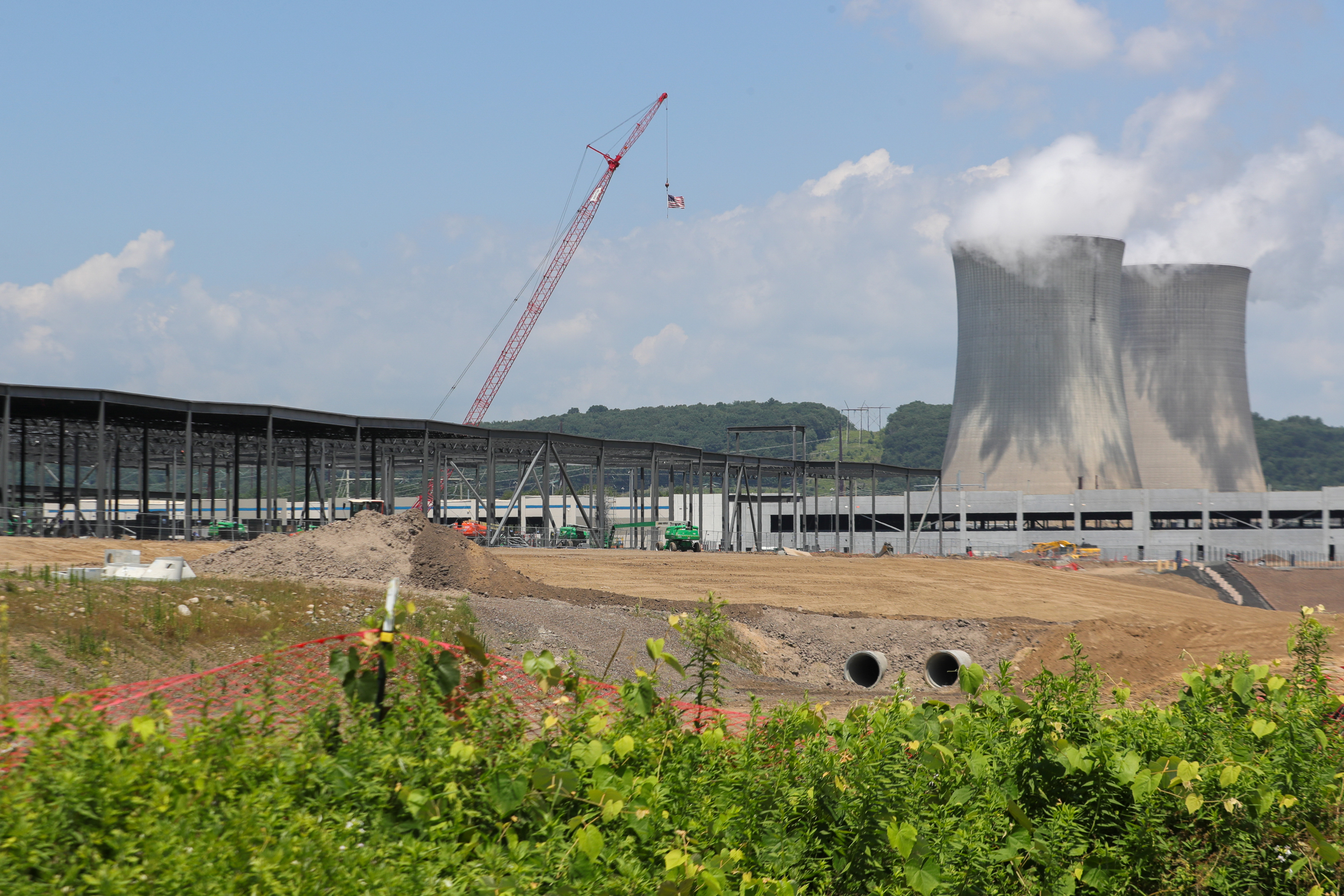
“Storage projects are not paired with any particular generation unless they are designated as part of a hybrid resource, which has its own category,” Jeffrey Shields, a PJM spokesman, said. “A battery draws electricity from the grid like any customer to charge and discharges to the grid like any generator.”
PJM’s release does not specify how much of the 3.9 gigawatts of the proposed wind capacity is offshore. But the resource remains critical for the clean energy plans of states like Maryland and has been the prime target of the Trump administration. Offshore wind projects both in and outside PJM’s territory nonetheless keep pushing forward despite repeated federal attempts to halt wind projects along the East Coast.
Under the new interconnection rules, developers must show a project is viable before it enters the study cycle, with up-front financial commitments and proof they control the site where they intend to build. Projects will be reviewed in what PJM describes as a one- to two-year process, depending on a given project’s impact on the grid.
“PJM is encouraged at the number and quality of applications” moving through the study process, said Jason Connell, the grid operator’s vice president of planning, adding that the reformed rules are “designed to encourage projects that will get built.” The diversity of the applications, Connell said, signals that developers remain eager to build across PJM’s territory as the operator works to meet the industry’s demand for faster connections.
PJM serves all or parts of Delaware, Illinois, Indiana, Kentucky, Maryland, Michigan, New Jersey, North Carolina, Ohio, Pennsylvania, Tennessee, Virginia and West Virginia, along with the District of Columbia.
This story is funded by readers like you.
Our nonprofit newsroom provides award-winning climate coverage free of charge and advertising. We rely on donations from readers like you to keep going. Please donate now to support our work.
Jon Gordon, a director at the industry group Advanced Energy United, said the new queue looks very different from the renewable-dominant queue of three years ago.
“They had 2,700 projects in queue … 255 gigawatts … and 95 percent of that was clean energy—solar, wind, and battery storage projects,” Gordon said.
A grid operator used to studying a few large plants a year couldn’t process thousands of small ones, Gordon said. Clearing them took four years and by that time most of the projects were dead. “The whole world had changed … COVID, supply chain disruptions, massive inflation, the Trump administration, you name it,” Gordon continued. Most withdrew and were never built, he said, calling it “the energy transition that never was.”
In his view, gas rushed in to fill that vacuum. Independent power producers “saw this huge opportunity … and they have risen to the occasion with all sorts of new natural gas projects … with lots of backing from the Trump administration and from local states.” But gas plants, Gordon added, have seen their price “doubled in the last two years and tripled in the last four years, all related to supply chain costs, tariff costs, just demand for materials and labor,” making them “very expensive plants to build compared to their clean energy alternatives.”
Abe Silverman, an assistant research scholar at Johns Hopkins University’s Ralph O’Connor Sustainable Energy Institute, said the gas-tilted PJM queue is indicative of “a gold rush on right now for new gas to serve the other gold rush, the data centers,” with commercial interest in gas plants surging regionwide to meet the data-center load. He said PJM itself is signaling it wants more gas-fired resources through its reliability backstop procurements and other channels, especially with offshore wind “slowed down by federal policy.”
Under its reliability backstop mechanism, PJM allows a small number of projects to skip the normal interconnection queue and connect faster to the grid in order to close the gap between surging demand and the supply actually coming online.
Silverman said he expects the new system to improve on the old one but cautioned that PJM has restructured its queue before “and it hasn’t always worked.” Whether the projects materialize depends on three things, he said: PJM completing its studies, developers obtaining the gas turbines needed to build the plants and state siting and permitting processes moving quickly enough.
“Just because we’re starting the queue process doesn’t mean that these projects are going to be on in the next couple of years,” he said. Unless something is also done about the pace of load growth, Silverman warned, PJM could face “a period of very high rates” and reliability problems until new generation begins arriving.
PJM defended the overhaul. “[T]he reformed process has stricter requirements, along with meaningful readiness deposits that are at risk as a project moves through the process,” PJM’s Shields said in an email.
The new rules will force developers to meet certain milestones or drop out, he said, which should “weed out speculative projects and result in projects with a higher likelihood of achieving commercial operation.” Studying projects together lets the cost of grid upgrades “be known sooner and shared,” Shields added, giving developers more certainty while moving faster “should both shave off months from when a project could start building” and strengthen a project’s viability.
PJM acknowledged that “state permitting, local opposition, supply chain backlogs and financing” are the factors most likely to derail a project and are outside its control. PJM continues to work with public and private stakeholders to reduce those barriers, Shields said.
About This Story
Perhaps you noticed: This story, like all the news we publish, is free to read. That’s because Inside Climate News is a 501c3 nonprofit organization. We do not charge a subscription fee, lock our news behind a paywall, or clutter our website with ads. We make our news on climate and the environment freely available to you and anyone who wants it.
That’s not all. We also share our news for free with scores of other media organizations around the country. Many of them can’t afford to do environmental journalism of their own. We’ve built bureaus from coast to coast to report local stories, collaborate with local newsrooms and co-publish articles so that this vital work is shared as widely as possible.
Two of us launched ICN in 2007. Six years later we earned a Pulitzer Prize for National Reporting, and now we run the oldest and largest dedicated climate newsroom in the nation. We tell the story in all its complexity. We hold polluters accountable. We expose environmental injustice. We debunk misinformation. We scrutinize solutions and inspire action.
Donations from readers like you fund every aspect of what we do. If you don’t already, will you support our ongoing work, our reporting on the biggest crisis facing our planet, and help us reach even more readers in more places?
Please take a moment to make a tax-deductible donation. Every one of them makes a difference.
Thank you,

Reporter, Washington, D.C.
Aman Azhar is a Washington, D.C.-based journalist who covers environmental justice for Inside Climate News with focus on Baltimore-Maryland area. He has previously worked as a broadcast journalist and multimedia producer for the BBC World Service, VOA News and other international news organizations, reporting from London, Islamabad, the United Arab Emirates and New York. He holds a graduate degree in Anthropology of Media from University of London’s School of Oriental and African Studies (SOAS) and an MA in Political Science from the University of the Punjab, and is the recipient of the Chevening scholarship from the UK government and an academic scholarship for graduate studies from the Australian government.
