


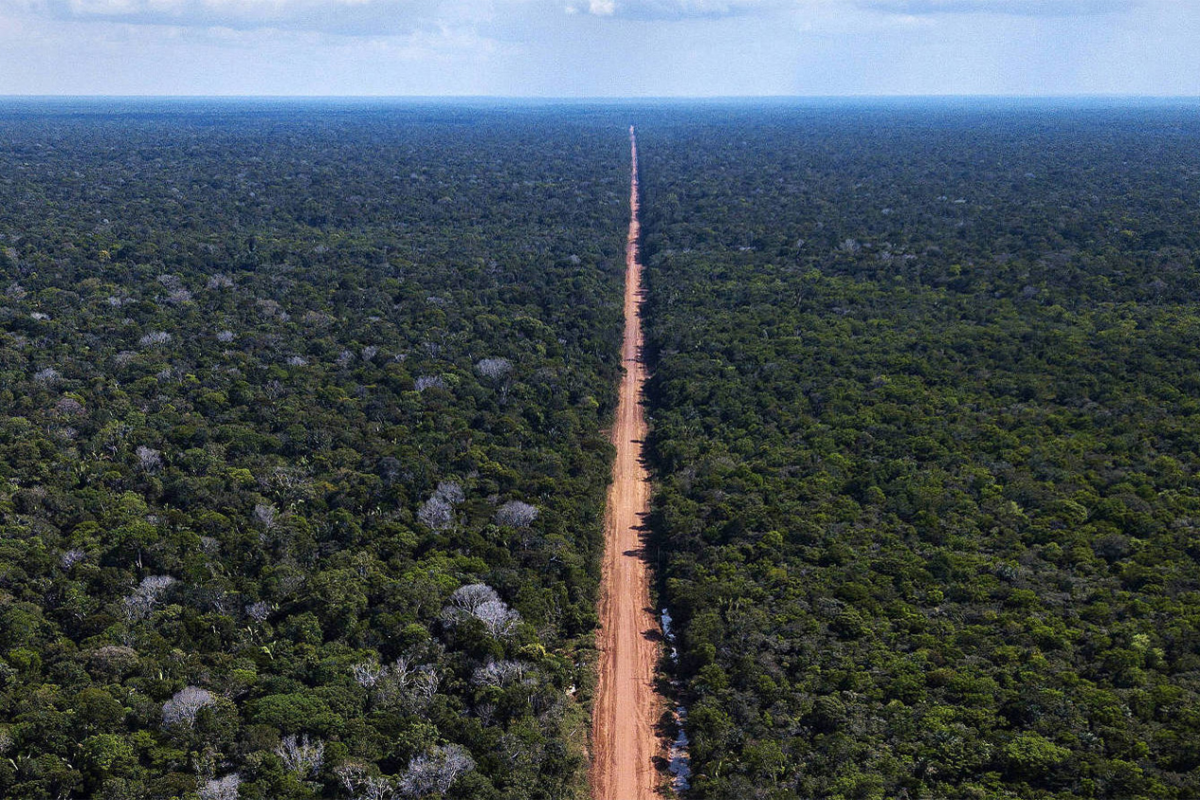
The Brazilian government has created four new sustainable development reserves in the Amazon as part of an effort to mitigate environmental damage from the controversial plan to fully pave the BR-319 highway. The road will pass through one of the most intact parts of the rainforest, which conservationists warn will lead to increased deforestation.
President Luiz Inácio Lula da Silva signed on Sept. 8 the decrees that would protect more than 668,000 hectares (1.65 million acres) of Amazon rainforest under a sustainable-use model, which allows existing residents to remain on the land and extract forest products.
“The federal government is working … to build a solution capable of enabling the highway’s paving, while ensuring environmental protection and encouraging sustainable economic development in the region,” João Paulo Capobianco, the minister of environment and climate change, said at an event announcing the new conservation areas.
The four reserves will be managed by Brazil’s Chico Mendes Institute for Biodiversity Conservation, a federal agency under the environment ministry.
The decrees also establish buffer zones around three of the four largest reserves, putting another 109,718 hectares (271,119 acres) of land under some level of protection, though mining could be permitted in those areas.
The BR-319 highway, which connects the cities of Manaus and Porto Velho in Brazil’s northern Amazon, was built during Brazil’s military dictatorship in the 1970s and later fell into disrepair. The highway’s 339-kilometer (211-mile) middle section is largely impassable in the rainy season, though many still try to traverse it.

Former president Jair Bolsonaro pledged to fully repave the BR-319 when he took office in 2019. He never did, but speculation fueled a 144% jump in deforestation between 2019 and 2022. The deforestation was in the classic “fishbone” pattern in which smaller roads branch off from main roads, each with an area of deforestation around it.
Capobianco said deforestation subsequently fell 73% between 2022 and 2025, following Bolsonaro’s exit from office, and an additional 43% by July 2026.
While protection on paper and a slowdown in deforestation are a good start, enforcement on the ground remains a huge concern in a region where public servants have been ambushed and threatened and environmental agencies set on fire.
“Creating conservation units alone isn’t enough. Is it good to create them? Yes, but it doesn’t solve anything, it’s not enough,” Suely Araújo, a senior public policy specialist at the Climate Observatory, told Mongabay in an audio message.
“The Chico Mendes Institute has a budget far below what’s needed for protected areas, and that hasn’t increased. So nothing guarantees these [sustainable-use reserves] will be effectively implemented,” she said. “You need to show how enforcement will actually happen in the region. That hasn’t been demonstrated.”
Banner image: The BR-319 highway in Amazonas state, Brazil, surrounded by forest. Image courtesy of DNIT.

