


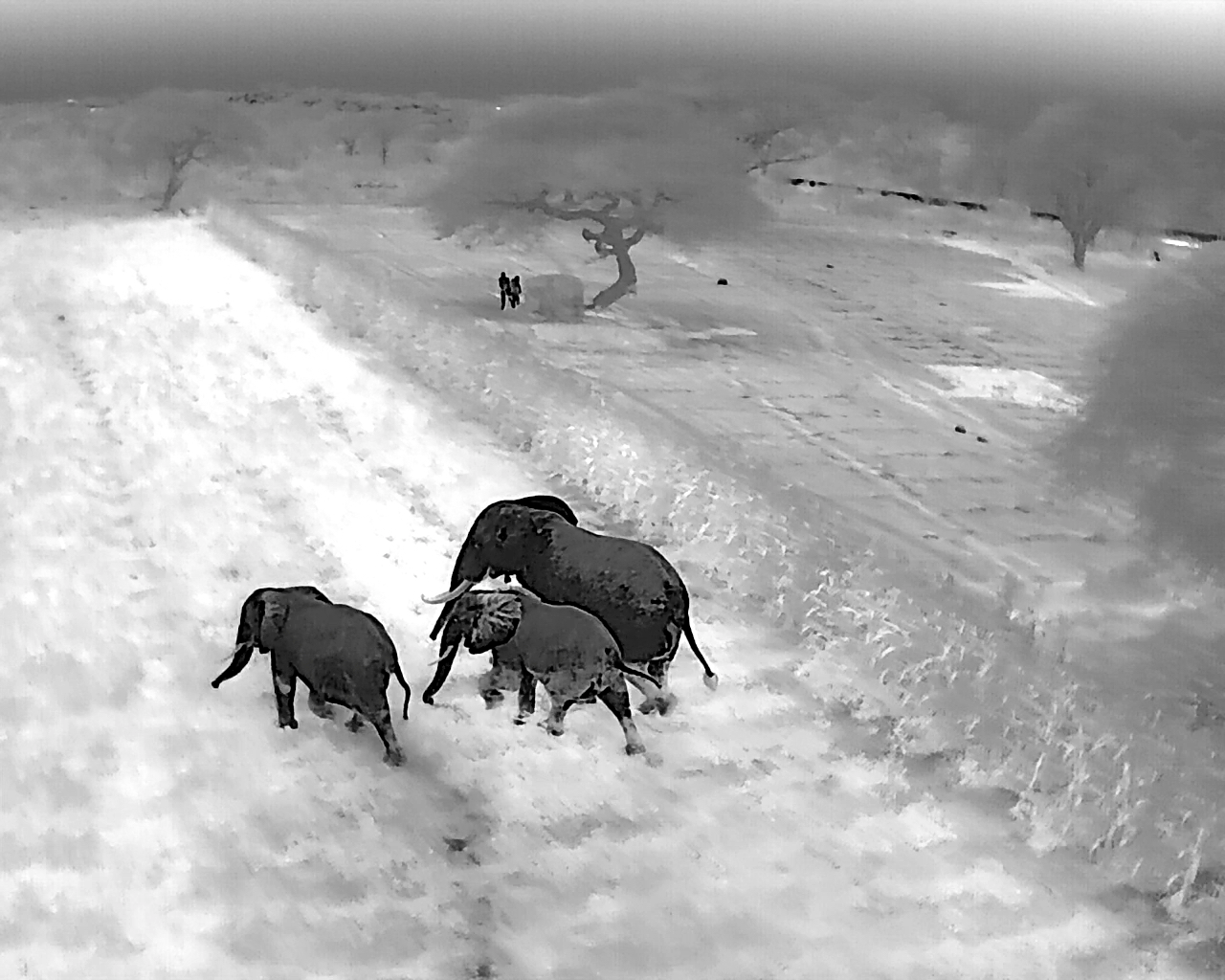
- Amboseli National Park, home to a population of nearly 2,000 African elephants, has witnessed significant human-wildlife conflict, in part, because it is largely unfenced to allow elephants to move freely.
- Park managers are turning to drones to help reduce contentious interactions between elephants and residents in surrounding areas.
- The drones provide real-time aerial surveillance that enables rangers and communities to track elephants and prevent dangerous encounters by corralling them away from human settlements and farmland.
- “Thanks to the use of drones in wildlife conservation, we have seen a reduction in retaliatory injuries and deaths,” Jeremy Goss, Program Director at Big Life Foundation, told Mongabay.
Dominic Mutua, a smallholder farmer from Inkoisuk village some 30 kilometers (19 miles) from Amboseli National Park, has often clashed with two elephants that enter his farm and destroy crops. “We had to stay up guarding most nights and chasing them away,” Mutua told Mongabay in a telephone interview.
The 2025 census conducted by the Kenya Wildlife Service (KWS) recorded a population of 42,072 elephants (Loxodonta africana) in Kenya, 1,903 of which were counted in the Amboseli park and its surrounding areas. The absence of a perimeter fence means elephants can move freely beyond the national park’s boundaries.
To address human-wildlife conflict in this remote rural region of southern Kenya, drones equipped with thermal-imaging technology enable conservation teams to monitor animal movement, detect wildlife at night and warn communities early before encounters escalate.
Amy Baird, Deputy Director of the Big Life Foundation, says that aside from data collection, the drones can also safely deter elephants from entering farms and settlements by guiding them away from these areas. The US-based nonprofit works with communities to protect elephants and conserve habitats in the larger Amboseli ecosystem.
Approximately 200,000 people live within the park and in the broader Amboseli region, which encompasses about 8,093 square kilometers (3,125 square miles) of rangelands, wetlands and wildlife corridors, according to the park’s management. As the park itself covers only 392 sq km (151 sq mi), its survival depends heavily on the health of the surrounding community lands.
Owing to the scarcity of arable land, agricultural plots near the Amboseli National Park overlap with natural wildlife habitats. Historically, this has led to significant economic losses for farmers and retaliatory action that has injured or killed elephants.
According to the 2020 annual report by the International Fund for Animal Welfare (IFAW), more than 9,000 cases of human wildlife conflict from the larger Amboseli ecosystem were reported over a 10-year-period with nearly half involving elephants.
Researchers at Big Life Foundation consider drones a cost-effective, efficient and safer way to track elephants’ movements, map and monitor habitats, combat poaching and promote coexistence between people and wildlife.
“Thanks to the use of drones in wildlife conservation, we have seen a reduction in retaliatory injuries and deaths,” Jeremy Goss, Program Director at the Big Life Foundation, told Mongabay.
Enter the drones

In May and June 2026, thermal drones were used in 78 incidents involving elephants inside and around this semi-arid protected area located near the Kenya-Tanzania border, according to Big Life data shared with Mongabay.
In 33 instances, drones successfully guided elephants out of farms and back into the park after they had crossed the crop protection fence. In the remaining cases, the drones were deployed proactively to respond to other incident types, such as wildlife monitoring and anti-poaching surveillance.
The drones and the sound of their propellers causes elephants to move away. Drone pilots carefully position the drone behind or above a herd, encouraging it to retreat away from human settlements toward less contentious areas. They are equipped with infrared sensors for use at night and in other low-visibility conditions.
“With their buzzing propellers, sounding like a swarm of bees, these drones are now used to chase elephants from farms,” said John Olekina, a farmer from Kimana Sanctuary, a community-managed reserve that forms a wildlife corridor linking Amboseli National Park with the key elephant habitats of Chyulu Hills and Tsavo West national parks. The 54-year-old father of four told Mongabay that the drone technology had been useful in detecting elephants at night.
Existing approaches to address this issue, such as strategic fencing, rapid-response rangers, chili oil or thunder flashes, have all proven effective, depending on the location, time of day and other circumstances. But conservation officials in Kenya describe thermal drones as more effective owing to improved precision of elephant and habitat monitoring.
The challenges of drone use

Experimental use of drones in wildlife conservation in Kenya began in the early 2010s, with broader adoption growing between 2014 and 2016. Conservation organizations and KWS started testing unmanned aerial vehicles (UAVs) for anti-poaching patrols, wildlife monitoring, habitat mapping and human-wildlife conflict mitigation.
Amboseli’s “open plains and sparse tree cover provide ideal conditions for drones to monitor wildlife movements across the landscape,” said Sospeter Kiambi, a senior conservation researcher at KWS in a phone interview.
“With land transformation accelerating due to [connectivity] with the capital Nairobi, real-time tracking is critical to prevent crop raiding and conflict,” Kiambi told Mongabay.
As long-ranging animals, elephants don’t just cross the boundaries of the park; they also migrate across national boundaries. Amboseli’s elephants spend about 80% of their time outside the national park, moving across farms, community land and into neighboring Tanzania.
This presents a challenge for expanding drone use. Drones are allowed in Kenya and Tanzania, but an operator needs proper permits and registration from the Kenya Civil Aviation Authority (KCAA) or the Tanzania Civil Aviation Authority (TCAA) before flying. Tanzania’s national parks, managed by the Tanzania National Parks Authority (TANAPA), do not permit drones without specific authorization. These regulations aim to minimize disturbances to wildlife and ensure park security.

A study published in late 2025 in the journal Scientific Reports suggests that “elephants can habituate to drones, especially when they are flown according to guidelines which minimise disturbance.” The study considers cases where the drones were flown for observation purposes. However, it says that “erratic and low altitude flight patterns of drones have been shown to consistently elicit a fleeing response, as when used to deter and chase elephants to prevent human-elephant conflict.” The research was conducted in northern Kenya among African savannah elephant populations, the same species found in Amboseli.
Conservation researchers argue that the complexity of the situation [in Tanzania] often makes it challenging to use the technology beyond the Kenyan border.
Yet conservationists are hopeful the approach will work for the Amboseli system — and so are residents. “The deployment of these drones has emerged as an effective tool for curbing wildlife incursions into community areas,” Mutua, the farmer from Inkoisuk village, said.
Banner image: Thermal imagery captured by a drone used by a ranger unit on the outskirts of Amboseli National Park. Image courtesy of Big Life Foundation.
Citations:
Carey-Douglas, A., Jasperse-Sjolander, L., Kokiro, P., Ilterewa, G. G., Lolchuragi, D., Scrase, J. E., … D’Ammando, G. (2025). Elephant habituation to drones as a behavioural observation tool. Scientific Reports, 15(1). doi:10.1038/s41598-025-25762-2
Hahn, N., Mwakatobe, A., Konuche, J., De Souza, N., Keyyu, J., Goss, M., … Olson, D. (2016). Unmanned aerial vehicles mitigate human-elephant conflict on the borders of tanzanian parks: A case study. Oryx, 51(3), 513-516. doi:10.1017/s0030605316000946
FEEDBACK: Use this form to send a message to the author of this post. If you want to post a public comment, you can do that at the bottom of the page.
Cite this article
Aimable Twahirwa (2026). Thermal drones deployed in Kenya’s Amboseli Park to tackle human-elephant conflict. Mongabay Conservation news. DOI: https://doi.org/10.66709/news-325538

