


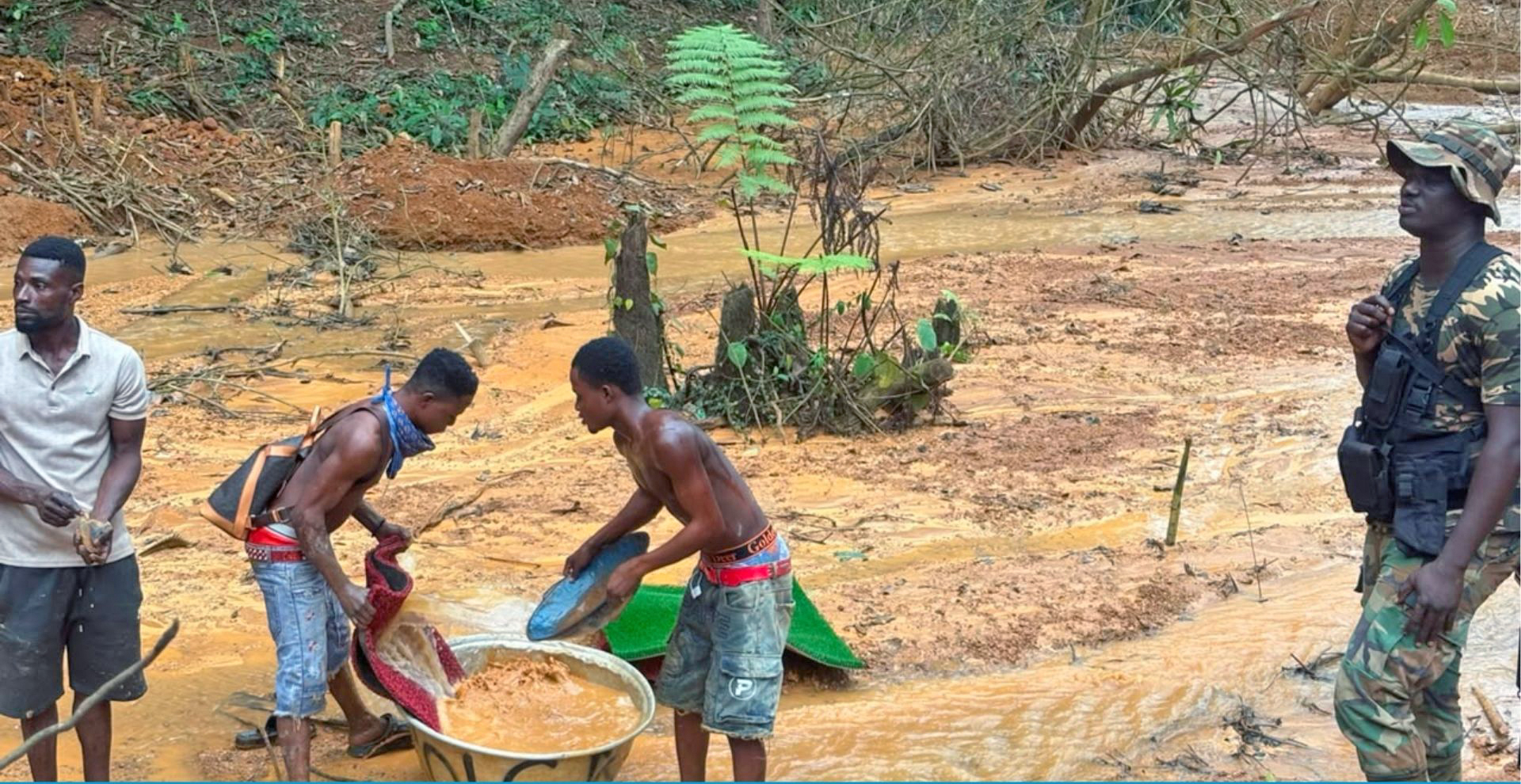
- Forestry officials charged with protecting the Atewa Forest Reserve in eastern Ghana have been overrun by illegal miners whose operations are putting the water supply of millions of Ghanaians in jeopardy, according to conservation groups.
- Atewa is a biodiversity hotspot, with more than 80 threatened and endangered species found in its 26,300 hectares (65,000 acres).
- Environment group A Rocha Ghana and others have called on the government to provide greater resources to counter illegal mining in Atewa and elsewhere.
Every day, scores of illegal miners on motorbikes swarm into the Atewa Forest Reserve, in eastern Ghana — ignoring the handful of Forestry Commission guards charged with keeping them out.
Inside the reserve, the miners have stripped forest cover and excavated pits, their passage marked by abandoned equipment and temporary camps and muddy and polluted streams. Their actions jeopardize the drinking water of as many as five million Ghanaians.
“We say this based on a lot of records coming from the Forestry Commission staff, some court records as well,” says Daryl Bosu, deputy national director of operations at conservation initiative A Rocha Ghana, which has been monitoring Atewa and other forested areas for a decade. A Rocha played a key role in a civil society coalition opposing government plans to mine for bauxite in the reserve.
Bosu says A Rocha has observed that many of the rivers and streams in the area, which previously ran clear, have turned brown with sediment since the miners overran the reserve. Miners, he says, have cut down trees along water courses, which he fears have been contaminated with mercury, cyanide and arsenic — all widely used in illegal mining operations.
“The Forestry Commission team is complaining of the unprecedented attack on the Atewa forest because of mining and how they are seriously overwhelmed as a result of pressure which they have never experienced,” he tells Mongabay.
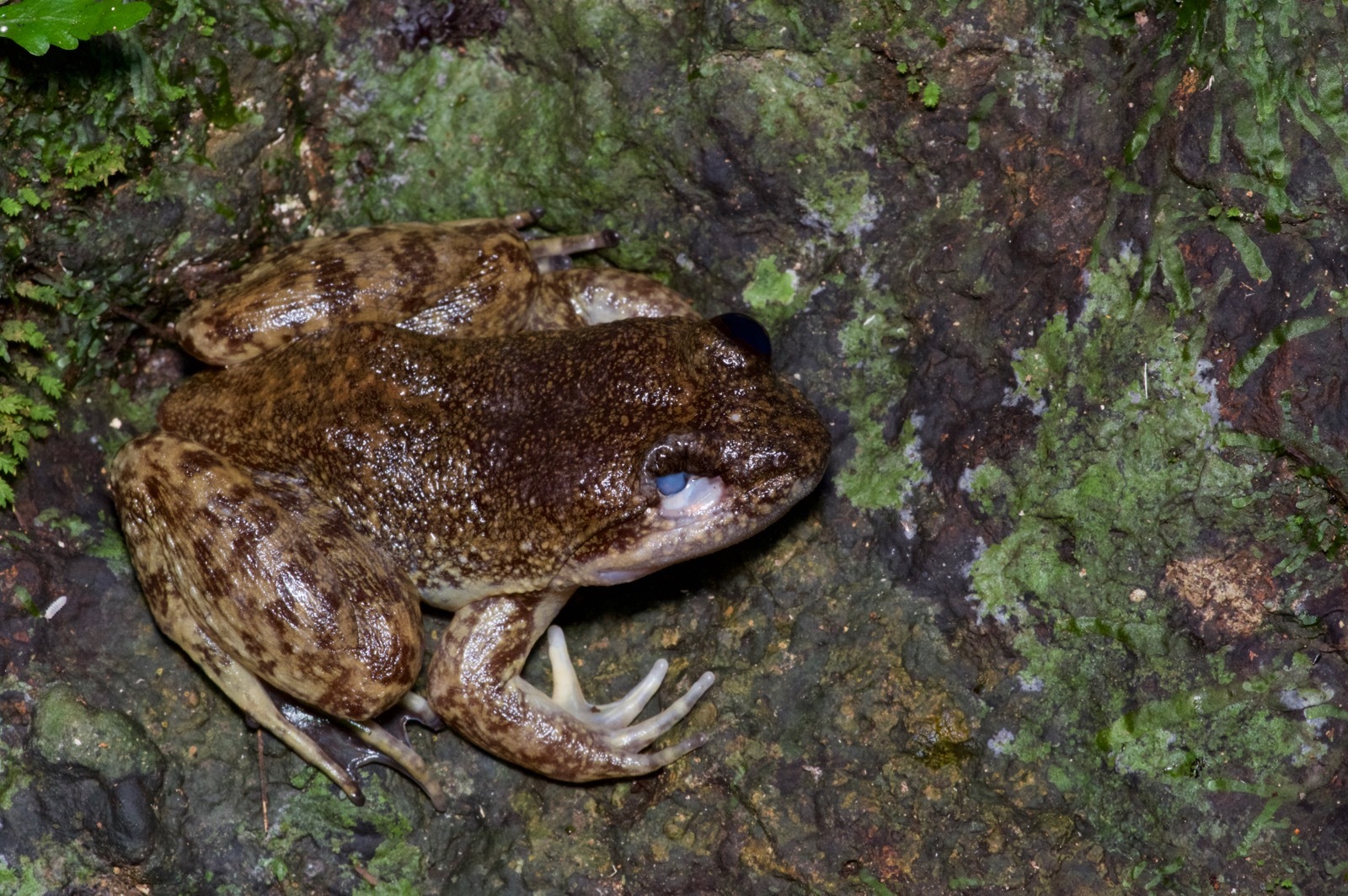
Atewa is home to 239 bird species, and an astonishing 711 butterfly species, according to A Rocha. “The forest is noted for having several endangered species such as the dotted border, which is a butterfly [Mylothris atewa],” Bosu says. “The [endangered] white-naped mangabey [Cercocebus lunulatus], which has not been seen in the area in recent times, but used to be there, and Shelley’s eagle owl [Bubo shelleyi] as well.”
A 2022 assessment by BirdLife International and the Ghana Wildlife Society, confirmed the reserve is a biodiversity hotspot — with around 20% of threatened species in Ghana found there. It is the only known home for the critically endangered Afia Birago’s puddle frog (Phrynobatrachus afiabirago) and the Atewa slippery frog (Conraua sagyimase).
In contrast to many other illegal mine sites that have sprung up in other parts of Ghana, Bosu tells Mongabay that the miners presently tearing into the forest here are working with only basic equipment: pickaxes and shovels and “one-leg” machines — portable versions of the diesel-powered pumps known in Ghana as “changfan”.
They are nonetheless doing major damage, he says, often operating at night when short-staffed forestry personnel are absent. Bosu tells Mongabay that the district manager responsible for the Atewa area told his superiors that the illegal miners have recently become very aggressive, citing a case in which two of his forest guards were taken hostage and had to be rescued by police.
The miners encroaching on the reserve include not only Ghanaians, but gold miners from neighboring countries, Bosu says.
“We’ve seen an influx of both foreigners and local people moving in droves into the forest reserves, just with pick axe and ‘one leg’ and digging along various trees that can be found in the forest reserve,” he says. “And as a result many entry points of the forest reserves have been encroached upon, with the miners going in and out by day and night and this has really exposed the forest to significant risk than ever before”

In a press release on Sept. 14, A Rocha Ghana and other concerned groups urged the government to provide the Forestry Commission and law enforcement agencies with more resources to counter illegal mining in Atewa and elsewhere. They also repeated demands that the reserve be listed as a national park, strengthening its protection.
Citing several recent cases, Bosu says he is also concerned that if arrested, the illegal miners are quickly granted bail and return to the forest to continue mining while their cases remain pending — in at least one case, for five years.
The Forestry Commission and the National Anti-Illegal Mining Operations Secretariat, (NAIMOS) declined to respond to questions from Mongabay. But, in a Sept. 15 media statement reported by local media, NAIMOS spokesperson Paa Kwesi Schandorf, acknowledged that A Rocha and others’ concerns are valid and would receive urgent attention.
“Having already conducted reconnaissance operations within the enclave, NAIMOS is currently collaborating with relevant security and state agencies, to take decisive action within the reserve,” the statement said. “This next line of intervention will be guided by verified intelligence and further operational assessment to achieve maximum results.”
Banner image: Illegal miners at work in the Atewa Forest Reserve, Ghana. Image courtesy of A Rocha Ghana.
Ghana’s government faces pushback in bid to mine biodiversity haven for bauxite
Ghana repeals legislation that opened forest reserves to mining
Feedback: Use this form to send a message to the author of this post. If you want to post a public comment, you can do that at the bottom of the page.

