


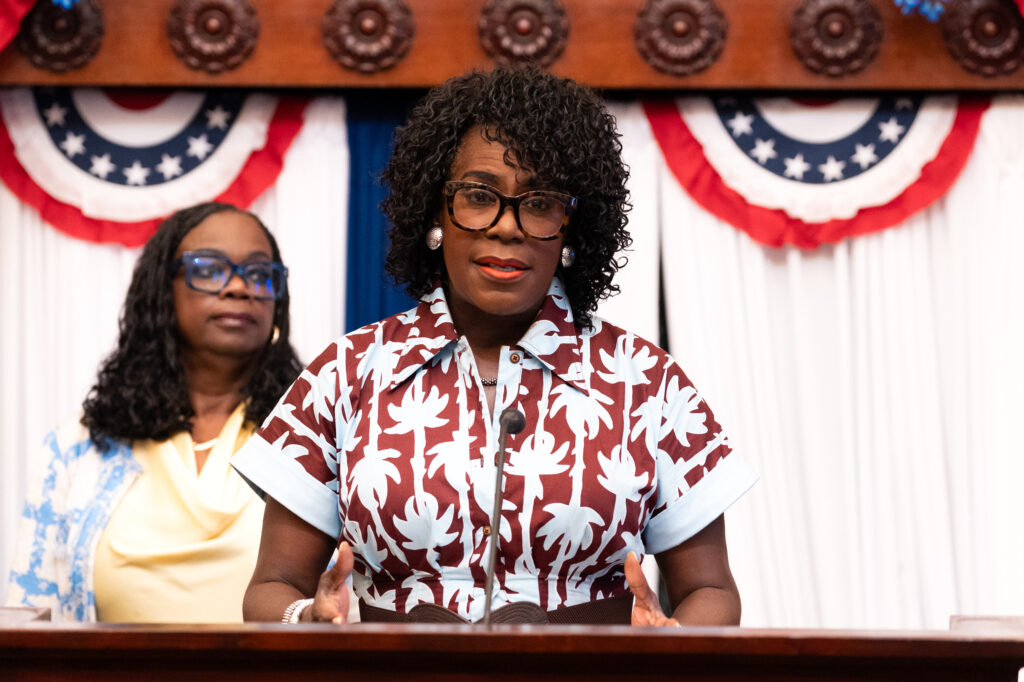
PHILADELPHIA—This summer has brought the full force of a changing climate, with wildfire smoke, extreme heat, flash flooding and severe storms continuing a trend of increasingly extreme weather affecting the city. But during negotiations over the city’s budget throughout the spring, climate policy was largely neglected.
Democratic council members Mark Squilla and Jamie Gauthier said that while the budget, signed into law in June, included some wins for sustainability, climate issues took a backseat to this year’s more urgent push for school funding.
“Every year something takes priority. So, how does it end up being the environment that ends up getting that big push? And what is the year to do that?” Squilla said.
Environmentalists hoped that budget negotiations would bring more attention to climate efforts around the city, including high-priority issues such as ending the city’s practice of incinerating its trash in nearby Chester, Pennsylvania, and pushing Philadelphia Gas Works toward electrification. They also wanted to find more funding for energy transition and efficiency leaders, and specific projects like a new wetland in Eastwick, a neighborhood vulnerable to flooding. With the fiscal year 2027 budget now enacted without major developments on these fronts, the push for this progress continues.
“I think Philly has a lot of really positive things, and I think in some places it’s kind of limping a little bit,” said Christina Rosan, a professor of geography, environment and urban studies at Temple University who researches local climate politics. She said the city has made significant progress despite financial constraints and competing issues.
Data from the 2022 Greenhouse Gas Inventory Report showed that Philadelphia’s citywide greenhouse gas emissions had declined by 31 percent since 2006, partly due to the 2019 closure of a major oil refinery along the Schuylkill River. Those numbers put Philadelphia ahead of its 2025 goal, but if emissions continue declining at the rate seen since 2006, the city remains slightly off pace to reach its targeted 80 percent reduction by 2050, even without the refinery’s pollution. Philadelphia has already almost achieved its goal to cut municipal sector emissions in half by 2030, in part because of efficiency work on city buildings and large new solar projects.
While these are substantial reductions, Rosan highlighted that in addition to ongoing efforts to address SEPTA’s funding woes and modernize school buildings for changing weather, the city still has work to do to address climate systematically. “Getting different agencies to work together, I think, is a challenge,” she said, but one necessary to overcome.
While education funding overshadowed climate policy in budget discussions this year, Mayor Cherelle Parker’s proposal to raise more revenue for schools included a new per-ride tax on rideshare services—an idea that caught the attention of urbanists for the downstream effects it might have had on how Philadelphians get around.
Council members said they weighed whether a tax on ride-hailing would incentivize people to use public transit, but Uber—which orchestrated a lobbying campaign against the proposal—presented data for council’s review showing that frequent riders were more likely to live in economically disadvantaged communities, meaning the tax would be regressive. Xiaoxia Summer Dong, an assistant professor of city and regional planning at the University of Pennsylvania’s Weitzman School of Design, said that research confirmed that and showed that service improvements had a greater positive effect on transit usage than small relative price changes. Ultimately, council rejected the rideshare tax, finding temporary funding for schools elsewhere.
Gauthier hoped that Philadelphia’s long-standing practice of burning around a third of its trash at the Reworld incinerator in Chester, a riverfront city 15 miles away that has struggled financially, would finally end this year. Advocates have long highlighted the brutal implications of the incinerator for air quality and environmental justice in Chester, a majority-Black city.
“We cannot become a cleaner, greener city on the backs of poor black people in Chester,” Gauthier said, echoing Parker’s trademark goals and her famous critique of then-opponent Jeff Brown on the campaign trail in 2023. The city’s four-year contract with Reworld was set to expire on June 30, and Gauthier thought the alignment between the contract and budget timelines might motivate the city to change course.

Earlier this year, Gauthier’s bill to ban city contracts with trash-burning facilities failed to secure enough support. When the city did not announce new contracts before July 1, it extended its existing contract with Reworld another six months. She cited Reworld’s $100,000 lobbying effort in City Hall between October 2025 and March 2026.
Last month, Parker’s administration announced its intention to renew the city’s contract with Reworld for another four years. But the contract is subject to City Council approval, and Gauthier’s office said they were hopeful that councilmembers might be more likely to oppose a new trash-burning agreement than proactively ban any city contracts with incinerators.
But Gauthier also blames Parker’s approach to negotiations for her bill’s failure and for the budget’s lack of climate investments overall.
“Because the mayor refused to come to the table with council to work out a way to fund schools that was better than levying taxes on working-class people, and council rejected that proposal,” Gauthier said, Parker rejected the council’s other priorities, leading to losses on climate issues.
Parker’s office did not offer a comment or response for this story. In a news conference shortly after the final budget was passed, she rejected the idea that her administration had been overly stubborn during negotiations.
Gauthier’s office said this approach also meant that the Philadelphia Energy Authority (PEA)—a climate leader for their regional work on electrification and renewable growth—didn’t get enough funding. Parker’s proposed budget allocated only $1.3 million for the agency out of the $4 million it requested. In past budgets, in which Parker has also proposed only partially funding PEA, council has used political capital to add more funding to the final budget. But because Parker refused to negotiate this cycle without her rideshare tax, Gauthier’s office said the final budget’s allocations were almost identical to Parker’s proposal. While there might be a mid-year opportunity to adjust allocations, PEA told Gauthier’s office that the agency could have to wind down some programs without full funding.
“[PEA] is an agency that is punching well above its weight, helping the city not only with our housing goals but with our energy goals, […] but it’s also a tragedy that we play this ridiculous game every single budget session,” Gauthier said.
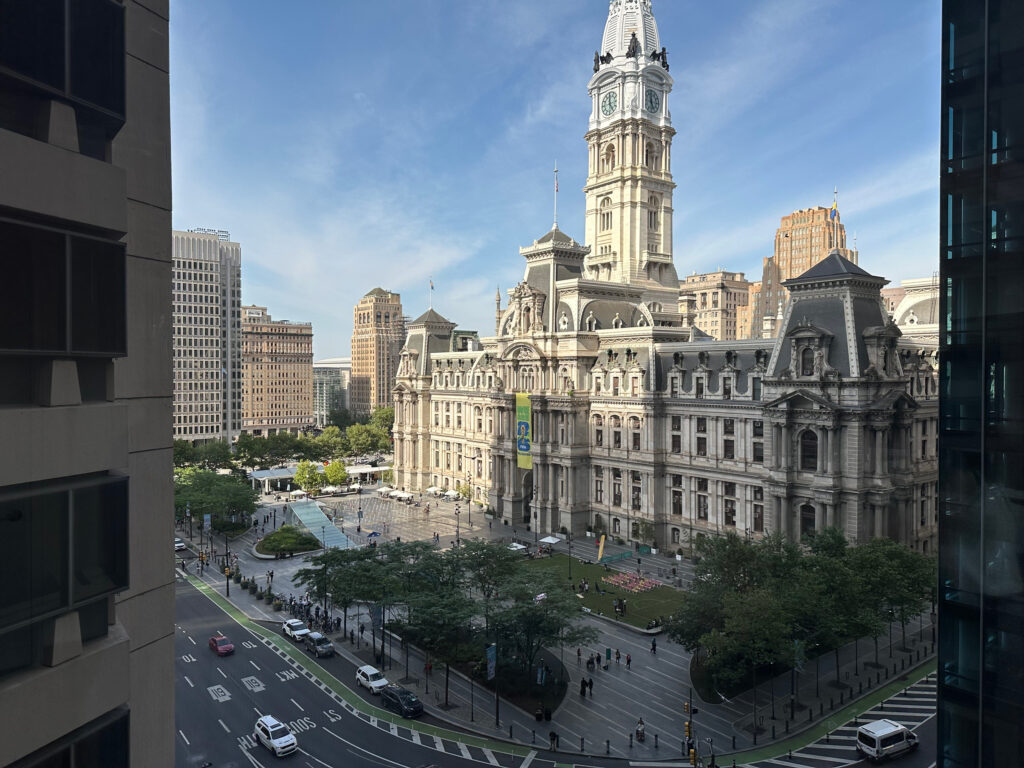
Squilla said that making adequate progress on climate policy requires more long-term attention than the fast-paced yearly obligations of council easily allow for. While education was top of mind this cycle, in the past, public safety, housing and other issues have been designated early on as priorities. If the city is to invest in large-scale climate solutions, its leaders should designate an upcoming budget cycle to prioritize those measures.
Rather than waiting for a budget cycle devoted to the issue, Rosan wants the city to start “incorporating climate investments into all investments.” About recent years’ focuses, she added, “I feel like schools and housing are all part of climate governance and justice.”
Squilla said the city should focus on turning its sustainability goals into more concrete policies for council and the mayor to enact each year. “We need a specific environmental plan to look at the city as a whole, and have a roadmap of how we could do these things, what the cost is, and within what budget, and what timeline,” he said. Rosan agreed, saying that cities should identify the characteristics of a sustainable city and then figure out which policies will help achieve them.
This story is funded by readers like you.
Our nonprofit newsroom provides award-winning climate coverage free of charge and advertising. We rely on donations from readers like you to keep going. Please donate now to support our work.
Philadelphia has long-term emissions goals, and its Climate Action Playbook articulates the steps the city is taking to reduce emissions and pursue sustainability. But these plans don’t lay out exactly which legislative policies would satisfy those long-term climate goals or how and when council and the mayor can enact them.
That long-term work would require the advocacy and collaboration of many city offices with existing sustainability plans. Rosan praised these plans, but said the difficulty of carrying each one out when their goals are interdependent and political constraints change over time might mean a more systematic approach is necessary.
Still, Gauthier and Squilla highlighted several recent wins for climate. Philadelphia committed almost $900 million over five years to support SEPTA. Both Mayor Parker’s proposed budget and the final budget fully funded the Office of Sustainability, while also allocating $25 million to a program that provides free transit passes to low-income residents. In June, the city enacted a law encouraging development near transit stations, a key strategy for reducing vehicle dependency. While he wants more attention devoted to maintenance, Squilla said Philadelphia is mostly on track with its ambitious tree-planting plans and continues to expand pedestrianization efforts.
For these specific accomplishments to become sustained, citywide progress, however, council members think more consistent pressure is needed to overcome the political constraints.
“Many times people move in this place because of political power, and so … building political capital that helps people to understand that voters care about this is probably a good thing,” Gauthier said.
Rosan wants Philadelphia’s climate plans to be ambitious. “To me, Philly has so many opportunities,” she said. “You could really go big in Philly, but I don’t think we often have the money to do that.”
About This Story
Perhaps you noticed: This story, like all the news we publish, is free to read. That’s because Inside Climate News is a 501c3 nonprofit organization. We do not charge a subscription fee, lock our news behind a paywall, or clutter our website with ads. We make our news on climate and the environment freely available to you and anyone who wants it.
That’s not all. We also share our news for free with scores of other media organizations around the country. Many of them can’t afford to do environmental journalism of their own. We’ve built bureaus from coast to coast to report local stories, collaborate with local newsrooms and co-publish articles so that this vital work is shared as widely as possible.
Two of us launched ICN in 2007. Six years later we earned a Pulitzer Prize for National Reporting, and now we run the oldest and largest dedicated climate newsroom in the nation. We tell the story in all its complexity. We hold polluters accountable. We expose environmental injustice. We debunk misinformation. We scrutinize solutions and inspire action.
Donations from readers like you fund every aspect of what we do. If you don’t already, will you support our ongoing work, our reporting on the biggest crisis facing our planet, and help us reach even more readers in more places?
Please take a moment to make a tax-deductible donation. Every one of them makes a difference.
Thank you,

Fellow
Daniel Perrin is a Philadelphia-based fellow at Inside Climate News, covering urban environmental issues. He is a rising senior at Swarthmore College, where he studies economics, literature, and history. He just finished serving as Editor-in-Chief of The Swarthmore Phoenix, overseeing the campus paper and reporting on trends within higher education, economic policy, sustainability, transportation, and governance at all levels. Having grown up in Chapel Hill, NC, before moving to Baltimore, he is especially interested in how large political and economic developments ripple through the built environment of local communities.
