


Scientists have spent decades debating what killed the dinosaurs. Some say volcanoes triggered the dinosaurs’ decline a million years before the infamous asteroid hit 66 million years ago. Others say the dinosaurs slowly starved after the asteroid’s impact generated a dust cloud so thick it blocked out the sun for months.
But land-dwelling dinosaurs may not have had time to starve. Many would have been incinerated by thermal radiation in the hours after impact, researchers report July 28 in the Journal of Geophysical Research: Biogeosciences.
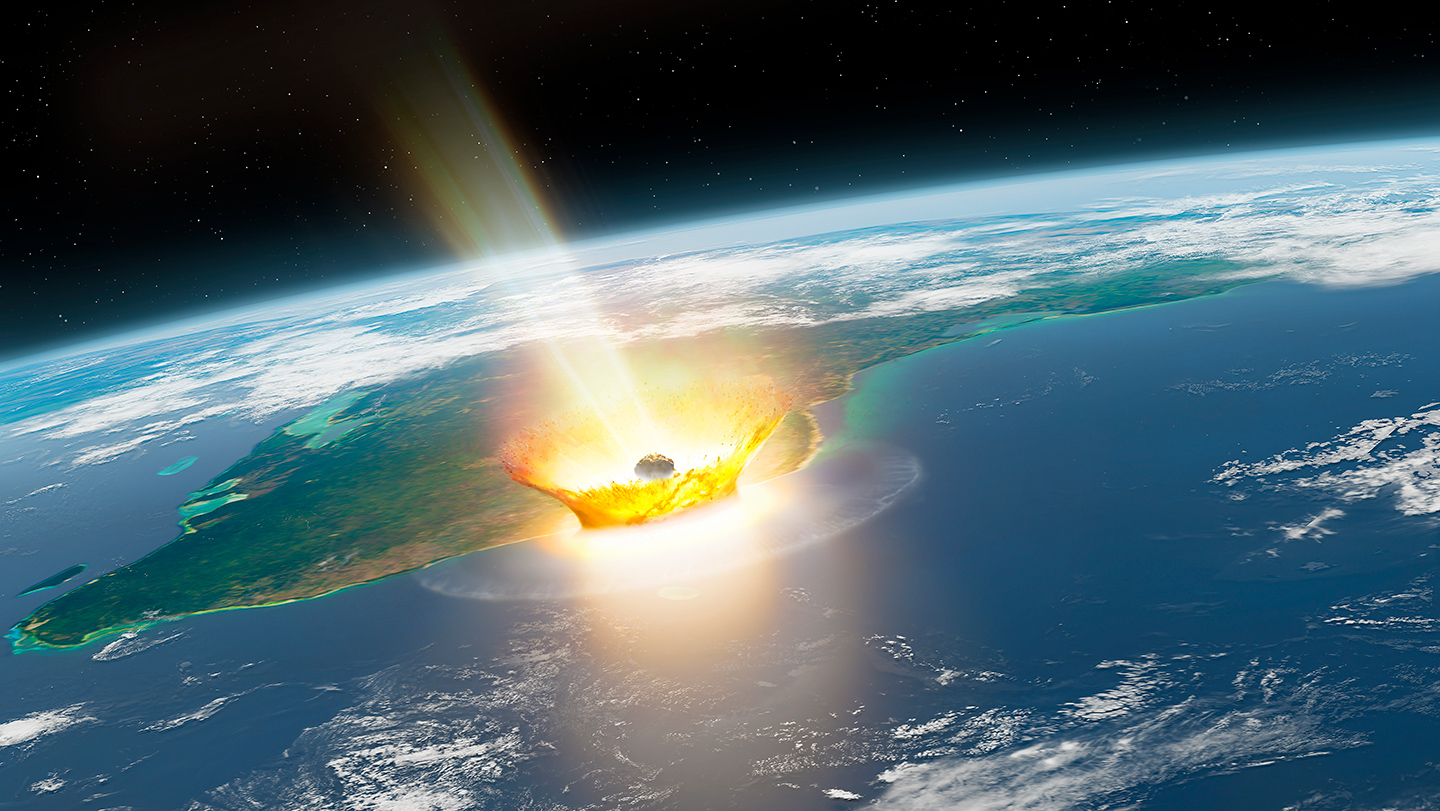
When the asteroid hit, it vaporized the surrounding rock, creating the 200-kilometer-wide Chicxulub crater underneath the Gulf of Mexico. Some of the vapor cooled in the atmosphere and condensed into droplets of molten rock. The rest became a cloud of fine dust.
What happened next has been a long-standing question, says planetary scientist Brandon Johnson of Purdue University in Lafayette, Indiana. Using deposits of asteroid material from North Dakota, Johnson and his collaborators simulated what would have happened as this dust spread around the globe.
The results painted a frightening picture. Molten rock would have rained down with the force of a bullet, generating a lot of heat. Instead of escaping into space, that heat would have been trapped by the dust cloud and radiated back to Earth’s surface. The air would have warmed rapidly, turning the sky red, while any creature that couldn’t take shelter received 17 times the lethal dose of thermal radiation for humans. About an hour later, the radiation would have dissipated, and the dust cloud would have blocked out the sun. The only light would have been from global wildfires spontaneously ignited by the heat.
This new hypothesis posits that most land-dwelling creatures were dead within hours of the asteroid’s impact. But it doesn’t address how underwater species went extinct, too.
“No matter how intense, fires are unlikely to do much in the middle of the ocean,” says Cem Berk Senel, a planetary scientist at the Royal Observatory of Belgium in Brussels who was not involved in the research. A collapsing food chain from the lack of sunlight probably still played an important role in the mass extinction.
The horrors persisted for anything that survived the heat and fires on land, Johnson says. Burrowing birds and mammals still had to brave the unending darkness and wildfire soot. “But thank goodness they did, because otherwise we wouldn’t be here.”
