


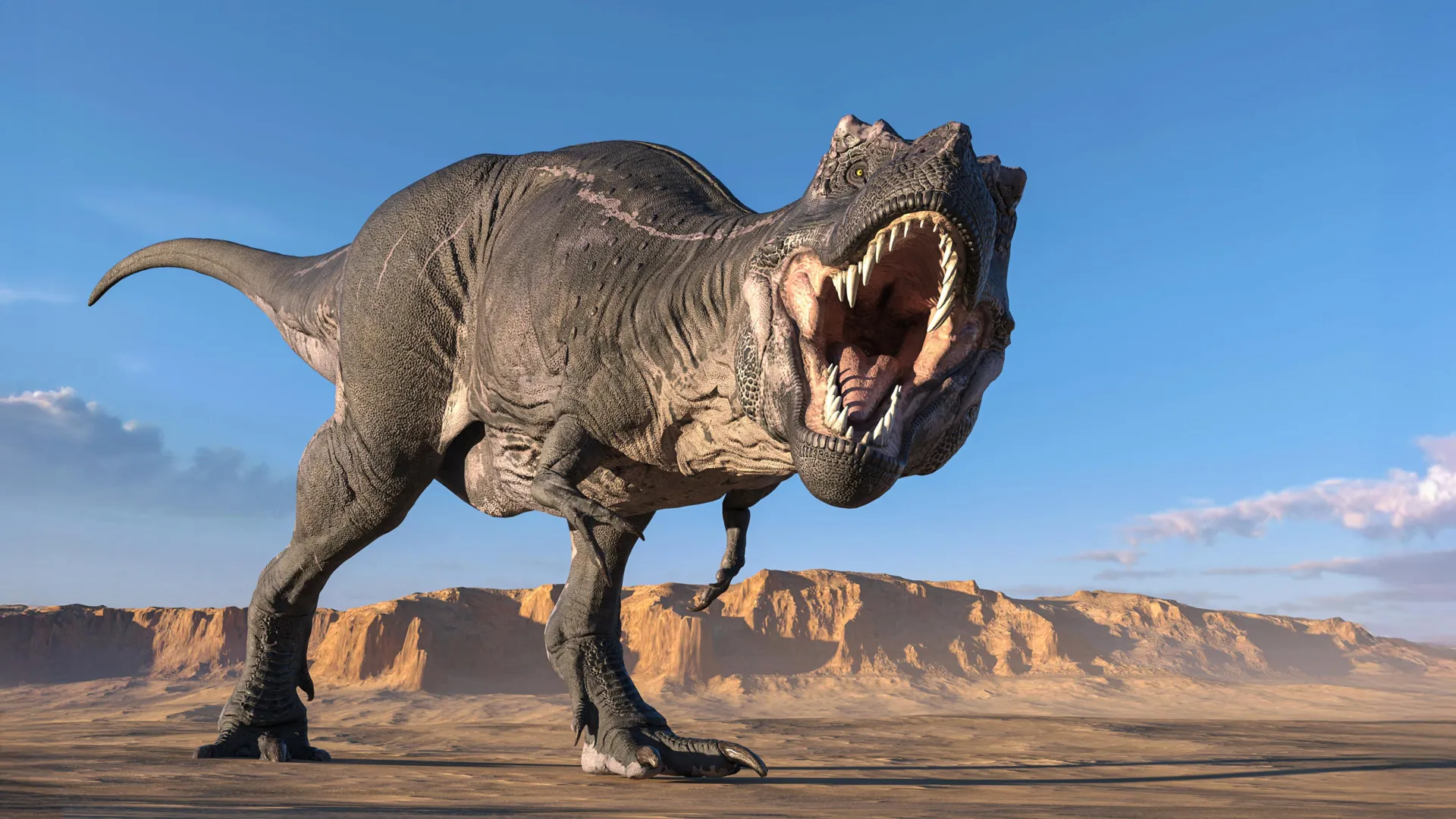
For more than a century, scientists have tried to reconstruct the biology of Tyrannosaurus rex from bones, teeth, footprints, and other traces left behind more than 60 million years ago. Fossils discovered as far north as Alaska have suggested that T. rex could tolerate cold conditions, adding to evidence that the giant dinosaur was moving away from the cold-blooded physiology of many reptiles and toward the warm-blooded metabolism seen in birds.
Now scientists have done something that once seemed impossible: they have effectively taken T. rex‘s temperature.
Researchers at UCLA developed a method for estimating body temperature from fossilized teeth and applied it to specimens held by the Natural History Museum of Los Angeles County. Their results indicate that T. rex maintained a body temperature of about 97 degrees Fahrenheit, remarkably close to that of humans.
The finding supports the picture of T. rex as an active predator or scavenger with a relatively fast metabolism rather than a sluggish animal that depended heavily on basking in the sun. Its ability to generate and regulate internal heat may also help explain how tyrannosaurs survived in colder regions that were inhospitable to many other reptiles.
A Fossil Thermometer Refined Over a Decade
UCLA researchers first developed their prehistoric thermometer method about a decade ago. The technique used skeletal material to investigate whether extinct animals were warm-blooded or cold-blooded.
Applying it to T. rex initially posed a major problem. The early version of the method required more fossil material than a museum would reasonably sacrifice from such an important and irreplaceable specimen.
Over the following decade, however, the UCLA team dramatically improved the technique. Researchers reduced the amount of material needed for testing ancient teeth by roughly 90%.
That improvement persuaded L.A.’s Natural History Museum to provide tiny portions of two teeth belonging to Thomas the T. rex, the most complete of the towering tyrannosaur skeletons displayed in the museum’s dinosaur hall.
Although other lines of evidence have increasingly suggested that T. rex was warm-blooded, the study, published Sept. 16 in Science Advances, provides the first actual temperature measurement for the animal.
“No one’s been able to make a temperature measurement like this before,” UCLA geobiologist and study co-author Robert Eagle said. “We found T. rex was 36 Celsius (97 Fahrenheit), about the same as humans. The temperature is about what I would have guessed — higher than a reptile or a slow mammal like a sloth, but lower than an avian.”
T. rex was still a scaly, egg-laying reptile, but its 36 C body temperature was much closer to that of a warm-blooded mammal than a modern reptile.
Modern cold-blooded reptiles typically maintain temperatures around 28-30 °C (82-86 °F), while most birds, the evolutionary descendants of dinosaurs, often have considerably higher body temperatures of 40-43 °C (104-109 °F), according to Eagle.
How Scientists Took T. Rex’s Temperature
The secret is hidden in microscopic chemical bonds preserved inside tooth enamel.
Rare isotopes of carbon and oxygen can bond together within enamel. How frequently those bonds form depends partly on temperature. More of the bonds form under cooler conditions, while fewer form at warmer temperatures.
That relationship allows researchers to use the chemical signature preserved in fossil teeth as a kind of ancient thermometer. A warm-blooded animal should leave behind fewer of these isotope bonds than a cold-blooded animal.
“That’s the basis of using the isotopes as a thermometer,” Eagle said. “In theory, we can make measurements using any part of the skeleton, but the bones in our body are constantly being remodeled and dissolved and replaced. Tooth enamel has large crystalline structures that are extremely durable, making it the part of the skeleton that most resists chemical alteration by the environment over the eons.”
To make the measurement, Eagle and lead author Randy Flores used a dental drill to collect enamel from the fossil teeth. They then dissolved the powdered enamel in phosphoric acid, releasing carbon dioxide gas that contained the isotope bonds they wanted to study.
A mass spectrometer was used to measure the isotope ratios in that gas. The researchers also pressurized the gas to create a denser stream of CO2, allowing the instrument to obtain usable measurements from much smaller quantities of fossil material.
A Warm-Blooded T. Rex Was Built for an Active Life
The 97-degree reading adds physical evidence to the idea that tyrannosaurs were energetic animals with relatively high metabolisms.
Maintaining their own body heat would have helped T. rex remain active while hunting or scavenging enough food to support such a metabolism, Eagle said. It also helps scientists place the dinosaur along the evolutionary path that ultimately produced modern birds, whose body temperatures are generally even higher.
Warm-bloodedness may have given T. rex another important advantage: access to colder environments.
Study co-author Alessandro Chiarenza, a paleontologist at University College London, said an internally regulated body temperature could have allowed tyrannosaurs to live in regions where cold-blooded reptiles struggled to survive.
T. rex lived during the Cretaceous Period, when Earth’s climate was much warmer than today. Global conditions were approximately 11-25 °F warmer than modern temperatures, and dinosaurs had millions of years to adapt to that hot-house world.
Yet even under those generally warmer conditions, winters in ancient Alaska would have been extremely challenging for a cold-blooded dinosaur.
That pattern is reflected in the fossil record. Paleontologists have not found fossils of lizards, turtles, crocodiles, or other reptiles from Cretaceous Alaska, Chiarenza said. Tyrannosaurus fossils, however, have been discovered there.
“Now we have empirical evidence using this geologic thermometer,” Chiarenza said. “Using paleoclimate models of the past, we were able to reconstruct a range in North America 66 million years ago that stretched from Mexico to Alaska, based on where T. rex could have survived with a 97 °F body temperature.”
Why Scientists Were Finally Allowed to Test T. Rex Teeth
Obtaining material from a famous fossil is not a simple decision. Any analysis that requires drilling or removing part of a specimen permanently alters an object that cannot be replaced.
After years of working with Eagle and UCLA, the Natural History Museum concluded that the improved technology could produce valuable results while requiring only very small samples.
The museum therefore allowed researchers to take portions of two Thomas the T. rex teeth that were not on public display, according to Luis Chiappe, curator of the museum’s Dinosaur Institute and head of NHM research and collections.
“We’re asked for fossils for use in destructive analysis all the time,” Chiappe said. “The museum contains tens of millions of specimens of minerals, animals and fossils that are irreplaceable. We have to make decisions that balance the damage to the specimen against gaining knowledge about the natural world. Sacrificing small portions of two teeth to learn about T. rex‘s body temperature is definitely worth the trade-off.”
An Ancient Crocodilian Provided an Important Check
Thomas the T. rex was excavated from Hell Creek in Montana, a site that also produced ancient crocodilian fossils analyzed by the researchers.
Those crocodilian remains provided an important comparison. The team measured a body temperature of 30 °C (86 °F) for the crocodilian, substantially lower than the 36 °C (97 °F) reading from T. rex.
That difference helped rule out the possibility that geological processes at the fossil site had altered the chemical signatures in both animals in the same way. If the surrounding geology had been responsible for changing their molecular composition, the two species would have been expected to produce similar temperature readings, Eagle said.
Instead, their sharply different temperatures support the conclusion that the chemical signals preserved in the fossils reflect genuine differences in the animals’ biology.
The research was supported in part by grants from the National Science Foundation.
