


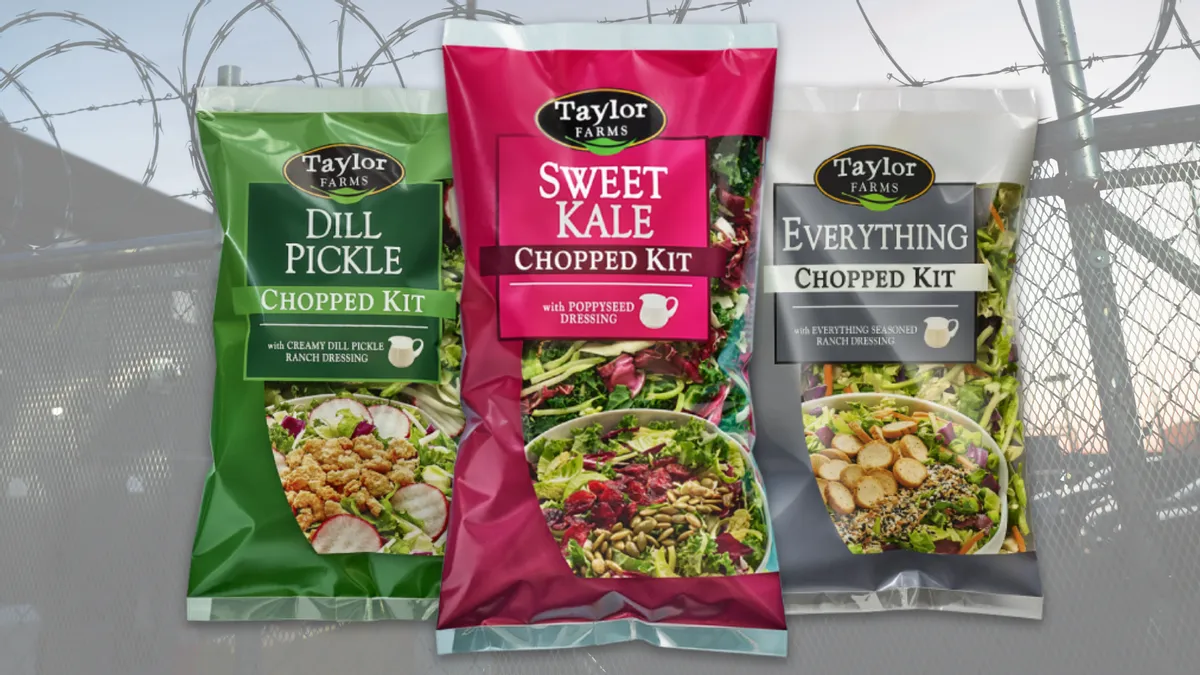
Taylor Farms, a produce company believed to be the source of the 2026 “explosive diarrhea” outbreak, once used prison laborers in its workforce.
The claim originated in a news report from 2022 and the documentation Snopes reviewed was from 2019. We don’t know whether Taylor Farms still uses inmate laborers as of this writing, but we reached out to Taylor Farms and the Arizona Department of Corrections, Rehabilitation & Reentry for comment and will update this article if we learn more.
Rumors circulated in August 2026 that Taylor Farms, a produce company believed to be the source of the 2026 “explosive diarrhea” outbreak across the U.S., once used forced prison labor in its workforce.
Users on social media claimed the produce supplier was leveraging a legal loophole that allowed it to use prisoners, some allegedly in the country without legal status, as cheap labor in its operations. Some posts alleged the net pay rate of incarcerated workers was as little as $1.50 per hour.
Not only is Taylor Farms serving you up a diarrhea parasite with your summer salad, they use forced labor to pick the lettuce. They pay the Arizona Department of Corrections $4.75/hr for prison labor, and the workers make $1.50/hr.
They are truly an evil.
— Hillcrest Card Company 🔥🍉🇨🇺🏳️⚧️🇻🇪🔥 (@HillcrestCardCo) August 2, 2026
According to documents acquired by the journalists who originally reported the story and reviewed by Snopes, the claim was true.
Important context to note is that the claim originated in a report from 2022 and the documentation we reviewed, embedded as a PDF below, was from 2019.
We don’t know if Taylor Farms still uses inmate laborers as of this writing, but we reached out to Taylor Farms and the Arizona Department of Corrections, Rehabilitation & Reentry for comment and will update this article if we get a response.
Origin of the claim
In a report published Dec. 13, 2022, The Arizona Republic highlighted a legal loophole in Arizona law that allowed undocumented prisoners to be contracted by private companies despite there being a law against using workers who lacked legal authorization to work in the country, because they were incarcerated at the time and not subject to the same protections as employees.
Taylor Farms and ADCRR didn’t respond to The Arizona Republic’s request for comment, but another company named in the investigation, NatureSweet, reportedly said it canceled its contract with the state in 2016.
According to the report, a spokesperson said, “If NatureSweet knew or heard that [the Department of Corrections] used undocumented workers, it would have taken immediate steps to investigate the situation and ensure full compliance with the law.”
The investigation was a joint effort by The Arizona Republic and KJZZ, who wrote they analyzed “more than 11,000 documents” and came to the conclusion that “prison labor … has become ubiquitous across the state.”
The reporters built a searchable database that featured invoices, contracts and timesheets connecting ADCRR to private companies. Taylor Farms was listed in the database, but the document its entry linked to appeared to have been removed.
However, this evidence, shared with Snopes by one of the reporters, revealed a 2019 inmate labor report that listed Taylor Farms as one of the contractors with a job description listed as “packaged food products.”
The report was picked up by Prison Legal News, a publication from nonprofit group Human Rights Defense Center, in a piece published June 22, 2023.
The Arizona Republic reported that at least 18 workers who were hired by private companies, including Taylor Farms, were under detainers from ICE that would typically make them ineligible for legal work in the United States.
According to The Arizona Republic, Michael Selmi, a law professor speaking to the paper, said labor rules requiring workers to have citizenship or legal status don’t apply to prisoners, who state law says aren’t afforded labor protections.
Summarizing Selmi’s comments, the report said “there should be concern that private companies, including privately owned prisons, have been able to use so many undocumented workers in Arizona without oversight from the labor department.”
The 13th Amendment, which abolished slavery in the U.S except “as a punishment for crime whereof the party shall have been duly convicted,” has been used by states, including Arizona, to force prisoners into physical labor at low cost to the state and taxpayers.
As of 2022, the Arizona prison labor law specified clearly that prisoners could not be considered employees whether they are compensated for their work or not:
No prisoner given a work assignment or required to perform any labor under this section shall be considered an employee or to be employed by the county or the sheriff, regardless of whether the prisoner is compensated or not, nor shall an employee-employer relationship exist between the prisoner and the county or sheriff for any purpose and none of the rights or privileges otherwise accorded to employees by law shall accrue to such prisoners.
According to The Arizona Republic, the jobs allegedly using undocumented incarcerated workers “paid at least $4.75 an hour, far below the federal or state minimum wage or what companies would actually pay for the work on the outside.”
In January 2022, Arizona raised its minimum wage to $12.80 per hour.
Arizona Correctional Industries
Futurism pointed out in an August 2026 article about the practice — brought back into the spotlight due to Taylor Farms’ role in the 2026 cyclospora outbreak — Arizona labor law for inmates also stated that prisoner compensation “shall not exceed one dollar fifty cents per hour unless the prisoner is employed in an Arizona correctional industries program.”
ADCRR’s for-profit Arizona Correctional Industries, which described itself as “transforming from a traditional prison industry into a workforce-first agency,” is one such program.
The company’s “About” page stated that it aimed “to be the nation’s leading correctional workforce agency where employers, communities, and individuals partner to build safer futures.”
ACI’s page dedicated in particular to its farming operations partnerships pitched participation in the program to companies under a heading that read, “What’s in it for you?” and answered, “Motivated workers that can be relied upon to be at work on time, no paid vacation, no paid sick leave, and prepared to work.”
The website doesn’t mention Taylor Farms but does feature a summary and video of a similar partnership with Hickman’s Family Farms — including a YouTube video telling the story of one inmate-turned-employee — which was also named in The Arizona Republic report and appeared in the database.
In sum, the information available suggested that the rates starting at $4.75 were likely paid to ACI, rather than the prisoners directly, cutting the company itself in on the profits.
According to KJZZ, “Despite their higher pay, prisoners who work for ACI don’t get to keep it all. Far from it. The state takes large chunks from their paychecks, forcing them to pay room and board, utilities and other expenses. In some cases, prisoners pay upward of $700 a month to live in their own cells.”
ACI’s 2023 annual report showed that its total net assets were just shy of $31 million.
