


Welcome to Foreign Policy’s South Asia Brief.
The highlights this week: Unrest in Pakistan-administered Kashmir underscores broader discontent, former Bangladeshi Prime Minister Sheikh Hasina reiterates from exile her plans to return home this year, and a former top Afghan military official makes a threat against the Taliban regime.
Pakistan’s Latest Headache
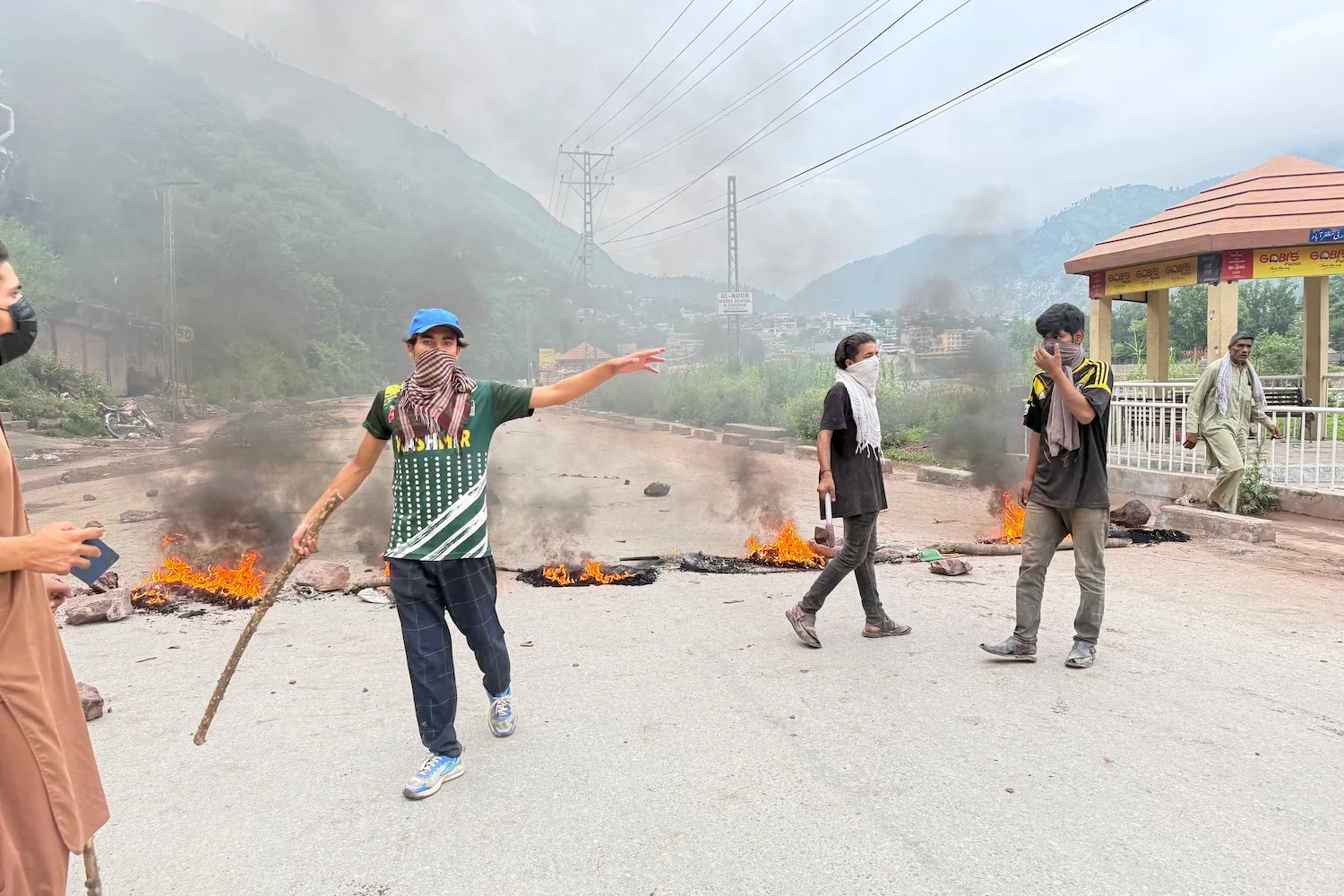
Political unrest has gripped Pakistan-administered Kashmir, known as Azad Jammu and Kashmir, for two months. The situation came to a head in recent days, turning deadly as protesters and security forces clashed. The escalation coincided with local elections, which run from July 27 to Aug. 10 in a three-phase process.
Making sense of the simmering crisis has been difficult until now. Local authorities cut the internet in Pakistan-administered Kashmir in June, leading to information shortages that have been exploited by those eager to fill the gap. In an apparent attempt to exaggerate the crisis, government critics posted fake videos depicting massacres on the streets of Kashmir.
Pakistani media outlets, facing threats for covering the unrest, have mostly limited their reporting to the elections. However, this week, international correspondents entered the region and provided a clearer picture of what is happening on the ground. The news isn’t good—and it amplifies how public anger with the government is rising across Pakistan.
At the center of the crisis is the Joint Awami Action Committee (JAAC), a group formed in 2023 that initially focused its demands on high food and energy prices. The group has expanded its scope, and this year, it began calling for the removal of a constitutional clause that stipulates that 12 seats in Pakistan-administered Kashmir’s legislature be given to refugees from India-administered Kashmir.
The JAAC argues that since these refugees don’t live in Azad Jammu and Kashmir, Pakistani politicians are exploiting the seats for their own ends. After the JAAC’s demand was rejected by both the region’s government and supreme court, the situation grew more tense.
In early June, the JAAC announced a long march to the capital of Muzaffarabad, but local authorities arrested some of its leaders and banned the group. JAAC members then clashed with security forces, and the group called a general strike. The shuttering of businesses, combined with the internet shutdown, brought much of the region to a standstill.
Protests continued throughout June, and they broke out again last week during elections. Death toll estimates vary, but reports suggest at least 40 people have been killed since June. This week, the BBC spoke to families who said their loved ones were shot dead while protesting. The authorities insist that the JAAC is a terrorist group, and that force was only used against violent protesters.
Kashmir is the latest ground zero for protests against poor governance in Pakistan. In the last few years, people have railed against state repression in the provinces of Balochistan and Khyber Pakhtunkhwa. Protesters in many parts of the country have decried the imprisonment of former Prime Minister Imran Khan and condemned what they see as a rigged election in 2024.
Now, in Pakistan-administered Kashmir, the JAAC and other protesters have vowed to push on, asserting their fight is about broader demands such as better health care and cheaper electricity, not just constitutional reform.
If these disparate movements managed to come together, then Pakistan might be the next South Asian country to experience a broad protest movement for change. But that’s unlikely given its social divisions and a repressive political environment that limits the capacity for mass mobilizations.
Still, Pakistan’s national leadership has a strong incentive to quickly resolve the crisis in Kashmir. It wants the world to focus on Islamabad’s mediation efforts in the Iran war, not its heavy-handed tactics in Kashmir. Because of Pakistan’s dispute with India over its status, Kashmir is also a critical and sensitive asset for Pakistan. (Its leaders often call it the country’s “jugular vein.”)
Ending the crisis peacefully will require dialogue—but with emotions running so high, that may be a hard sell for now.
What We’re Following
Hasina reiterates plan to return. On Wednesday, exactly two years after fleeing the country amid mass protests against her rule, former Bangladeshi Prime Minister Sheikh Hasina spoke virtually via audio feed at an event hosted by the Foreign Correspondents’ Club of South Asia in New Delhi. She reiterated her pledge to return to Bangladesh in December and turn herself in to legal authorities.
Last November, Hasina—who has remained in India since 2024—was sentenced to death in absentia for crimes against humanity, charges linked to brutal crackdowns against protesters by her security forces. According to the United Nations, as many as 1,400 people may have died during the protests.
One thing that stands out is how India distanced itself from the Wednesday event. India has close ties to Hasina, but her residency there has strained bilateral ties with Bangladesh. New Delhi is keen to get the relationship back on track with the government that recently took office in Dhaka, which is led by the Bangladesh Nationalist Party—a bitter rival of Hasina’s Awami League.
As a result, India had a strong interest in signaling that it was not endorsing Hasina’s event or trying to provide her with a platform. Nonetheless, Bangladesh won’t be pleased that she was given the microphone and that her remarks were broadcasted live on YouTube.
Pakistani minister says system is broken. Last week marked a rare public admission from a senior Pakistani official about the shortcomings that have sparked protests in Kashmir and beyond. Speaking at an economic summit in Islamabad, Interior Minister Mohsin Naqvi said the governance system has “collapsed” and lacks capacity to address the country’s problems.
Naqvi called for Pakistan’s political parties to unite around a governance reform agenda. The comments are significant for their candor but also because of who made them. Naqvi is close to army chief Asim Munir, Pakistan’s most powerful figure—suggesting that Naqvi was articulating a view that Munir at least endorses.
It’s unclear what specific reforms Naqvi is calling for, but Pakistani analysts familiar with the government’s thinking believe that one likely target is the devolution of power and resources from provincial governments to local authorities.
A constitutional amendment passed in 2010 was hailed for extending more autonomy to the provinces, seen as a democratic move that shifted control away from the central government and thus the military. But the amendment has also been faulted for not devolving authority further to the local level, where key decisions on matters of governance are implemented.
India and Pakistan exempted from new U.S. visa bond. India and Pakistan got a break this week from the Trump administration. They will not be among the countries whose citizens may be asked to make refundable deposits of up to $20,000 in order to receive B-1 (business) and B-2 (tourist) visas—a policy that went into effect on Aug. 1 and is intended to reduce overstays.
It’s unclear why the United States exempted India and Pakistan but included Bangladesh and Nepal among the 50 affected countries. It’s not a matter of doing a favor for countries on good terms with U.S. President Donald Trump: Bangladesh and Pakistan have each logged bilateral achievements with the United States in recent months, while U.S.-India ties have sputtered.
Bangladeshis and Nepalis are dealing with significant economic stress in their countries; the idea of posting a five-figure bond to visit the United States won’t be palatable for many of them.
Under the Radar
Nearly five years since taking power in Afghanistan, one constant for the Taliban is that it has faced no organized armed resistance. There are those who would like to see the group gone, from common Afghans who reject its repressive rule to the Islamic State-Khorasan, which periodically attacks the Taliban.
But the Taliban has easily been able to maintain its hold on power in Kabul—making last weekend’s announcement by Sami Sadat, a former top Afghan military official, that his Afghanistan United Front (AUF) has taken up arms against the regime significant.
Until this point, the AUF has operated as a political opposition group. On Monday, a post on its official X account said that the group had struck the Taliban’s main police headquarters in Kandahar, Afghanistan. As the Taliban’s birthplace, the city is a symbolically significant place to carry out an initial operation.
Sadat, who has been based in northern Virginia, has sought support from the West for his movement. But the AUF faces many challenges. The Taliban remain a formidable force; to become stronger, the AUF will need the type of external backing that anti-Taliban factions enjoyed before 2001.
With the world essentially moving on from Afghanistan under Taliban rule—no matter how unsettling—the AUF will be hard-pressed to secure that support. And while Sadat has spoken of the capacity to quickly mobilize tens of thousands of recruits, many Afghans don’t want another war.
FP’s Most Read This Week
Regional Voices
In the Print, education expert Karishma Shangvi argues that India’s Cockroach Janta Party protests provide an opening to change school entrance exams so they measure competence, not rank. “The recent protests over examination failures mean that the government now has a rare political mandate to bring substantial reforms in the entrance examination system,” she writes. “Let’s not waste it.”
In the Kathmandu Post, retired diplomat Lok Raj Baral writes that politicization has undermined Nepal’s foreign policy. Its diplomatic “initiatives have shrunk in recent years,” he writes. “The main reasons are uncalled-for mobilising rhetoric, miscalculation and a lack of objectivity in weighing the pros and cons of any decision taken at the whim of the leaders.”
A Dawn editorial contends that Pakistani security forces need better training to preempt terrorist attacks: “The gaps in training need to be filled so that security forces are able to defend themselves, gain the upper hand over violent elements, and, through better intelligence, break up their networks and thwart their attacks.”
