


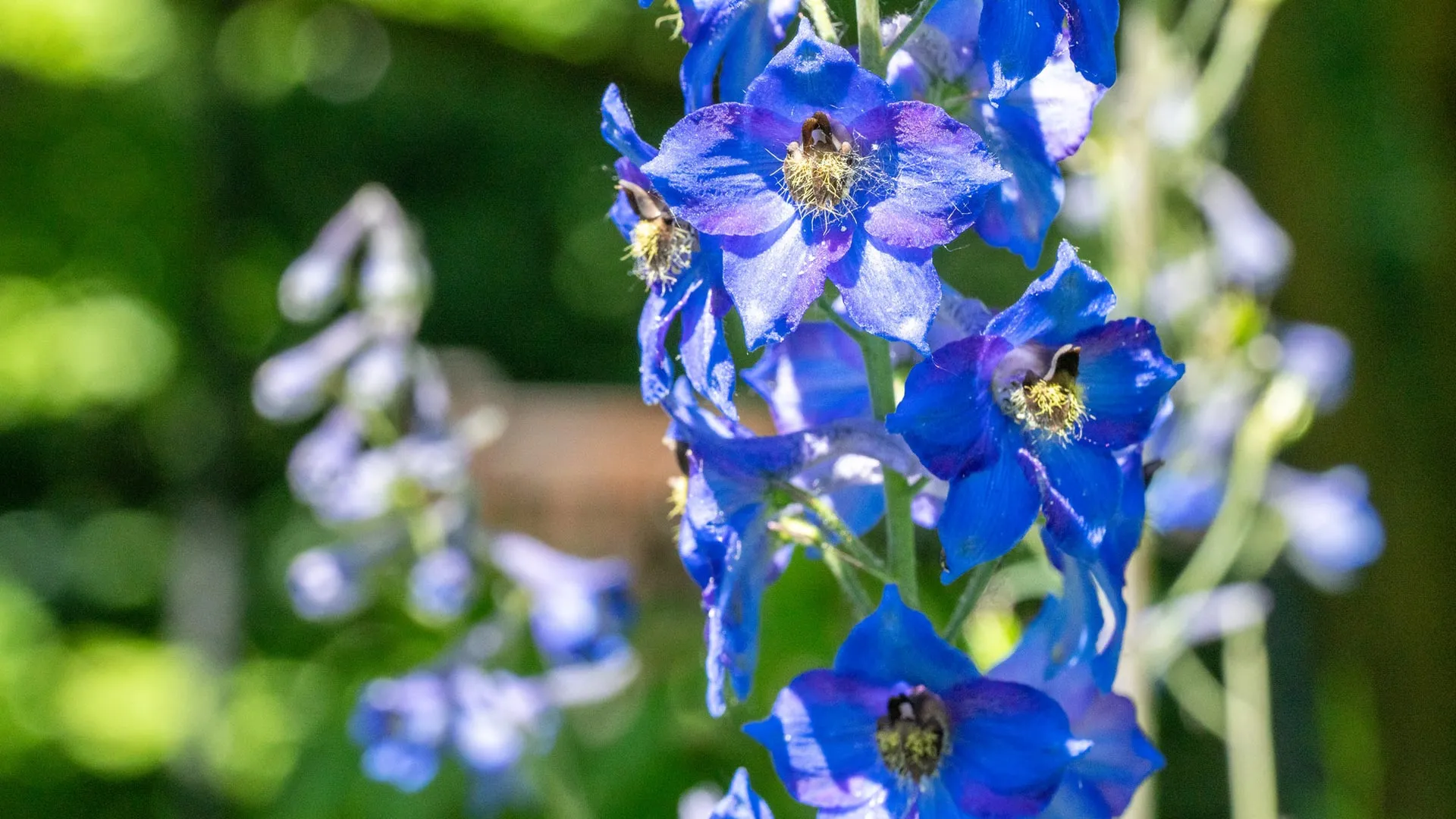
Two plants capable of causing nerve damage and paralysis at extremely low doses may also contain compounds with valuable uses against pain, malaria, cancer, and agricultural pests. Researchers have now identified a way to reproduce part of this potent chemistry in a laboratory setting, creating a possible path toward more sustainable treatments based on natural products.
The work focused on wolfsbane and larkspur and brought together scientists from Michigan State University and the Czech Academy of Sciences. The findings were published in the journal Molecular Plant.
“These plants have been used in different forms of medicine throughout the world for thousands of years,” said MSU alum Garret Miller, co-first author of the paper and now an assistant professor of biotechnology at the University of Michigan-Flint.
“We know they interact with our bodies in so many ways, and understanding how to create them can help provide totally new routes of testing.”
The Powerful Chemistry of Poisonous Plants
Despite major advances in modern science, plants remain unmatched in their ability to produce intricate natural chemicals.
“Plants are the best chemists around, upgrading their arsenal of natural compounds over millions of years to help them survive,” said Björn Hamberger, study author and the James K. Billman Endowed Professor in MSU’s Department of Biochemistry and Molecular Biology.
“Humans have found countless uses for these molecules in everyday life,” added Lana Mutabdžija, a graduate student at the Czech Academy of Sciences and co-first author of the latest paper.
“These include caffeine, capsaicin, menthol and vanillin, not to mention the fact that many of the medicines we use today either come directly from plants or are inspired by plant chemistry.”
The Hamberger Lab at MSU studies these natural substances, known as specialized metabolites, and explores how they might be put to practical use.
In recent years, the group turned its attention to larkspur, which is also called delphinium because of its dolphin-shaped flowers. The researchers wanted to determine how the plant produces diterpenoid alkaloids, a group of chemicals that are highly toxic but may also have useful medical properties.
A Long-Standing Chemical Puzzle
Unraveling this process presented a major challenge.
Diterpenoid alkaloids combine features from two of the planet’s oldest and largest groups of plant chemicals. Their structures are so complicated that scientists have struggled for decades to understand exactly how plants construct them.
Aconitine, one of the most familiar compounds in this family, was isolated nearly 200 years ago. Even so, researchers have still not successfully synthesized it in a laboratory.
The project gained momentum through an unexpected partnership.
At a scientific conference in Barcelona, Hamberger met researchers from Tomáš Pluskal’s laboratory at the Czech Academy of Sciences. The Pluskal Group, including Mutabdžija, was studying the same difficult family of diterpenoid alkaloids in wolfsbane, a famously poisonous relative of larkspur that is also known as monkshood.
“When this happens, we can either go our own ways, or come together, and it’s joining up that always leads to the best science,” said Hamberger.
Tracing the Plants’ Chemical Assembly Line
After joining forces, the international team set out to identify the precise sequence of biochemical steps used by wolfsbane and larkspur to make diterpenoid alkaloids.
The search resembled a molecular scavenger hunt. Researchers examined several species of both plants and tracked thousands of genes, looking for those that became “switched on” in the right tissues at the right moment.
“You can imagine a biosynthetic pathway almost as an assembly line,” said Miller, who earned his Ph.D. in the Hamberger Lab. “If you have ten steps in a row needed to build a finished product, and suddenly one quits, the next steps can’t happen.”
Plants generally make specialized metabolites in very small quantities and at a slow pace. Identifying the biochemical pathways behind them is therefore essential for producing these compounds on a larger scale and applying them to real-world problems.
Once researchers solve a pathway, they can transfer the genetic instructions for building a compound into an engineered host, such as yeast.
This form of biohacking can turn the host into a biological production system, allowing it to manufacture larger amounts of the desired chemical for further study and development.
“In an ideal scenario, this could eventually help create new drugs inspired by these natural products,” said Mutabdžija.
Tobacco Plants Become Living Biofactories
After identifying a promising collection of genes from wolfsbane and larkspur, the researchers transferred those genetic instructions into tobacco plants. The tobacco served as a convenient living factory for testing whether the genes could reproduce the plants’ chemical process.
Analysis showed that the modified tobacco plants had assembled the pathway the team was seeking. Six distinct enzymes worked together to produce atisinium, a diterpenoid alkaloid.
The enzymes helped shape the molecule into its complicated final structure. They also enabled the addition of an essential source of nitrogen that the researchers had not expected.
By identifying the first biochemical steps required to make atisinium, the team has gained an important starting point for studying the broader diterpenoid alkaloid family and its potentially useful medicinal properties.
“Our vision is to provide green, sustainable tools that will allow us to harness these plants’ natural power,” Hamberger said.
