


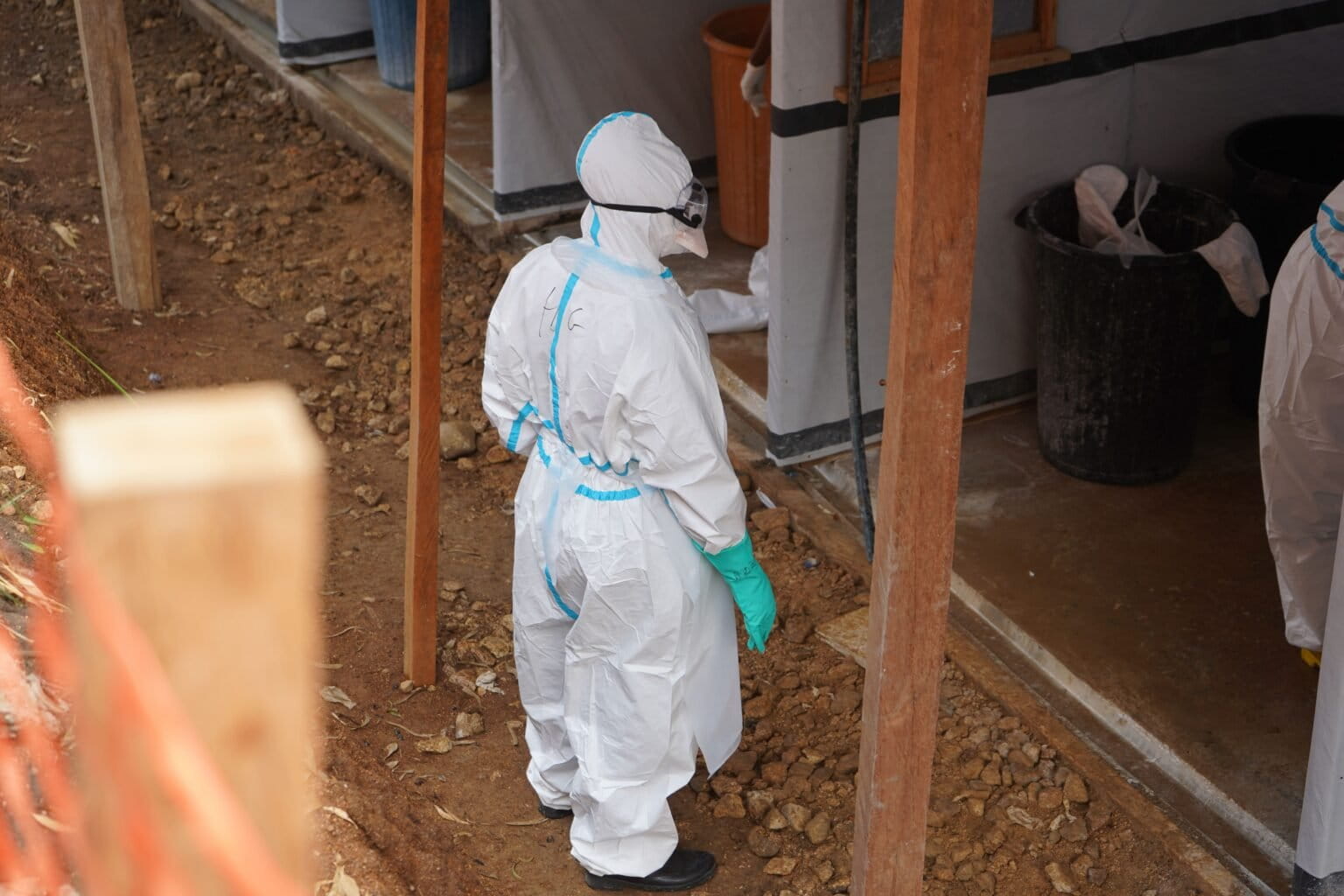
- Community leaders and local radio stations are fighting widespread misinformation, while resistance to safe burials has fueled attacks on Ebola treatment facilities.
- The current Ebola outbreak has become the fastest-growing outbreak recorded in the Democratic Republic of Congo, with more than 3,360 reported cases and nearly 1,487 deaths in about two and a half months.
- Aid workers say funding cuts have weakened disease surveillance, community outreach and logistics at a time when the response is already constrained by armed conflict.
- According to WHO, in Uganda, the last confirmed patient was discharged from care on July 16, and the 42-day with no new Ebola cases countdown necessary to declare the end of that country’s outbreak has started.
Several members of the Ebola response gathered on July 15, 2026, outside the Ebola Treatment Center (ETC) in Bunia, eastern Democratic Republic of Congo (DRC), to protest their working conditions. Demonstrators said they had not received their risk allowances for several weeks, payments that are supposed to be made by the Congolese government.
“It’s outrageous for such a high-risk job,” Robert Uyergiu Mambo, a community leader and French teacher in Bunia, Ituri province, told Mongabay by phone. Although he is not officially part of the Ebola response, his position within the Alur community, an ethnic group living in northwestern Uganda and northeastern DRC, has made him an important local ally. Uyergiu Mambo, a volunteer host on the community radio station Radio Terra FM, which states it has an audience of five million listeners, said he was frustrated with the situation, but not surprised.
“It’s common for government employees to go unpaid for long periods. Recently, the minister [Samuel Roger Kamba, minister of Public Health, Hygiene and Social Welfare] came here and managed to calm tensions, but there has been a lot of frustration among Ebola response workers lately and protests have continued one after another,” he said. “If nothing changes, the protests will continue. The problem is that it is paralyzing the response.”
It is not unusual for Congolese civil servants to work for months without receiving their salaries, a situation that has long fueled corruption across the country. It was a part of life even under Mobutu Sese Seko, the president of the DRC (then called Zaire) from 1965 to 1997.
However, it is now hobbling the country’s response to a major public health emergency.
In May 2026, the DRC declared its 17th Ebola outbreak in Ituri province, which borders Uganda. Although this strain of the virus is not the deadliest in terms of mortality rates, the reality on the ground tells a different story. According to WHO, it is the fastest-spreading Ebola outbreak ever recorded.
“By comparison, the 2018-2019 Ebola outbreak in DRC took more than 10 months to reach 2,000 confirmed cases,” WHO Director-General Dr. Tedros Adhanom Ghebreyesus said during a press briefing on July 16. “It’s now the third largest Ebola outbreak on record. And in the past months, it has expanded faster than any previous outbreak.”
Per the latest figures compiled by the U.S. Centers for Disease Control and Prevention, there were 3,360 confirmed cases and 1,487 deaths as of July 27.
“This isn’t the first time we’ve had Ebola here in Ituri. The last outbreak was in 2019, I think. Back then, there were a lot of resources, a lot of personnel and many treatment tents. International NGOs were highly involved,” Uyergiu Mambo said. “This time, the response’s capacity is weaker so as soon as the government fails to pay people, it becomes obvious. I volunteer to support the response, but not everyone can afford to do that.”
The diminished financial aid from the global community is not helping either.
Since U.S. President Donald Trump returned to office in 2025, his administration has reduced financial support for several international organizations, including the WHO. That decision quickly had tangible consequences. Several humanitarian organizations say the loss of U.S. funding has reduced surveillance teams, community outreach and logistical capacity.
The Africa Centres for Disease Control and Prevention Director-General Jean Kaseya said in late June that $1.4 billion was needed to comprehensively tackle the outbreak. At that time, only 13% of the pledged funding had been released. “If we don’t have this $1.4 billion and if we don’t resolve the humanitarian issue, we will not stop this outbreak,” he said during a virtual press conference.
‘When it rains, traveling becomes impossible’
The impact of these funding cuts is being felt on the ground, Jacques Pithua, deputy coordinator of civil society “Forces vives des djukoth” in Djukoth, Mahagi territory in Ituri province, told Mongabay. “It’s difficult to organize meetings with civil society organizations because people are scattered across the territory. To bring them together, we have to cover transportation costs and provide food, and those are funds that are becoming increasingly difficult to find,” he said.
As part of the Ebola response, Pithua meets with local civil society representatives to train them on the procedures needed to prevent infections. He also helps health workers register alerts about suspected Ebola cases and collect samples that are later sent to Bunia for laboratory analysis.
Traveling across the province, however, is often extremely difficult. “Sometimes we have to travel 40 kilometers between one community and another, but our roads are in such poor condition that Land Cruisers [the four-wheel-drive vehicles widely used in the region] can’t always get through,” he said. “We have to use motorcycles, and even then, covering 40 kilometers can easily take two or three hours. And that’s only when it isn’t raining. When it rains, traveling becomes impossible.”

Armed conflict, mining and misinformation
Beyond transportation challenges, Ituri is also plagued by armed conflict, which has forced more than 900,000 people to flee their homes, limiting access to affected communities and further weakening the health system. “Recently more than 100,000 additional people have been displaced on top of close to 1 million that have been displaced in the past and that makes the response difficult,” Ghebreyesus said, adding that being a mining hotspot with significant movement of people has also made it harder to control the spread of the disease.
Uyergiu Mambo in Bunia is also especially concerned by the behavior of some residents. “Since the outbreak was declared, there has been a massive influx of people, especially from Mongwalu [53 miles from Bunia, the capital of Ituri province]. Young miners returned to their villages without reporting to the health authorities. When they develop symptoms, they feel ashamed and hide inside their families. By the time they finally reach a treatment center, it’s usually too late. That represents a major risk for all of us,” he said. “On the radio, I encourage them to come forward. Whenever a new treatment center opens, I inform people so they know where to go.”
He believes there is a need for stronger measures to restrict movement within and beyond the province. “There has been a certain lack of seriousness. Despite the outbreak, schools remained open, churches continued to be packed with worshippers, and the government didn’t really take concrete action beyond awareness campaigns. That’s not enough,” he said. “In Uganda, they restricted movement, and today the outbreak has almost disappeared. We should do the same because the virus travels with people.”
According to WHO, in Uganda, the last confirmed patient was discharged from care on July 16, and the 42-day with no new Ebola cases countdown necessary to declare the end of that country’s outbreak has started. On July 28, the Ugandan health minister declared the country Ebola-free.
However, in the DRC, the WHO says that 80% of new cases are being detected outside known contact lists, meaning that transmission is still happening undetected.
In this context, reaching communities requires alternative approaches. That is exactly what Uyergiu Mambo is trying to do. Through his radio programs, he broadcasts Ebola prevention messages provided by response teams, explaining how the virus is transmitted, its first symptoms and what people should do if they suspect infection. “There is a huge amount of misinformation. Many people simply don’t believe the disease exists, so I do everything I can to help. Even the origins of the disease were misunderstood. For a long time, people believed it was something mystical,” he said.
According to him, the virus outbreak began in March, much before the official declaration, when someone brought back the body of a deceased relative in a damaged coffin. Because the coffin was in poor condition, the family bought another one for the funeral and burned the first. A few days later, several people started showing signs of the deadly illness.
“People believed it was a curse, that funeral rites had not been properly respected according to our traditions and that the spirit of the deceased was punishing the community. Nobody believed it was Ebola. By the time the authorities declared the outbreak, the idea that it was a curse had already become deeply rooted,” he said. “Others believed it was simply a business scheme, a disease invented to embezzle money.”

Coping in the time of Ebola
This misinformation has also fueled tensions between Ebola response organizations and local communities. One major point of contention has been the management of the bodies of Ebola victims. Because Ebola spreads through bodily fluids, health authorities recommend avoiding any physical contact with the deceased. Yet, in this part of Congo, tradition dictates that family members wash the body before holding a funeral vigil, gatherings that often attract large crowds. These cultural misunderstandings have repeatedly led to violence, with treatment center tents being set on fire on several occasions.
“To prevent this kind of situation from happening, we invite young people and local authorities to observe how a ‘safe and dignified burial’ is conducted. We hope they will understand the process and explain it to the rest of the community so that the response can continue its work,” Pithua said.
But, even for those who recognized the severity of the health crisis from the start, it has taken a toll. Once the outbreak was officially declared, those who believed the warnings were overcome with fear, Uyergiu Mambo recalled.
“Oh, it was stressful. When you see your neighbors dying, along with doctors and nurses, it’s frightening. Even my daughter. She’s 7 years old. She doesn’t understand everything, but she knows something is happening. She struggles to sleep, and she’s not the only one,” the father of two said.
For him, broadcasting public awareness messages on the radio has become almost therapeutic, a way of taking action rather than feeling powerless.
Banner image: A worker disinfects himself at the Evangelical Medical Center in Bunia, DRC. Image by Prosper Heri Ngorora.
Confinement and disinfected bedding: An ape sanctuary in DRC responds to Ebola
Ebola outbreak draws attention to longstanding virus spillover risks in western Uganda
FEEDBACK: Use this form to send a message to the author of this post. If you want to post a public comment, you can do that at the bottom of the page.
