


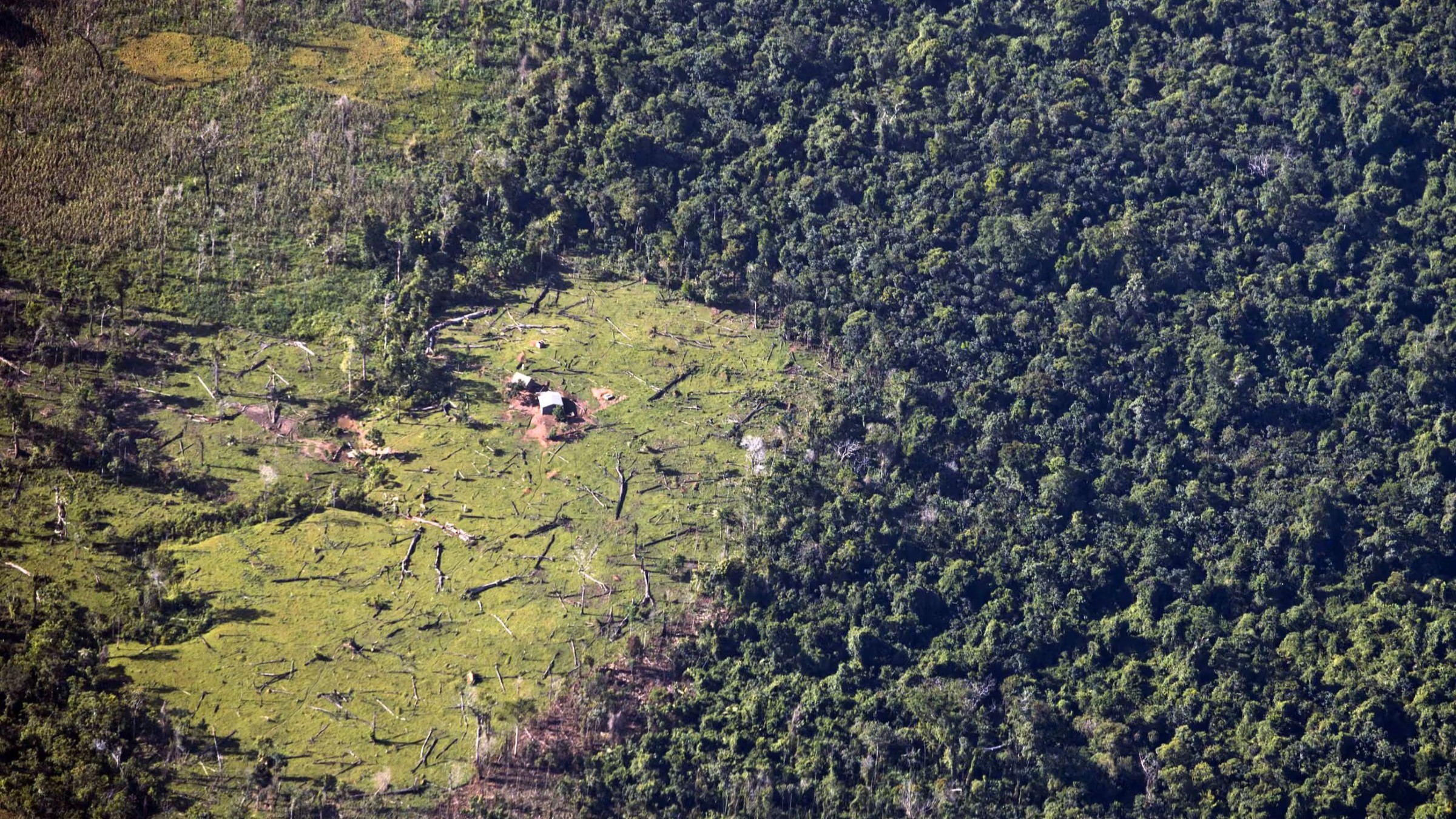
- Mining concessions have begun to encroach on protected areas and Indigenous and Afro-descendant territory, the result of a mining boom that began in 2022, according to a new investigation from community-based Indigenous group Wangki.
- Since 1994, Nicaragua has granted 213 mining concessions covering more than 2.4 million hectares (5.9 million acres), representing approximately 20% of the country’s total land area. A significant portion of that — 113 of the concessions — has only been granted in the last three years.
- The Nicaraguan government has signed trade agreements, passed new laws, and revised environmental regulations to help accelerate the expansion of the mining sector, especially by Chinese companies.
- Pollution and deforestation from mining threaten ancestral traditions, and make it harder to practice subsistence farming and find clean drinking water, the investigation said.
In Nicaragua, the mining sector has steadily grown over the last two decades, with gold becoming a top export and a pillar of the national economy. For most of that time, the growth was gradual. But in more recent years, there’s been an unprecedented boom, with the creation of dozens of mining concessions and a rush of new legislation to attract foreign companies.
The boom coincides with Nicaragua’s increasing economic and political isolation. President Daniel Ortega has cracked down on dissent and cancelled elections, prompting countries like the U.S. and Canada to issue sanctions against numerous officials and institutions, making it difficult for them to trade and carry out other international business. With the price of gold on the rise, the government has turned to mining for economic stability.
That decision has been disastrous for the environment and Indigenous communities, critics say. Mining concessions have started encroaching on protected areas and ancestral territory, threatening pollution, deforestation, and the displacement of residents, among other issues.
“From 2022 and on, there’s been an incredible boom in the number of concessions granted,” said Carmen Corea-Sánchez, lead author of a new report from community-based Indigenous group Wangki and other researchers.
A golden age of mining
Ortega held office in the late 1980s and took power again in 2007, ushering in a massive investment in the mining sector, largely propelled by Chinese interest in the country and Latin America more broadly. In 2006, the year before he returned to office, Nicaragua exported 109,200 ounces of gold, worth more than $55 million at the time, according to the country’s central bank. By comparison, last year’s numbers are significantly higher: it exported 473,700 ounces, worth $1.9 billion.
Since 1994, Nicaragua has granted 213 mining concessions covering more than 2.4 million hectares (5.9 million acres), representing approximately 20% of the country’s total land area, the Wangki investigation found. A significant portion of that — 113 of the concessions — has only been granted since 2022. At least 53 of them were granted as recently as 2025.
Growth has happened so fast that the Ministry of Energy and Mines surpassed its own estimates, creating uncertainty about where future concessions will be granted, the Wangki investigation found. As of 2024, the ministry has reserved nearly 640,000 hectares (1.6 million acres) for future mining concessions. But it’s already granted more than that, around 685,000 hectares (1.7 million acres) — a surplus of more than 40,000 hectares (100,000 acres).
“We don’t know where the other concessions that are granted from now on will be located, whether they will be in cities or somewhere else,” an attorney and resident of the Wangki Li Aubra Indigenous territory told Mongabay on the condition of anonymity, citing risks to his safety. “There’s concern among [Indigenous] communities because they don’t know whether concessions exist in their territories.”
The Ministry of Mines and Energy didn’t respond to Mongabay’s request for comment for this story.
At least 84 of the 213 concessions are controlled by Chinese companies, totaling over 1.2 million hectares (3 million acres). Canadian companies account for at least 54 concessions, 45 of them held by the company Equinox Gold, covering 635,370 hectares (1.6 million acres). Other concessions are held by Colombian, Nicaraguan and U.K. companies.
Despite its economic sanctions against several mining companies and government institutions, the U.S. continues to be the top destination for Nicaraguan gold, according to the central bank. However, the data don’t specify where it’s shipped, who the buyers are, or if there were any intermediaries.
In recent years, Canada has also emerged as a major buyer. Other destinations include Switzerland, Austria, Italy, the United Arab Emirates, and Mexico, the investigation found.
“There’s nothing that guarantees a Chinese company, through another company that isn’t sanctioned, won’t sell to the U.S. or any other market,” Corea-Sánchez said. “That’s ultimately the problem, the difficult of traceability and tracking of gold.”
New laws, weaker protections
Since 2023, the Nicaraguan government has signed trade agreements, passed new laws, and revised environmental regulations to help accelerate the expansion of the mining sector, especially by Chinese companies. In 2025, the National Assembly passed a law granting long-term tax breaks for mining companies, streamlined environmental permitting, and concessions on state-owned land.
That same year, it also revised a law on environmental conservation and sustainable development areas that ties natural resource management to “the generation of goods and services.” It also recognizes the ability to obtain permits for mineral extraction within protected areas.
None of the 37 mining concessions granted in the three years leading up to the revision of the law were located within protected areas, the Wangki investigation found. Fourteen of them were located “critically close” to protected areas, but they never technically overlapped with the boundaries of an established protected area.
But since the law passed, 10 concession blocks covering 137,594 hectares (340,002 acres) inside protected areas have been granted for mining, the investigation found.
“This weakens the protective function of protected areas, broadens the authorities’ scope for interpretation, and creates a serious challenge for environmental governance, since activities that were previously legally incompatible with conservation may now be presented as compatible with ‘sustainable development,’” the Wangki investigation said of changes to the law.
In the Bosawás Biosphere Reserve, in northern Nicaragua, 5,746 hectares (14,199 acres) have been granted under the La Diabla-Cerro Kum concession block, the investigation found. In the south, the Indio Maíz Biological Reserve has seen more than 56,000 hectares (138,400 acres) concessioned.
Some protected areas, including Salto Río Yasica Natural Reserve and Yúcul Natural Reserve, are completely overlapped by mining concessions. Other protected areas like Cerro Cola Blanca Natural Reserve and Cerro Guabule Natural Reserve have more than half of their land overlapping with concessions.

On titled Indigenous and Afro-descendant territory in Nicaragua’s two Caribbean regions, approximately 541,000 hectares (1.3 million acres) overlap with mining concessions. The Wangki report argued the concessions increase private sector and state control, weakening communities’ ability to manage their own territories.
Pollution and deforestation from mining threaten ancestral traditions, and make it harder to practice subsistence farming and find clean drinking water, the report said. Some families have had to relocate.
“Indigenous people live in precarious conditions because even their land has been taken away and their areas are contaminated, including the fish and everything else,” Yakal Siksa, a member of the Indigenous Yulu community, told Mongabay. “They’re become completely vulnerable.”
Communities have a right to free, prior and informed consent, or FPIC, a process in which they learn about mining projects that could affect them, and, in some cases, have the authority to reject the ones that would negatively impact their quality of life. That process is rarely adequately carried out, the report found.
Out of 213 mining concessions, 32 have no record of community consultation at all, according to the investigation. More than 120 of them consulted local government bodies, which is not the same as informing the community itself and receiving its consent, the report argued.
“For concessions and establishing operations in a specific area belonging to Indigenous peoples, there has to be consent and consultation,” Siksa said. “And that doesn’t happen in our country. It doesn’t work that way.”
Banner image: Forest loss in Murubila, Nicaragua. (AP Photo/Esteban Felix, File)
See related from this reporter:
Human rights abuse allegations continue to rise in the mining sector, report finds
FEEDBACK: Use this form to send a message to the author of this post. If you want to post a public comment, you can do that at the bottom of the page.
Cite this article
Maxwell Radwin (2026). Nicaragua’s gold boom is now encroaching on protected areas and Indigenous land. Mongabay Conservation news. DOI: https://doi.org/10.66709/news-325077

