

Close Menu
NCIJ Network NCIJ Network
    What's Hot

    New York AG Seeks $36B From Kalshi Over ‘Illegal Gambling’

    July 31, 2026

    Destructive Fires Char Western Europe

    July 31, 2026

    MOL Group buys Shell’s subsidiary in Cyprus for $720 million

    July 31, 2026
    Facebook X (Twitter) Instagram
    Trending
    • New York AG Seeks $36B From Kalshi Over ‘Illegal Gambling’
    • Destructive Fires Char Western Europe
    • MOL Group buys Shell’s subsidiary in Cyprus for $720 million
    • Will Burnham fix our barbaric prisons – or cave to rightwing populism? The answer is a tragedy | Simon Jenkins
    • Video doesn’t show Black kids protecting Latino neighbors from ICE officer. Here’s evidence
    • Italy World Cup winner and AC Milan legend Franco Baresi dies aged 66 | Football News
    • How the Pro-Trump Media Ecosystem Is Splintering Ahead of the Midterms
    • Plug-In Solar Panels Are Starting to Sprout in U.S. Backyards
    • About
      • Our Team
      • Editorial Policy
      • Editorial Independence
      • International Support
    • Trust & Standards
      • AI Usage Policy
      • Conflict of Interest Policy
      • Corrections Policy
      • Ethics Policy
      • Fact-Checking Policy
      • Source Protection
    • Get Involved
      • Guide for Sources
      • Support Independent Journalism
    • Legal
      • Cookie Policy
      • Privacy Policy
      • Terms of Use
    Facebook X (Twitter) Instagram
    NCIJ Network NCIJ Network
    Friday, July 31
    • Home
    • World
    • Ai
    • Business
    • Politics
    • Health
    • Crypto
    • Science
    • Technology
    • Cybersecurity
    • Defense & Security
    • Economy
    • Energy
    • Europe
    • More
      • Fact Check
      • Investigations
      • Opinion & Analysis
      • Environment
    NCIJ Network NCIJ Network
    Home»Cybersecurity

    Google says AI helped Chrome fix 1,072 security bugs in two releases

    NCIJ NETWNCIJ NETWORKBy NCIJ NETWNCIJ NETWORKJuly 31, 2026 Cybersecurity No Comments4 Mins Read
    Share
    Facebook Twitter LinkedIn Pinterest Email

    Google says artificial intelligence is dramatically increasing the number of security vulnerabilities it can find and fix in Chrome, with more than 1,000 security bugs patched across the browser’s two most recent releases as it expands its use of AI.

    According to Google, Chrome 149 and Chrome 150 fixed 1,072 security bugs, surpassing the total number fixed across the previous 23 Chrome milestones combined.

    The company says it now uses large language models throughout the vulnerability management process, including discovering flaws, reproducing reports, determining severity, assigning bugs to developers, generating candidate patches, and creating tests.

    image

    Google began using LLMs to improve security fuzzing in 2023 before working with Project Zero on Naptime, a system that provided AI models with specialized vulnerability research tools.

    The company later collaborated with Google DeepMind and Project Zero on Big Sleep, an AI-powered vulnerability discovery agent that found flaws in Chrome’s V8 JavaScript engine and graphics components.

    In early 2026, Google created a Gemini-powered agent harness to search the broader Chrome codebase for vulnerabilities while reducing false positives.
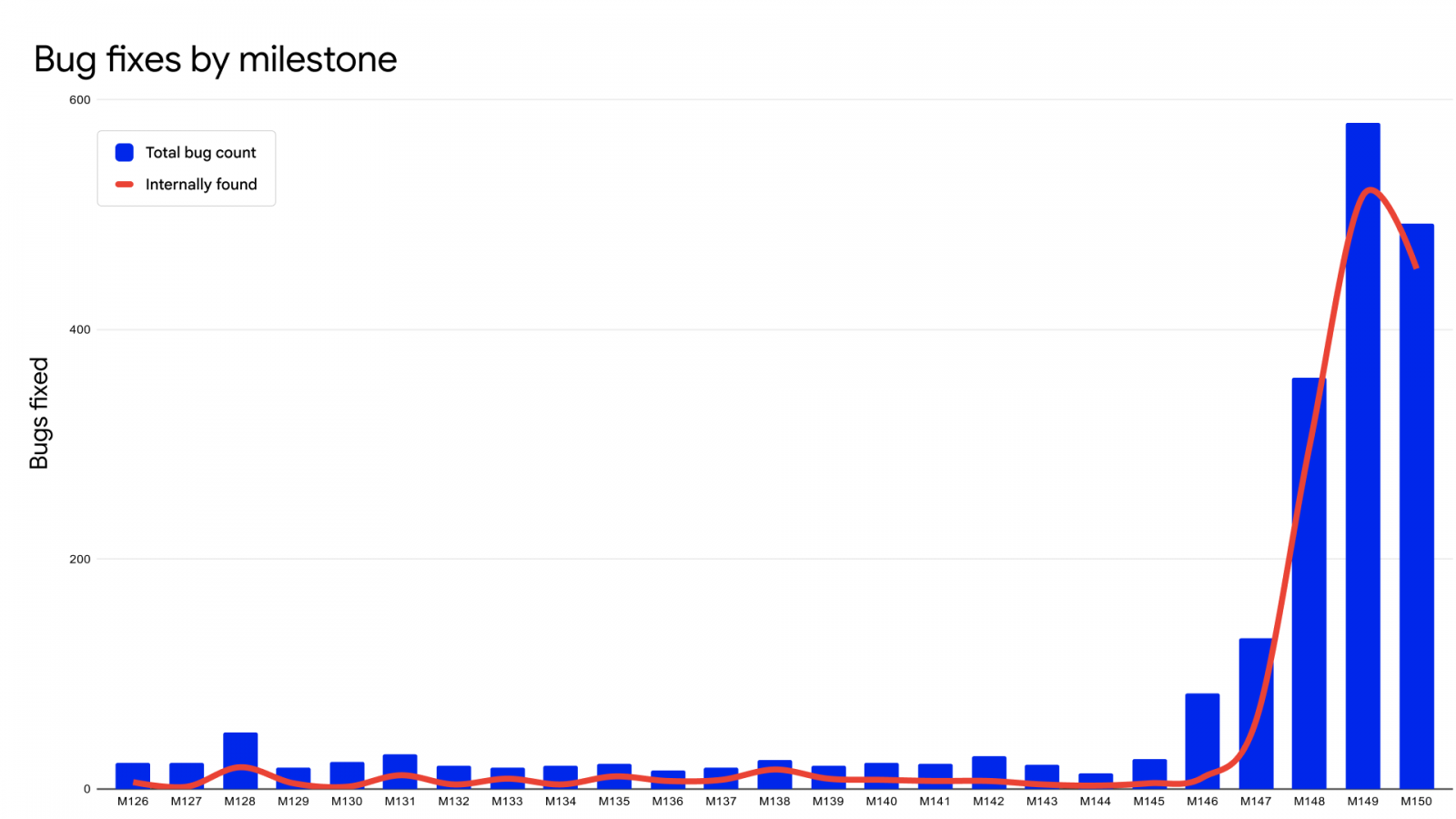
    Number of security bugs fixed in recent Chrome Stable release milestones
    Number of security bugs fixed in recent Chrome Stable release milestones
    Source: Google

    One vulnerability discovered by the system was a Chrome sandbox escape that had remained in the codebase for more than 13 years. If exploited, the flaw would have allowed a compromised renderer to escape the sandbox and trick the browser into reading local files.

    Google is also encouraging its developers to add SECURITY.md files describing trust boundaries and threat models, helping its AI systems better identify operations with security implications.

    The company says its multi-agent AI workflows help rather than replace existing security testing, including fuzzing, which remains effective at discovering complex vulnerabilities.

    Google has also seen a sharp increase in reports submitted through the Chrome Vulnerability Reward Program, and by March 2026, the company had received more security bug reports than during all of 2025.

    This prompted Google to modify its program to prioritize reports that add to what its already finding and processing through its automated tooling.

    The company is also automating vulnerability triage, including filtering spam and duplicates, reproducing proof-of-concept exploits, assigning severity ratings, and routing reports to the appropriate developers.

    Google estimates that this automated process saves hundreds of hours of developer time each month.

    After a vulnerability is confirmed, fixing agents generate multiple potential patches, while another agent evaluates the proposed fixes and produces additional information for developers to review.

    In May, these systems reportedly prevented more than 20 vulnerabilities from reaching production, including one issue classified as critical.

    However, Google says finding and fixing vulnerabilities more quickly also requires accelerating how patches are delivered to users.

    Once a security fix is committed to Chrome’s public source code, attackers can inspect the change and attempt to reverse-engineer the vulnerability before the update reaches users.

    Google is also transitioning Chrome to a two-week major release cycle with weekly security updates and is piloting two security releases per week to reduce this patch gap.

    To reduce disruptions, the company is developing “dynamic patching,” which would allow Chrome to apply updates without restarting the browser.

    Starting with Chrome 150 on macOS, the browser can automatically restart to apply a pending update when it is running in the background without any open windows.

    Google says its long-term goal is to keep Chrome continuously updated through dynamic patching, automatic restarts during periods of inactivity, and improved session restoration.


    article image

    Security teams log 54% of successful attacks and alert on just 14%. The rest move through your environment unseen.

    The Picus whitepaper shows how breach and attack simulation tests your SIEM and EDR rules so threats stop slipping by detection.

    Get the whitepaper

    Bugs Chrome fix Google helped Releases Security
    NCIJ NETWNCIJ NETWORK
    • Website

    Keep Reading

    Will Burnham fix our barbaric prisons – or cave to rightwing populism? The answer is a tragedy | Simon Jenkins

    Anthropic says its own AI models breached three companies during security tests

    Prompted by OpenAI Disclosure, Anthropic Finds Its Own Models Hacked 3 Organizations

    Critical Flaw Led to Azure Cosmos DB Pwnage

    JetBrains warns of critical TeamCity remote code execution flaw

    PolyAI Releases Dialog-RSN-1: An Audio-Native Dialog Model That Fuses Turn-Taking, Speech Recognition, Function Calling, And Response

    Add A Comment
    Leave A Reply Cancel Reply

    Editors Picks

    New York AG Seeks $36B From Kalshi Over ‘Illegal Gambling’

    July 31, 2026

    Destructive Fires Char Western Europe

    July 31, 2026

    MOL Group buys Shell’s subsidiary in Cyprus for $720 million

    July 31, 2026

    Will Burnham fix our barbaric prisons – or cave to rightwing populism? The answer is a tragedy | Simon Jenkins

    July 31, 2026
    Latest Posts

    Advancing the next era of national science

    July 22, 2026

    Arcee, a US open source AI lab, says Chinese models are not inherently dangerous

    July 22, 2026

    Most bus fares in England to be capped at £2 from January

    July 22, 2026

    Subscribe to News

    Get the latest sports news from NewsSite about world, sports and politics.

    NCIJ Network is an independent digital news platform delivering trusted investigative journalism, European and global news, in-depth analysis, and fact-based reporting with accuracy, transparency, and integrity.

    Facebook X (Twitter) Instagram Pinterest YouTube

    New York AG Seeks $36B From Kalshi Over ‘Illegal Gambling’

    July 31, 2026

    Destructive Fires Char Western Europe

    July 31, 2026

    MOL Group buys Shell’s subsidiary in Cyprus for $720 million

    July 31, 2026

    Subscribe to Updates

    Get the latest creative news from FooBar about art, design and business.

    Type above and press Enter to search. Press Esc to cancel.