


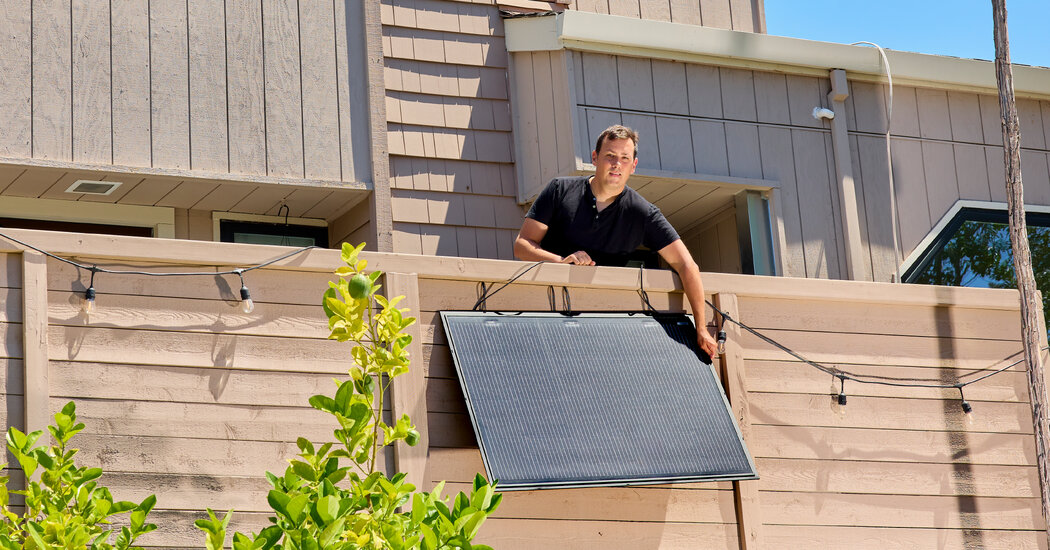
After watching a YouTube video about solar panels that can be plugged into a regular electrical outlet, Melani Jackson plopped four panels in the backyard of her Salt Lake City home.
In the six months since, she has lowered her electricity bill by about $77 in total. While that’s not a large sum, she is happy to have banked those savings, which required little effort on her part.
“I just really appreciated the idea of being able to do something to cut even just a few dollars off my energy bill plus just become a little bit more environmentally friendly,” Ms. Jackson, 35, said.
Millions of Americans worried about rising energy costs might soon follow in her footsteps as states start allowing homeowners and renters to plug in solar panels on balconies, in backyards and other places. Plug-in systems are much smaller and cheaper than rooftop build-outs — some costing just a few hundred dollars a panel. Permits are not required in the states that allow their use, and people can often install them on their own.
Utah became the first state to legalize plug-in solar systems last year. Nine others, including New Jersey, Virginia and Colorado, have joined it, and lawmakers in California, Massachusetts, New York, Pennsylvania and several other states are considering doing so.
Colorado enacted one of the broadest plug-in solar laws this year. The sponsor of the bill, State Representative Lesley Smith, a Democrat, said she had first seen the technology during a trip to Germany, which has pioneered its use. When she discussed plug-in solar systems at a town hall, she said, “everyone started clapping.”
Home solar panels have, of course, been around for many years. But conventional rooftop systems can cost as much as $36,000, and in many American cities and towns it can take months to obtain the required permits. Such systems have also lost financial appeal in recent years because states, at the urging of electric utility companies, have reduced the bill credits that homeowners can earn from the excess electricity their panels send to the grid.
Plug-in systems get around many of the hassles of conventional rooftop solar. But despite the enthusiasm for the technology, no plug-in solar system has yet been certified as safe to use in the United States. States that have passed laws allowing the systems to be sold require them to be certified by organizations like UL Solutions, a company that tests, validates and sets standards for various products.
The result is a gap growing between enthusiasm for plug-in solar and the availability of a product that has been proven safe.
UL Solutions soon expects to certify at least one of the plug-in solar systems for use in the United States, said Kenneth Boyce, the company’s vice president of engineering. He warned that people should avoid uncertified products, because they could cause electrical shocks or damage electrical equipment and start fires.
For now, some Americans are exploiting a murky certification landscape and shopping online for plug-in systems for their homes, condominiums and apartments.
In the San Francisco Bay Area, Alex Ottoboni, who lives in a condominium, bought two panels even though he knew that California had not yet passed a plug-in solar law. Hanging from his balcony, the panels generate enough electricity to save him $5 to $7 a month on a bill that typically runs about $400 but has reached as high as $680 in winter.
“I don’t like having to be reliant on my utility,” said Mr. Ottoboni, 32, who works in software. He added that his electricity service was not reliable and “just getting more expensive every year.”
The average residential electricity rate in the United States in April was up 7 percent from a year earlier, according to the Energy Information Administration. But rates have been steadily rising for several years, and most industry experts expect costs to continue increasing. Utility companies are spending to upgrade their systems to keep up with electricity demand from data centers and to make up for maintenance that was deferred over the past several decades.
Energy experts say power bills this summer could rise as much as 10.5 percent. The National Energy Assistance Directors Association, which represents state governments in securing federal money, warned last month that one in six U.S. households had fallen behind on its electric bills this year.
A handful of companies have begun catering to people like Mr. Ottoboni and Ms. Jackson.
Bright Saver, a California nonprofit group, recently began selling plug-in solar kits at cost, meaning the organization makes no profit on the sales. Its goal is to expand access to solar systems and push other companies to drive down their prices. Its two-panel, 360-watt system is roughly big enough to power a refrigerator and sells for $414.17.
Those systems are too small to pose any safety risks, said Cora Stryker, a co-founder of the organization. Even so, the laws in Maine, New York and Vermont require certification of those systems because of the more stringent policies in those states.
“We know people want these — they want them now,” Ms. Stryker said. “Electricity prices are skyrocketing, and people are really worried about climate change.”
EcoFlow and Craftstrom sell larger systems for $1,300 to $2,600. EcoFlow ships to addresses in Utah and Maryland, which have passed laws allowing plug-in solar, and Craftstrom sells to all 50 states, capitalizing on certification standards. Both companies have said they plan to seek full certification from UL Solutions.
Stephan Scherer, founder and chief executive of Craftstrom, said sales had increased 50 percent in the past year as state lawmakers passed legislation for plug-in solar systems. The company is on track to sell thousands of units a year, he said.
Plug-in solar systems route the direct current generated by one or a few panels to an inverter, which converts it to alternating current. The inverter, in turn, is plugged into a wall socket through which it transmits energy to appliances, lightbulbs or anything else that is using electricity.
Germany first allowed residents to install plug-in solar in October 2024. Some 800,000 people registered their systems in the first three months, and buyers can now pick them up at IKEA in that country. But the American electrical system is different enough from Germany’s that panels sold there cannot be used here.
Utility executives in the United States have expressed concerns that electricity produced by the systems might feed back into the power grid, posing a danger to linemen working on power lines that they believed were not carrying electricity.
Pedro J. Pizarro, president and chief executive of Edison International, the parent company of the utility Southern California Edison, said that he supported the idea of the plug-in solar technology but that his company opposed legislation introduced in the California Legislature to legalize such systems. He said the bill did not go far enough in protecting utility workers.
“It has to be safe, not only for consumers but for our workers,” Mr. Pizarro said. “It shouldn’t receive unfair subsidies. Beyond that, though, we’re all for it.”
But companies that sell plug-in systems argue that safety risks are minimal or nonexistent. Mr. Scherer of Craftstrom said his company’s systems would not shock electrical workers because they shut off automatically within one second of a power disruption or grid outage.
Mr. Boyce of UL Solutions said his company would certify panels only if they did not pose a risk to consumers or utility workers.
Backers of plug-in solar technology say that the safety issues will soon be resolved and that more states ought to legalize it to help people with rising energy costs.
“Politicians all over the country are wringing their hands, wanting to do something about energy affordability,” said Bernadette Del Chiaro, a senior vice president at the Environmental Working Group, a nonprofit organization focused on health and safety. “Here is an immediate answer.”
