


Reading Time: 8 minutes
Click here to read highlights from the story
- Social media videos started popping up earlier this year with users complaining about the cost of living in Green Bay, other cities in Wisconsin and other battleground states.
- The people posting the videos make claims that run the gamut – some factual, some misleading and some totally false.
- Wisconsin Watch and Sunlight Research Desk looked into the trend, but couldn’t determine who – if anyone – was paying the creators to make the videos.
- If the videos were paid for, creators not disclosing that paid relationship could be in violation of federal prohibitions on deceptive advertising, one political advertising expert said.
- Republicans and Democrats are increasingly paying for user-generated content, raising questions about the future of election campaigning in the digital age.
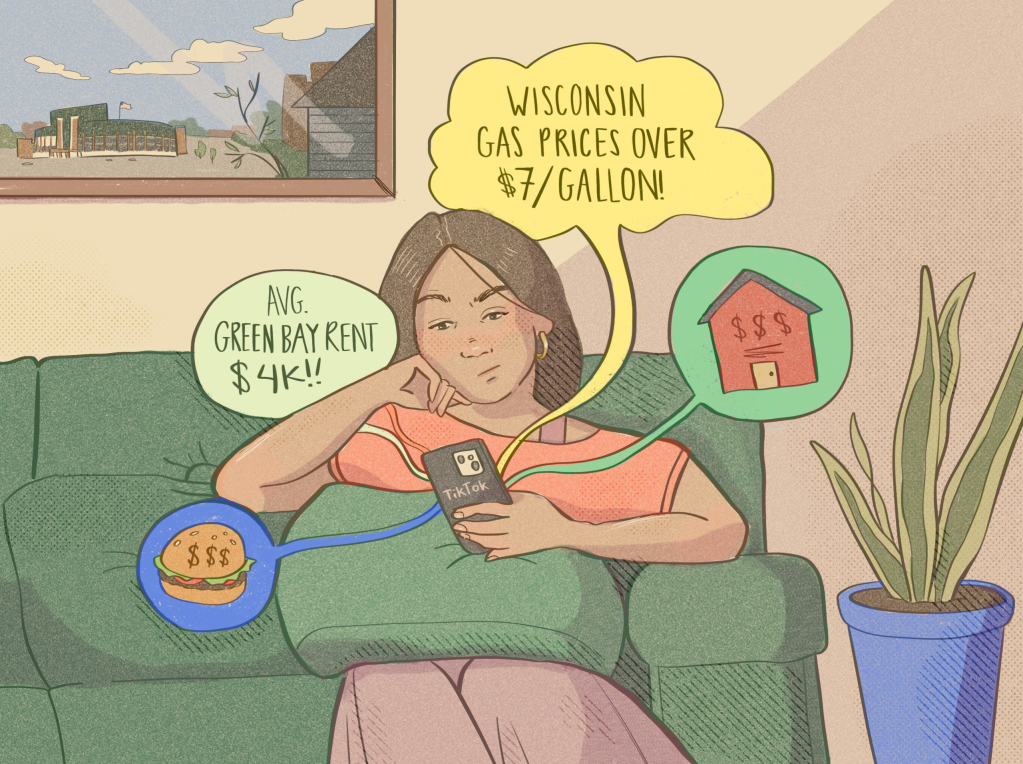
In May, TikTok user @lifewithjacob1 uploaded a 20-second video blasting Green Bay’s rent prices.
“Why is rent in Wisconsin so expensive right now?” he said. “I’m on a website looking for a new spot. I can’t find anything under $4,000 in Green Bay, Wisconsin.”
He went on to post more than 100 more, bemoaning skyrocketing prices for gas, housing and even dinner at Culver’s. Almost every video on the account, which was created in May, focused on how expensive life is in Green Bay.
The problem? Many of the videos seem to be pure fiction.
It’s not just that the average rent in Green Bay is a quarter of what he claims, according to July figures from Zillow. It’s also that his name isn’t Jacob, and it’s unclear if he’s ever lived in Wisconsin.
Through a reverse image search, Wisconsin Watch and Sunlight Research Desk identified the man in the videos as Connor Printz, a self-described “user-generated content creator” who gets paid by brands to make social media posts that don’t look like ads. It’s a burgeoning industry, and one that many Americans may never have heard of — though they’ve likely seen these kinds of posts.
This model is spreading nationwide as dark money groups try to sway voters stealthily by hiring social media creators to push their agendas. Wisconsin Watch and Sunlight Research Desk identified more than a dozen users publishing near-identical messaging about the cost of living in battleground states — claims that oscillate between factual, misleading and downright false.
The videos targeting Wisconsin don’t mention specific political parties or candidates, but they’re strikingly similar to videos where creators in other states supported or knocked certain candidates — part of what MS NOW called a “secret paid influencer campaign.”
It’s unclear who, if anyone, is funding the videos about Green Bay and Wisconsin, or what the goal is. Printz declined to answer questions, and the videos and biography on his account have since been deleted, a phenomenon common with short-term social media campaigns.
The videos themselves do not indicate whether they were paid for. If they were, one political advertising expert said, creators not disclosing that paid relationship could violate federal prohibitions on deceptive advertising. The trend raises questions about the future of political campaigning and the reforms needed to protect elections in the modern age.
Meanwhile, though many of the statistics the creators shared are false — Green Bay is often hailed as a particularly affordable city — the posts speak to a question increasingly on Americans’ minds, one that could prove pivotal in upcoming elections: Why is everything so expensive?
Making money on misinformation?
To try to understand who is behind the Green Bay videos, Wisconsin Watch and Sunlight Research Desk researched creators using public records databases, scoured campaign finance records, conducted reverse image searches, interviewed elected officials representing the city and compiled more than 5,000 videos.
Among the findings: The person shaking his head disapprovingly over the high cost of living in northeast Wisconsin is a former college basketball player turned social media creator whose LinkedIn profile says he’s based in Los Angeles.
While @lifewithjacob1’s TikTok bio said he was “Green Bay born and raised,” his Claremont McKenna College basketball webpage says he’s from Waterbury, Connecticut, and attended high school in Connecticut and Massachusetts.
Printz claimed to live in Green Bay and sometimes referred to moving from California to Wisconsin in TikTok videos posted under the @lifewithjacob1 account. Wisconsin Watch and Sunlight Research Desk found no evidence he has ever lived in Wisconsin.
Today, according to his LinkedIn, Printz works as a user-generated content creator through SideShift, a platform where organizations hire content creators. His account states he manages between six and 10 social media accounts at a time, “completing campaigns for brands.” SideShift did not respond to Wisconsin Watch’s questions.
According to the American Marketing Association, user-generated content is “sponsored content that looks and feels like genuine customer posts.” While the person on screen has likely received payment or free products, the videos are meant to feel like they’re ranting or raving about something of their own accord. It’s typically a cheaper way to advertise than making sponsorship deals with high-profile influencers or celebrities.
When those posts endorse or recommend brands, products or services, federal law and platform policies require they be labeled as ads or sponsored content. TikTok did not respond when Wisconsin Watch asked if its policies require such disclosures for videos like Printz’s.
Political organizations are increasingly buying this form of content, eager to leverage its authentic — and often undetectable — feel.
Both political parties are hiring influencers to build online enthusiasm for their candidates. Democrats have poured tens of millions of dollars into these secret influencer campaigns since their 2024 election defeat, according to a New York Times report. The influencer firm Creator Grid, which has received funds from the Republican National Committee and the National Republican Congressional Committee, boasts connecting “Republican candidates with the internet’s most powerful conservative influencers,” the Times reported. This election cycle, MS NOW reported that influencers received payment to post favorable content about politicians in California and Michigan and attack a candidate in Illinois.
Wisconsin Watch and Sunlight Research Desk found similar videos about the cost of living in cities across the country: La Crosse. Milwaukee. Madison. Pittsburgh, Pennsylvania. Charlotte, North Carolina. Atlanta, Georgia. Many of the users creating these videos have similar usernames, including @rantswithsaum, @rantswithcarlyy or @rants.with.k. Wisconsin Watch contacted several of the users behind the accounts but none responded.
It’s unclear who paid for the videos Wisconsin Watch identified. The Sunlight Research team searched spending records for registered political action committees and political candidates in key swing states but found no evidence of payments to the influencers or influencer platforms tied to these videos. And while Wisconsinites will elect a new governor in November, spokespeople for candidates David Crowley and Tom Tiffany both said they had not paid for or even seen the videos in question.
What is clear is that this type of political content is in demand: Wisconsin Watch found a listing on SideShift from “Project Bullhorn” offering creators $1,500 monthly to “speak on the rising crisis of affordability in the United States ahead of the 2026 midterms.” Project Bullhorn is one of several influencer efforts the New York Times reports Democratic donors are funding. A leader of the initiative declined to answer questions from Wisconsin Watch on the record.
‘More expensive than NYC’
From May through July, Printz posted roughly two videos a day about Green Bay’s cost of living.
In May, he claimed gas prices in Green Bay soared to almost $7 a gallon. While the Iran war has driven fuel prices up, prices at local pumps peaked this spring around $4.50 a gallon.
“Is Green Bay, Wisconsin, actually more expensive than New York City?” Printz asked in a June video, recounting the experience of a friend who purportedly moved from the Big Apple to Packerland, anticipating a lower cost of living.
“Guess what? It was just as expensive. Rent prices were crazy. Gas was crazy. Culver’s is so expensive, more than almost every restaurant in New York City,” Printz said.
In another video, he said tuition at Wisconsin colleges now cost $70,000 annually.
“Just makes you question if it’s worth it now,” reads text on the video of Printz repeatedly shaking his head. According to CollegeBoard data, Wisconsin’s public universities charged in-state students $10,600 on average in 2025.
In addition to the overblown numbers, locals might spot other faux pas. In one video, Printz asks for feedback from his “fellow Wisconsiners,” a term that would make any self-respecting Wisconsinite cringe.
Green Bay resident Allyson Brunette started seeing the videos pop up in her TikTok feed around May. The inaccuracies were obvious, she said, especially the part about $4,000 rent.
What was less obvious was where all these videos came from. She clicked on the creators’ profiles and discovered that not only did they often follow each other, but some of the users following them were making parallel videos elsewhere.
“It seemed that there was almost this network of these avatars with similar usernames and almost identical content in different cities and states across the U.S.,” said Brunette, who wrote to Wisconsin Watch in May about her suspicions.
“I was like, am I nuts? I think this is a coordinated effort,” Brunette said in a July interview. “What immediately struck my mind, as someone who’s 38 and lived through the Facebook misinformation of the last few elections, was: Is this gearing up to shift political (opinions) before the gubernatorial election?”
Brunette isn’t the only TikTok user raising the alarm about these types of claims. On many of Printz’s videos, commenters called out misinformation and offered the facts.
“Obvious rage bait,” wrote one user in response to the claim that Green Bay is more expensive than New York City.
“Literally nothing you said is true,” wrote another.
Is it legal?
Experts say this novel influence model seems to test the limits of laws governing campaign finance and advertising.
Christopher Terry is an associate professor of journalism and mass communication at the University of Minnesota who studies political advertising. He told Wisconsin Watch these types of videos could potentially violate state and federal law, even if they don’t mention candidates, parties, elections or products.
Paid posts are a form of commercial speech, which is not subject to the same First Amendment protections as standard political speech, Terry said. If creators don’t disclose that they were paid to create posts, that could violate the Federal Trade Commission prohibition on deceptive practices, Terry said, though he noted the agency has not enforced that policy against social media influencers to date.
“It has warned a bunch of them. It has threatened a ton of them, but it has not actually brought an enforcement action against any of them,” Terry said.
Any posts that mislead voters about candidates or referendums could also potentially violate a Wisconsin statute barring “false representation … intended to affect voting in an election,” Terry said.
“Any chucklehead in any northern Wisconsin bar will give you an opinion on a political thing … That’s fine,” Terry said. “If he’s paid to think that and paid to sit in the bar and talk to people about it, that’s something else, right?”
Meanwhile, democracy advocates have called on the Federal Election Commission to clarify laws to explicitly require that influencers post disclaimers indicating who paid for their political content.
Prices, misinformation on the rise
While many of these videos are riddled with false information, they channel popular frustrations over real spikes in prices.
“Gas is not $7 a gallon in Green Bay, and average rent is not $4,000. But they’re both more expensive than they used to be … It’s simply true that people are anxious and concerned about the cost of living,” said state Sen. Jamie Wall, D-Green Bay. “And I hear that from people across the political spectrum.”
Across the country, consumers have been sour on the economy for years, said Joanne Hsu, who oversees the University of Michigan’s Surveys of Consumers. The monthly consumer sentiment survey, first conducted in 1946, asks Americans how they feel about the economy and where it’s headed.
The answer in recent months: still not good. When survey workers asked Americans in June about their personal finances, 56% brought up high prices without being prompted.
In Green Bay, where the average home value is about $290,000, the cost of living remains relatively low. But local residents are feeling the strain of rising prices too, state Rep. Amaad Rivera-Wagner, D-Green Bay, said.
Still, he fears the misinformation could stifle Green Bay’s future.
“That’s one of the most frustrating things about social media is that we are now fighting an army of misinformation, sometimes by innocent bystanders, but sometimes by bad actors,” Rivera-Wagner said.
“This is where that confusion can actually cost or have real impact,” he said. “There might be people in and around our community or businesses thinking about moving or working in our community, and they’re seeing a larger narrative that is not only inaccurate, but doesn’t actually talk about how much work we’ve done to make Green Bay still one of the most affordable places to live in the state or the country.”
Meanwhile, rising costs could shape the outcome of midterm elections across the country this fall. American adults ranked inflation and the high cost of living as the most important issue in every Marquette University Law School Poll national survey this year. President Donald Trump has drawn criticism for largely dismissing concerns about high prices.
“It doesn’t feel good to be told the economy is doing great when you feel like you’re stretching to make ends meet,” Hsu said.
Anna Massoglia, Michael Nolan, Jason Dearen and MuckRock’s Sunlight Research Desk provided research and data analysis for this story.

Wisconsin Watch is a nonprofit, nonpartisan newsroom. Subscribe to our newsletters for original stories and our Friday news roundup.
$4K rent? $7 gas? Inside the internet campaign insisting Green Bay is ‘more expensive than NYC’ is a post from Wisconsin Watch, a non-profit investigative news site covering Wisconsin since 2009. Please consider making a contribution to support our journalism.
