


The Theban Necropolis, located across the Nile from Luxor, contains more than 400 tombs. In a new study published in Frontiers in Environmental Archaeology, researchers in Spain took a closer look at chamber three inside tomb TT 209 to understand how the burial space changed over time.
The tomb was constructed during the Twenty-fifth Dynasty (754-656 BCE) and remained in use until the Ptolemaic period (305-30 BCE), when it was eventually abandoned. By examining the placement of human remains and burial objects, the researchers reconstructed how generations of people repeatedly adapted the chamber for new burials.
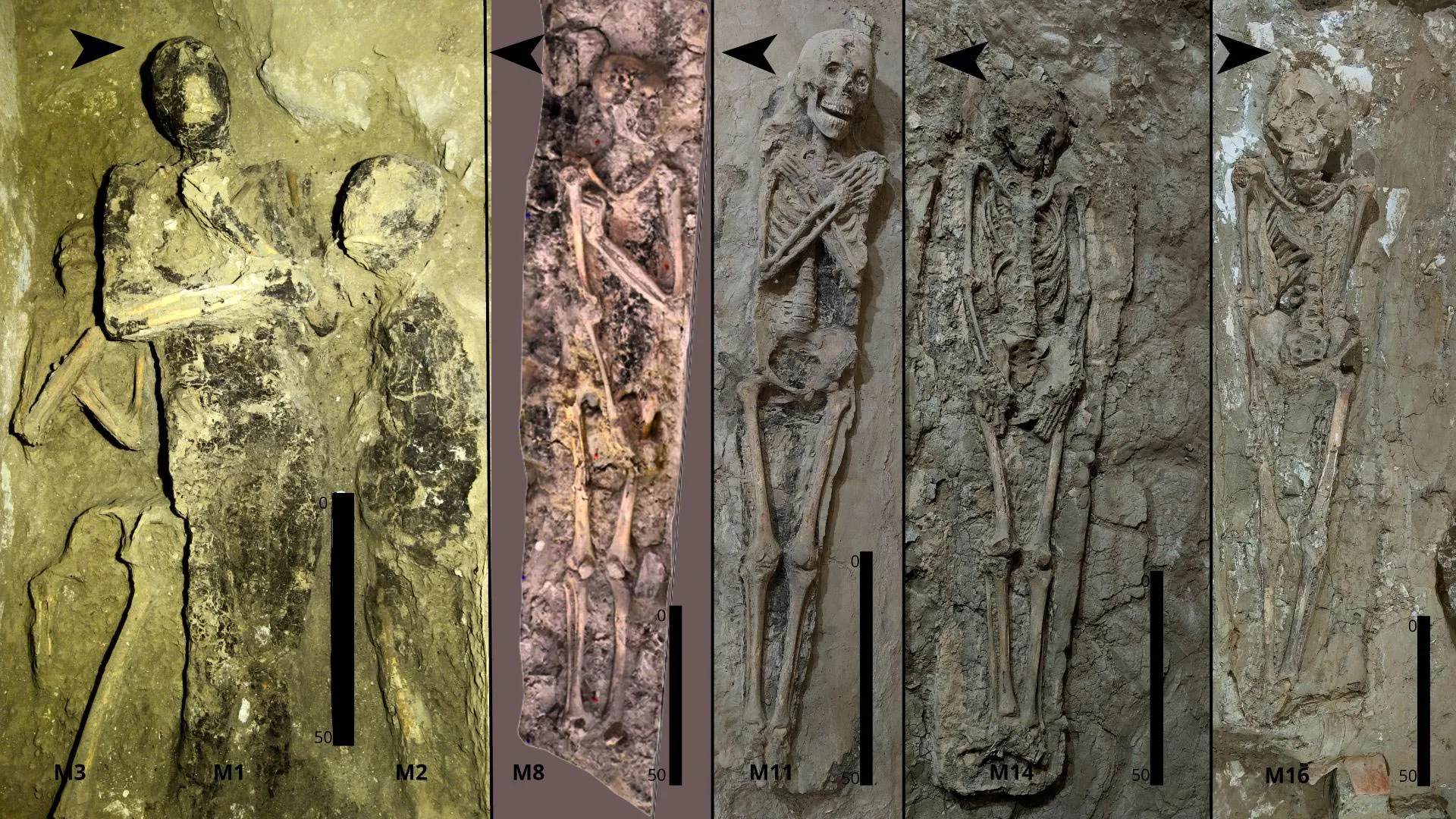
“We found a total of 16 mummified human individuals, a mummified dog, and a disturbed deposit containing the remains of at least four individuals,” said first author Dr. Jared Carballo-Pérez, a researcher at the University of La Laguna. “The detailed study of the bodies indicates neither chaotic accumulation nor a loss of the original ritual over time. Rather, there was a spatial logic in which each new deposition was adapted to the presence of previous bodies — a kind of funerary memory in the processes of reuse.”
Senior author Dr. Miguel Ángel Molinero Polo, a professor of Egyptology at the University of La Laguna, added: “We have few details regarding how the people who entered tombs behaved, what their motivations were in each historical period, and how they conceptually reconfigured the pre-existing space.”
How the Egyptian Tomb Changed Over Time
To better understand how the bodies were placed and how the burial chamber evolved, the researchers excavated the space, photographed the mummies, and created detailed sketches and descriptions. They recorded the position and orientation of each body, along with its relationship to the chamber’s architectural features.
The team identified nine funerary deposits within the chamber. These included both individual and multiple burials, along with objects associated with the dead.
The earliest burials were generally spaced apart from one another, and the bodies were placed inside coffins.
“The earliest individuals buried here appear to have been of high social standing, as they were interred in coffins, with funerary nets and amulets, and with an assemblage containing costly items, such as the contents held in Phoenician amphorae, a large number of which were found alongside them,” said Molinero Polo.
As time passed, burial practices began to change. Toward the end of the 25th dynasty and during the Persian period (around 680-404 BCE), new bodies were placed wherever unused room remained. The chamber consequently became much more densely occupied.
Researchers also noticed changes in the way some bodies were positioned. In earlier burials, the arms were usually extended, while some later individuals had an arm folded inward.
During the Persian period, another major shift appeared. Instead of relying mainly on separate individual burials, people increasingly arranged bodies vertically. Bodies placed on top of one another were found in two-thirds of the chamber’s burials.
Mummified Dog Found With Human Burials
One of the most striking arrangements was located in the southeastern part of the chamber. Dating to the Ptolemaic Period, it consists of four mummies and a mummified dog placed on top of one another.
“The bodies buried in vertical superposition did not have coffins but were carefully mummified. They also can be associated with upright jars that point to a specific ritual not found in the earlier phases of the tomb’s use,” said Molinero Polo.
The dog may offer another clue about the beliefs or relationships of the people buried there.
“One detail I find quite beautiful is the presence of a mummified dog placed directly on top of the mummies of a man and a woman,” said Carballo-Pérez. “This could indicate a close relationship between these human individuals and the animal, an idea that I think is quite easy to empathize with.”
“It could also reflect a further change in ritual practice, with an animal taking on the role of a psychopomp, a symbolic helper in the journey to the afterlife,” added Molinero Polo.
A Carefully Reused Burial Space
Other changes in body placement support the idea that burial traditions continued to evolve rather than simply breaking down. In later deposits, for example, some individuals were buried with both arms crossed over the chest in what Egyptologists call the Osirian position.
Taken together, these patterns suggest that the increasingly crowded tomb was not simply becoming disorganized and that its cultural traditions had not disappeared. Instead, the researchers argue that the chamber was repeatedly brought back into active use. Each new burial altered how the available space was organized and understood while still taking earlier burials into account.
Reconstructing every stage of the tomb’s history is not always possible. In some deposits, researchers cannot determine the exact order in which bodies were added or the precise intentions behind their placement.
The chamber remained in use for centuries and experienced several disruptive events. It flooded multiple times, suffered fires, and was repeatedly entered by people, all of which moved debris and complicated the archaeological record.
Even with those limitations, the findings could change how archaeologists interpret other crowded burial spaces.
“Nevertheless, what we present means that deposits that were previously considered ‘disordered’ can be reinterpreted,” concluded Carballo-Pérez. “This helps us develop a better understanding of the social behaviors behind funerary practices.”
