


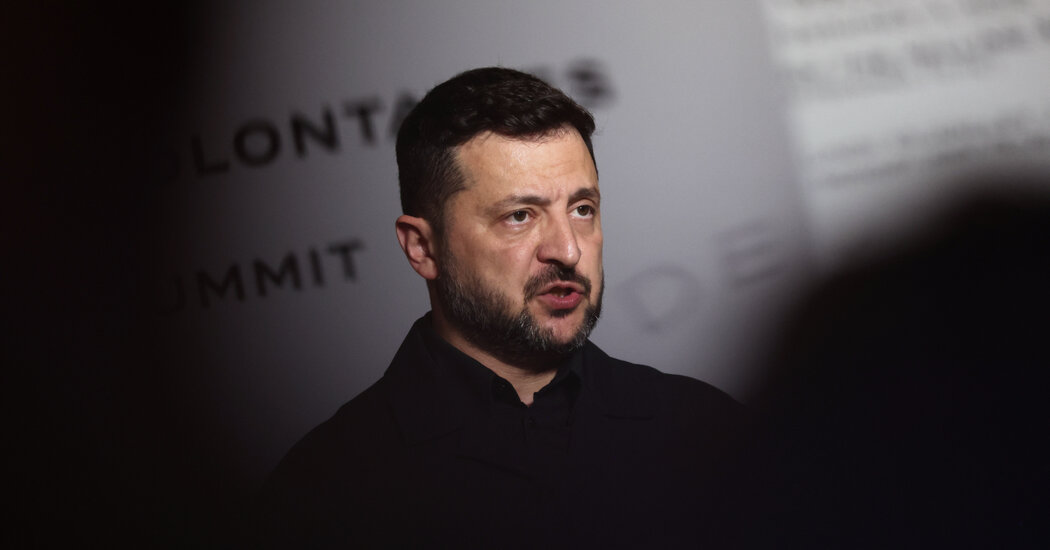
Before he became president, Volodymyr Zelensky played Napoleon in a comedic film that portrayed his character as a headstrong idiot who refused to change course even as he led his army to ruin.
As president, Mr. Zelensky has been the opposite of his depiction of the French general — being, perhaps, flexible to a fault. He has so often reversed decisions on appointments and policies that confusion and personnel churn are risks in his wartime leadership, analysts say.
In the latest turmoil, over the past week and a half, Mr. Zelensky sided at first with a seasoned commanding general in a dispute with a popular, reformist defense minister over military strategy and what weapons to buy. He dismissed the minister last week. Then, late Tuesday, he fired the general and appointed in his place a military chief a generation younger who is allied with the defense minister just ousted.
It was a head-scratching reversal that Mr. Zelensky did not explain publicly, other than to affirm his commitment to overhauls aimed at strengthening the army.
The episode has left Ukraine in the grips of some of the worst turbulence in domestic politics since Russia’s all-out invasion in 2022. Protesters have taken to the streets in anger over the dismissal of the defense minister, Mykhailo Fedorov, and Mr. Zelensky’s latest about-face has not quelled calls for further demonstrations.
To Mr. Zelensky’s allies, his willingness to listen to public opinion and make U-turns is a sign of the strength of Ukrainian democracy and an important contrast with autocratic Russian governance. Nearly four and a half years into the war, and seven years into his presidency, a majority of Ukrainians say they trust Mr. Zelensky as a leader.
But his frequent swerves can project weakness as the crucible of war demands steadfast leadership. One criticism of Mr. Zelensky is that he has carried his show business instincts into politics, playing for the loudest applause and zigzagging in search of approval.
“The good news is, he course-corrects,” said Orysia Lutsevych, head of the Ukraine program at Chatham House in London.
The bad news, she added, is how often and blatantly he does it. “He bends. He has some doubts as a person. He is unsure of himself,” Ms. Lutsevych said.
The risk Mr. Zelensky now faces is that the dismissed defense minister, Mr. Fedorov, will emerge as a potential political opponent. If that comes to pass, Mr. Fedorov could be emboldened by Mr. Zelensky’s tacit admission that the military overhauls he advocated were right.
In the U-turn on military leadership, Mr. Zelensky did not openly concede an error. At a closed-door meeting with members of his political party last week, he described a quandary in the clash between his defense minister and his top general, Oleksandr Syrskyi, according to Ukrainian news media.
Mr. Fedorov, an evangelist for automated weaponry, had accused General Syrskyi of stalling robotization strategies. Mr. Zelensky told his political allies that he had considered resolving the rift by firing both men but worried about overly abrupt changes in leadership, according to the news reports. So he dismissed only the minister, signaling that he had sided with the general.
One cause for the misstep, Ms. Lutsevych said, was Mr. Zelensky’s focus on foreign policy in recent months, traveling often as he rallies European diplomatic and military backing for the war. Domestic matters went untended, she said.
Before Russia’s invasion, Mr. Zelensky’s government was a revolving door. He began his presidency with an ambitious agenda of privatizing agricultural land and overhauling governance of state-owned enterprises. But he ousted his first cabinet after less than a year.
At one point during the Covid-19 pandemic, he replaced his health minister twice in one month.
In the first years after the all-out invasion, Mr. Zelensky left in place most key ministers and security service leaders. But a government reshuffle he initiated this month, which included his removal of Mr. Fedorov, is the second in a year.
And last summer, Mr. Zelensky made another switchback, on his government’s plan to weaken anticorruption agencies. He and his party’s lawmakers enacted the changes and then, amid mass demonstrations, reversed course.
Some appointments in his government overhaul this month stuck and generated little controversy.
Mr. Zelensky replaced Yuliia Svyrydenko, an economist, with Serhiy Koretsky, a former energy executive, as prime minister. The move was seen as preparation for expected Russian wintertime attacks on Ukraine’s energy grid.
But a major question remains over whether Mr. Zelensky will reverse himself completely by restoring Mr. Fedorov as defense minister. Doing so, said Volodymyr Fesenko, head of Penta, an independent analytical group in Kyiv, would weaken Mr. Zelensky’s position.
Mr. Fedorov has been offered other government positions but has insisted on returning to the Defense Ministry, members of Parliament have said. Mr. Zelensky has already signaled that he will nominate another candidate for defense minister.
“If Fedorov returns to the post of defense minister in the current situation, a parallel power center will emerge in Ukraine,” Mr. Fesenko said. “This will be the beginning of Zelensky’s political end.”
