


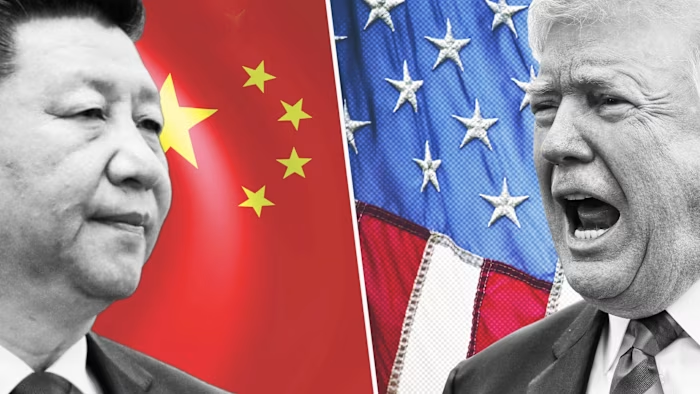
Here is my market-shaking prediction for the state dinner Donald Trump is hosting for Xi Jinping next week: Nvidia’s Jensen Huang (and probably OpenAI’s Sam Altman and Elon Musk) will make the guest list; Anthropic’s Dario Amodei will not.
Trump’s selections will have little to do with Xi’s sensitivities and everything to do with his administration’s Kremlinology. Amodei, who is calling for his industry’s regulation, is considered in Trump’s orbit to be too woke (he uses the word “democracy” a lot). The others, especially Huang, who is opposed to regulation, are abettors of Trump’s accelerationist impulse.
We are all by now acclimatised to the extravagant sci-fi diction of people from that world. The optimists insist that AI will save humanity; the pessimists say our extinction is nigh. Often these are the same people. Nothing caught Silicon Valley’s super-maximalist rhetoric as well as Huang’s introduction of Trump when he called in to an “All-in” conference earlier this week. “Mr President, you’re now talking to the planet,” Huang told Trump after he’d placed a mike next to his cell phone so other attendees could hear. Did the rest of our galaxy do something to offend you, Mr Huang?
But it was Trump’s assertion that fears over AI were a “hoax” that gave me interstellar vertigo. Trump tends to reserve that word for things that obsess him (the “Russia hoax”, “Epstein hoax” and so on). That word is a sign that he means business.
Whether it was intentional or not, Trump also seemed to be ensuring that nothing significant will come out of this US-China summit on AI. “There is a SICK conspiracy going on against AI and Data Centres, and the only one that is happy about it is China,” Trump posted on Truth Social. Trump’s anti-regulatory certitude reinforces China’s view that the US will always treat AI as a zero-sum game.
To be fair, Amodei’s appeal for regulation in his 3,800-word essay last weekend (“We must pace the frontier”) also put China’s back up. Amodei said that any Chinese lead in AI would pose “a grave danger for the United States and the world”. To Chinese ears, both sides of the US debate thus seem to land in the same place. The so-called rationalists want to maintain America’s narrowing AI lead over China while putting guardrails around all; the accelerationists insist that any form of US government oversight would cede the edge to China. Were America consciously trying to put China off from talking about AI it could not have arranged it better.
This is odd for two reasons. The first is that Trump said in May at his Xi summit in Beijing that AI was now on their bilateral menu. The next time they met the two leaders would discuss guardrails, Trump said. In what was an otherwise unremarkable meeting, that pledge offered a somewhat reassuring sliver of hope. Even if we applied a 90 per cent sci-fi discount to the AI world’s habit of giving humanity a 10 per cent extinction chance, there is no more important topic for the world’s two superpowers to discuss. AI will increasingly dominate the future of warfare.
The second oddness to Trump’s anti-regulatory stance is that it fails to take into account that China is catching up rapidly. Nobody can put a precise number on America’s alleged AI lead over China. I hear talk of six to 18 months but rarely more. In some areas, China is ahead.
The judicious approach would be to embark on an intense US-China discussion of AI across many fields. Owing to commercial sensitivities — not least over US claims that China’s cheaper AI platforms use American models to train their own (a practice known as “distillation”) — such talks would take a while to establish trust. Getting to a useful exchange of information might take years, rather than months. There is thus no time to lose. I also tend to agree with this essay by Julian Gewirtz, a former Biden official, on why the US needs to be the first mover on regulation. “China is unlikely to take American calls for restraint seriously unless the United States is willing to restrain itself,” he argues. “America’s most important negotiating position may be the AI rules it adopts at home.”
Will Trump see the light on this? I greatly doubt it. The rest of America, however, needs to be aware that a majority of the world’s AI token usage comes from free Chinese models, not the increasingly expensive US ones. If there is a US-China technological great game in the global south, America is now running well behind.
I am turning this week to my colleague Demetri Sevastopulo, who is the world’s leading scoop-meister on all things US-China. Demetri, since expectations are so low, might we be surprised on the upside by next week’s summit? Either way, what in your view would it be realistic for us to expect out of US-China AI talks in the next couple of years?
Recommended reading
-
My column this week looked at how the US Treasury secretary Scott Bessent is harming himself by taking on the markets and losing. He should keep his powder dry; nothing matters more for someone in that job than the credibility of what you say.
-
I am late to this characteristically top-notch essay by the New Yorker’s Evan Osnos on the US-China battle for tech supremacy. Osnos depicts a country that is leaping ahead in ways that most non-visitors can only guess at. Yet at the same time younger Chinese are losing their optimism — “lying flat”, as the saying goes. Osnos’s piece is well worth your time.
-
Also in the New Yorker, do read Dexter Filkins on Jared Kushner’s dollar diplomacy. I addressed Kushner and Steve Witkoff’s “blind amateurism” in my FT column last week. Filkins has the grifting receipts. On a related note, do also read Anne Applebaum in the Atlantic on how Maga is making the world safe for corruption. She also has the receipts.
-
Finally, my colleague Martin Wolf, who recently turned 80 (!), makes an unarguable case for the precautionary principle on AI in his latest column, “With AI, ‘I told you so’ will be too late”.
Demetri Sevastopulo replies
Ed, I am an optimist by nature (which you had to be growing up in Ireland in the 1970s and 1980s with a Greek name). But I am not optimistic that the US-China summit will produce anything substantial on AI — for a few reasons. It is true that Trump said he and Xi discussed “guardrails” when they met in Beijing in May. But very recently, he claimed that “guardrails” would just hold back the US. Following the Beijing summit, China said the two countries had agreed to set up an AI dialogue. But in the four intervening months, there has been no sign of serious movement.
US Treasury secretary Scott Bessent and his Chinese counterpart He Lifeng will definitely talk about AI when they meet in New York on Sunday. They may still surprise us, but it is hard to see how one pre-summit meeting, which also has to address non-AI issues, will be enough to produce anything meaningful in Washington.
I asked an AI model about the prospects for a big enforceable AI deal. Its response was: “appears limited”. Even that is too optimistic. I think the most we will get is a vague statement talking about working together in the future. But I would love to be proven wrong.
