


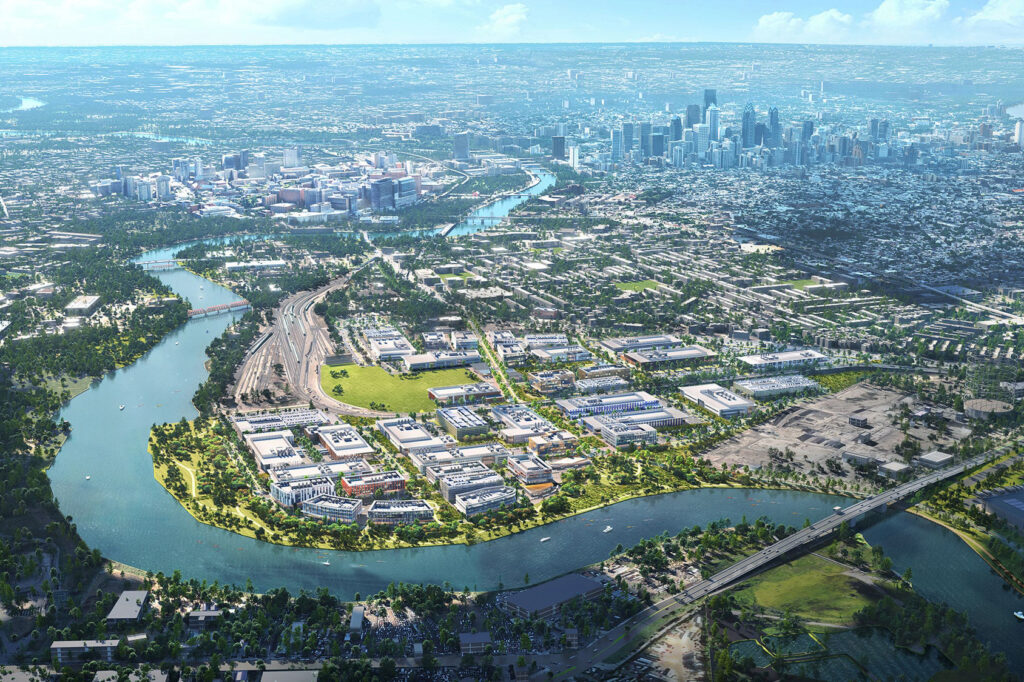
PHILADELPHIA—A simmering debate over the future of Philadelphia’s Bellwether District has been reenergized by a Planning Commission presentation last month that identified the industrial zone as one of only two sites in the city capable of hosting a large data center.
Neither the commission nor the site’s owner, HRP Group, report any such proposals to date.
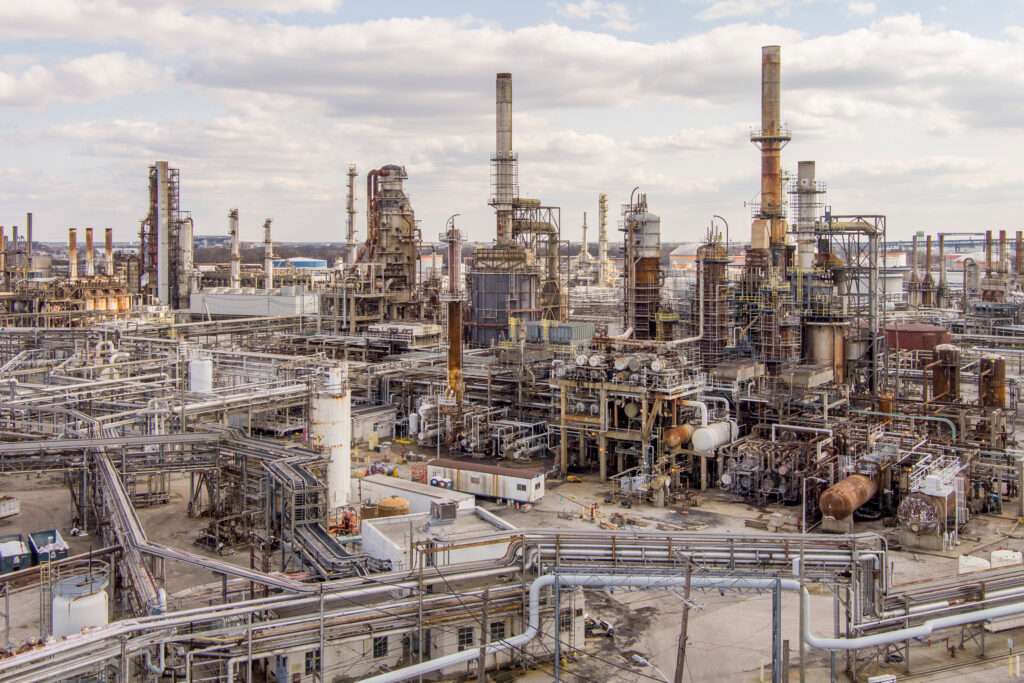
HRP acquired the 1,300-acre tract after a catastrophic 2019 fire forced the previous owner of a massive refinery on the site, once the oldest and largest on the East Coast, to stop operations and into bankruptcy. HRP then worked with the Environmental Protection Agency and the Pennsylvania Department of Environmental Protection (DEP) to remediate the portion of contamination it inherited responsibility for as it planned to transform the land for the Bellwether District.
The process continued an ongoing clean-up that Sunoco, a previous owner of the refinery, had been required to pursue since 2003, but is only set to remediate the site enough for nonresidential use. Far more remediation would have been necessary to make it suitable for parks or housing, as some advocates hoped. A ban on those environmentally sensitive uses was renewed during the sale to HRP, limiting its long-term versatility.
Thus far, HRP has landed two marquee tenants, a beverage manufacturer and a nuclear-medicine business, and built the first two of a dozen envisioned warehouses in what will become a massive industrial park. Critics worry about the potential for heavy truck traffic to a site that inundated nearby Black neighborhoods with refining pollution for more than a century.
In 2024, HRP announced that it had negotiated a $10 million community benefits commitment with grassroots groups, the week after the Philadelphia City Council unanimously approved a 10-year extension of potential tax breaks for tenants of the site under the state’s Keystone Opportunity Zone program.
HRP has not commented on the likelihood of a data center on the site. In December, Amelia Chasse Alcivar, HRP’s executive vice president of corporate affairs, told technical.ly that the developer wasn’t building data centers speculatively, before confirming a lessee’s demand, and won’t discuss specific tenants. Still, she said the firm was “certainly entertaining those conversations.”
Philadelphia’s I-3 zoning of the district allows for “intensive, high-impact uses,” and matches that of a far smaller data center in north Center City, the Planning Commission said. An April briefing revealed that Exelon presented a proposal to PJM, the regional grid operator, for a large new substation to distribute electricity for a hypothetical data center at Bellwether.
Bruce Bohri, a spokesperson for the Planning Commission, said that the agency identified the two compatible sites because they are over 40 acres, zoned for industrial use and vacant. “We in no way intended to advertise these sites to developers or the public,” he wrote.
Shawmar Pitts, managing co-director of Philly Thrive, an environmental justice coalition influential in the effort to end refining operations, said his organization was not confident that the Bellwether District will remain data center-free. “I’ve been around long enough to see what’s happening without the smoking gun,” he said.
Philly Thrive made waves when it didn’t sign HRP’s community benefits commitment. Pitts said the group wanted a more robust environmental clean-up of the site and a prohibition on harmful construction to be included.
“They did what corporations do. They just wanted to step right over us,” Pitts said. While Philly Thrive was part of a negotiating process parallel to that of the main Community Advisory Panel, the commitment was enacted without Philly Thrive’s endorsement.
Donna Henry, executive director of the Southwest Community Development Corporation, said that while she’d be very concerned about the impact of a data center on the property, she has not heard of a proposal through her membership on Bellwether’s Community Advisory Panel.
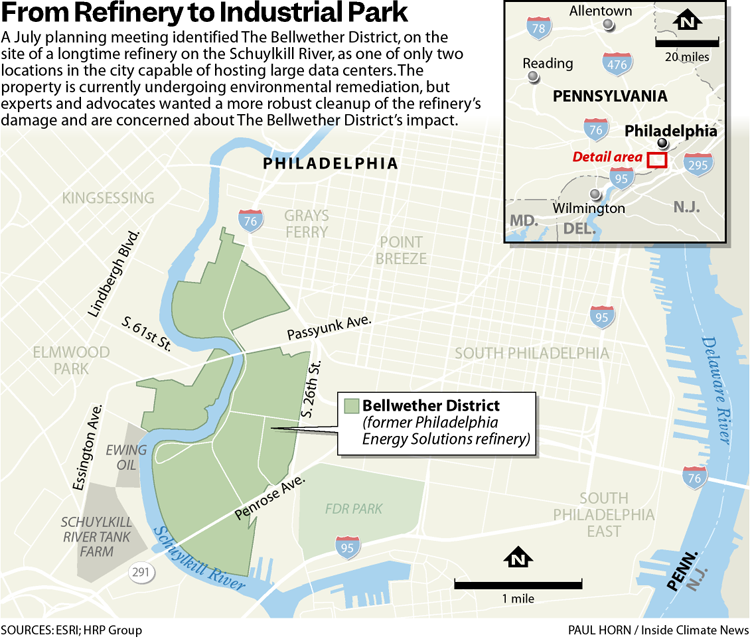
Both Henry and Marilyn Howarth, an occupational and environmental medicine physician at the University of Pennsylvania who has long studied the land’s contamination, said a data center proposal would attract massive public backlash. Howarth said Philadelphia’s strict air management regulations would be a significant obstacle for any data center.
These kinds of urban roadblocks, along with the cost of real estate, are part of why data centers are being built in more rural areas. On Aug. 18, Gov. Josh Shapiro signed an executive order enacting stricter guardrails for the development of data centers in Pennsylvania, shifting from his earlier support amid growing attention to the facilities’ impacts on water demand, energy prices and noise pollution.
Other Options for the Site
Data center or not, Michael Miller, a partner at Philadelphia-based urban planning and design firm OLIN and an author of a report describing an alternative vision for the property, stressed the importance of the land within the city’s urban fabric.
“Will it be integrated with the city? Will there be public access? […] Are we just investing in a lot of road infrastructure for trucks serving distribution centers?” Miller said. He voiced the need for versatility in long-term planning and cautioned against the creation of single-use districts.
In a statement provided for this article, Alcivar highlighted the LEED status of recent construction in the Bellwether District, as well as its solar-ready roofs, EV-equipped infrastructure and plans to plant 10,000 new trees on the grounds. She said the campus would be elevated above the 100-year floodplain and have sustainable stormwater management, as well as improved connection to nearby public space and green transportation modes.
Miller, as well as environmental engineering professors Mira Olson of Drexel University and Peter DeCarlo of Johns Hopkins University, who worked on the city’s Refinery Advisory Group while at Drexel, all said the site was complicated in ways that made a stronger clean-up process harder, both financially and legally.
Pennsylvania Act 2, known formally as the “Land Recycling Program,” was designed in part to allow polluters and landowners to take on long, often-complicated and always-expensive environmental remediation work on private property to relieve liability. The program, administered by DEP, will govern the clean-up of the refinery site to nonresidential standards and even looser, site-specific direct-contact standards for lead in the soil.
“The Act 2 process allows for the DEP and the EPA and the city to get together and decide, ‘Well, which of the environmental regulations should we be using? Should we be loosening them?’” said Howarth, the Penn physician. “I think that is not serving the interests of Philadelphians well.”
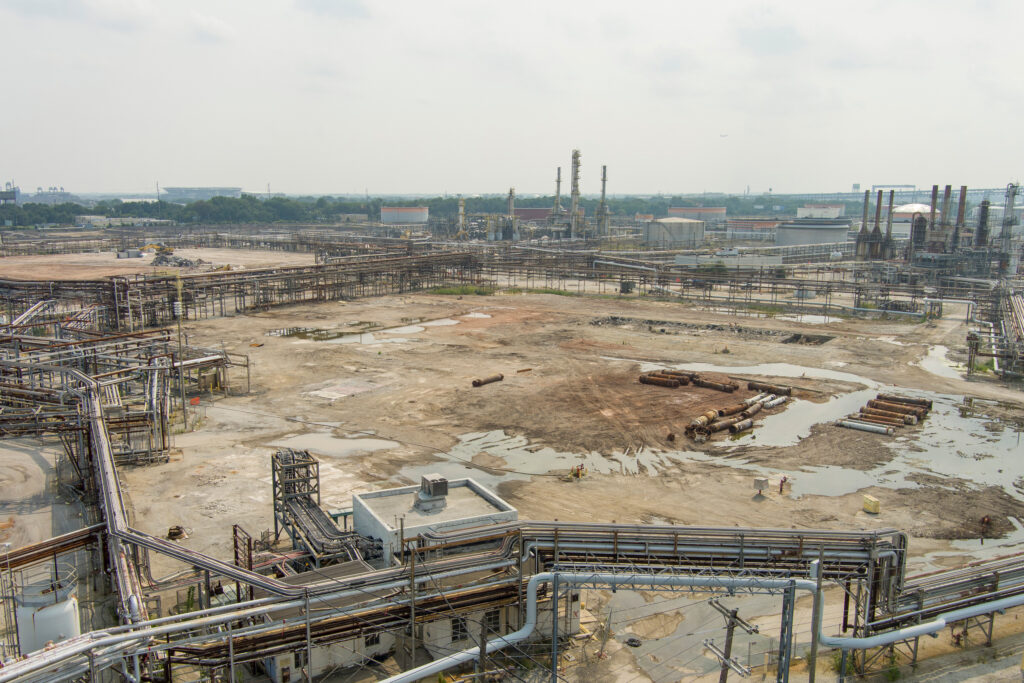
Robyn Briggs, a spokesperson for DEP, said Act 2 allows remediation to be funded by “capable parties,” like owner HRP and former owner and polluter Sunoco, instead of taxpayers. “DEP thoroughly reviews all Act 2 submissions, including cleanup plans for proposed remedies, to ensure site remediation will be protective of human health and the environment, consistent with regulatory requirements,” she wrote in a statement.
Many who had long pushed for a change at the site are glad that HRP’s plans are bringing an end to refining operations, especially given the financially superior bid of a company hoping to relaunch refining that emerged during bankruptcy proceedings. The acquisition by a nonrefining developer “inherently improved the surrounding environment on the day of acquisition,” said Alcivar. The refinery once produced 16 percent of Philadelphia’s carbon footprint.
But others saw such a momentous transition away from refining as an opportunity to pursue an even bolder future, like building a park, housing or new mixed-use areas. The fact that new owners, plans and environmental remediation will only equip the land for nonresidential use is a disappointment to Miller, Howarth, DeCarlo, Pitts and others.
“I would have liked to have seen it at least remediated to a better level than was required for zoned industrial use,” DeCarlo said. Pitts emphasized Philly Thrive’s push for a more robust clean-up and the report that Miller worked on advocated for a lot of recreational access.
After 130 years of damaging production, however, doing so would take an enormous amount of resources, and the land’s future was being decided largely through its sale in bankruptcy court, where attention to anything but efficiency is limited.
Furthermore, a 2012 deed restriction enacted by Sunoco, with DEP’s approval, mandated that the property only be used for energy and chemical production while prohibiting more sensitive construction like schools, homes and parks. Therefore, there was little short-term justification for DEP to require a clean-up adequate for those uses. ”The Act 2 cleanup standard, residential or nonresidential, must align with the planned and actual land use,” Briggs wrote, citing the deed restriction.
But the energy and chemical production requirement was lifted in 2020 to make way for the sale to HRP and its non-refining vision. The ban on more environmentally sensitive uses, however, remained in a new consent order and agreement.
Howarth therefore sees the agreement as unfair to the city and its residents: “It was a terrible injustice to the people of Philadelphia that an agreement was made without their knowledge and consideration and input to give up 1,300 acres in the middle of Philadelphia,” she said, highlighting the region’s struggle for housing and green space.
A Tension Point
Activists and experts have long called into question HRP and Sunoco’s plans to address lead in the soil. Without fully removing the contaminant from the soil or all contaminated soil from the site, HRP plans largely to cap dirty soil with asphalt, which DEP anticipates will be a permissible remedy, while disposing of some soil offsite.
Olson, the engineering professor, and Miller, the urban planner, both said that capping contaminated soil can be an acceptable remediation approach for industrial use, given the expense and risks of removal. Still, it raises some concerns. “There are always cracks where water can get in, and then mobilize the pollutants to travel offsite or to other points of exposure,” said Olson.
Any areas not capped, however, will be remediated by Sunoco to a site-specific direct-contact standard of 2,240 parts per million, far higher than even the nonresidential use statewide health standard of 1,000 ppm. DEP felt the value “was protective of human health for nonresidential land use” on the site.
This story is funded by readers like you.
Our nonprofit newsroom provides award-winning climate coverage free of charge and advertising. We rely on donations from readers like you to keep going. Please donate now to support our work.
Russell Zerbo, an advocate with Philadelphia-based Clean Air Council, disagreed, as did Olson and Howarth. “In fact, the science on lead safety is going in the other direction,” Howarth said.
“The science says that there’s no safe amount of lead,” added Zerbo.
Sunoco’s affiliate in charge of remediation did not respond to a request for comment for this article.
The Time for Cleanup “Would Be Now”
Some experts and community leaders spoke about the Bellwether District as a happy, potentially temporary, compromise between oil refining and more utopian visions: It identified a company willing to finalize the clean-up of the land so that it could then reap the profits of developing it. If things changed many years from now, experts said it would still be possible to clean the land up to a higher environmental standard.
But generating the money and will would be harder in the future than in 2019, when the future of the site was up in the air and responsible parties were easy to identify. “If the city ever hopes that this may be anything other than industrial, the time to require it to be cleaned up would be now,” Howarth said. She blames the standards of Sunoco’s ongoing Act 2 clean-up and the lack of democratic input on the deed restriction for limiting the long-term versatility of the land.
“Everybody had great ideas for the land after the fire. They fell on deaf ears when the DEP and the EPA were the ones under Act 2 deciding what the clean-up level would be,” Howarth said. “Once that decision to clean up only to an industrial standard was made, all of those other options were off the table.”
About This Story
Perhaps you noticed: This story, like all the news we publish, is free to read. That’s because Inside Climate News is a 501c3 nonprofit organization. We do not charge a subscription fee, lock our news behind a paywall, or clutter our website with ads. We make our news on climate and the environment freely available to you and anyone who wants it.
That’s not all. We also share our news for free with scores of other media organizations around the country. Many of them can’t afford to do environmental journalism of their own. We’ve built bureaus from coast to coast to report local stories, collaborate with local newsrooms and co-publish articles so that this vital work is shared as widely as possible.
Two of us launched ICN in 2007. Six years later we earned a Pulitzer Prize for National Reporting, and now we run the oldest and largest dedicated climate newsroom in the nation. We tell the story in all its complexity. We hold polluters accountable. We expose environmental injustice. We debunk misinformation. We scrutinize solutions and inspire action.
Donations from readers like you fund every aspect of what we do. If you don’t already, will you support our ongoing work, our reporting on the biggest crisis facing our planet, and help us reach even more readers in more places?
Please take a moment to make a tax-deductible donation. Every one of them makes a difference.
Thank you,

Fellow
Daniel Perrin is a Philadelphia-based fellow at Inside Climate News, covering urban environmental issues. He is a rising senior at Swarthmore College, where he studies economics, literature, and history. He just finished serving as Editor-in-Chief of The Swarthmore Phoenix, overseeing the campus paper and reporting on trends within higher education, economic policy, sustainability, transportation, and governance at all levels. Having grown up in Chapel Hill, NC, before moving to Baltimore, he is especially interested in how large political and economic developments ripple through the built environment of local communities.
