


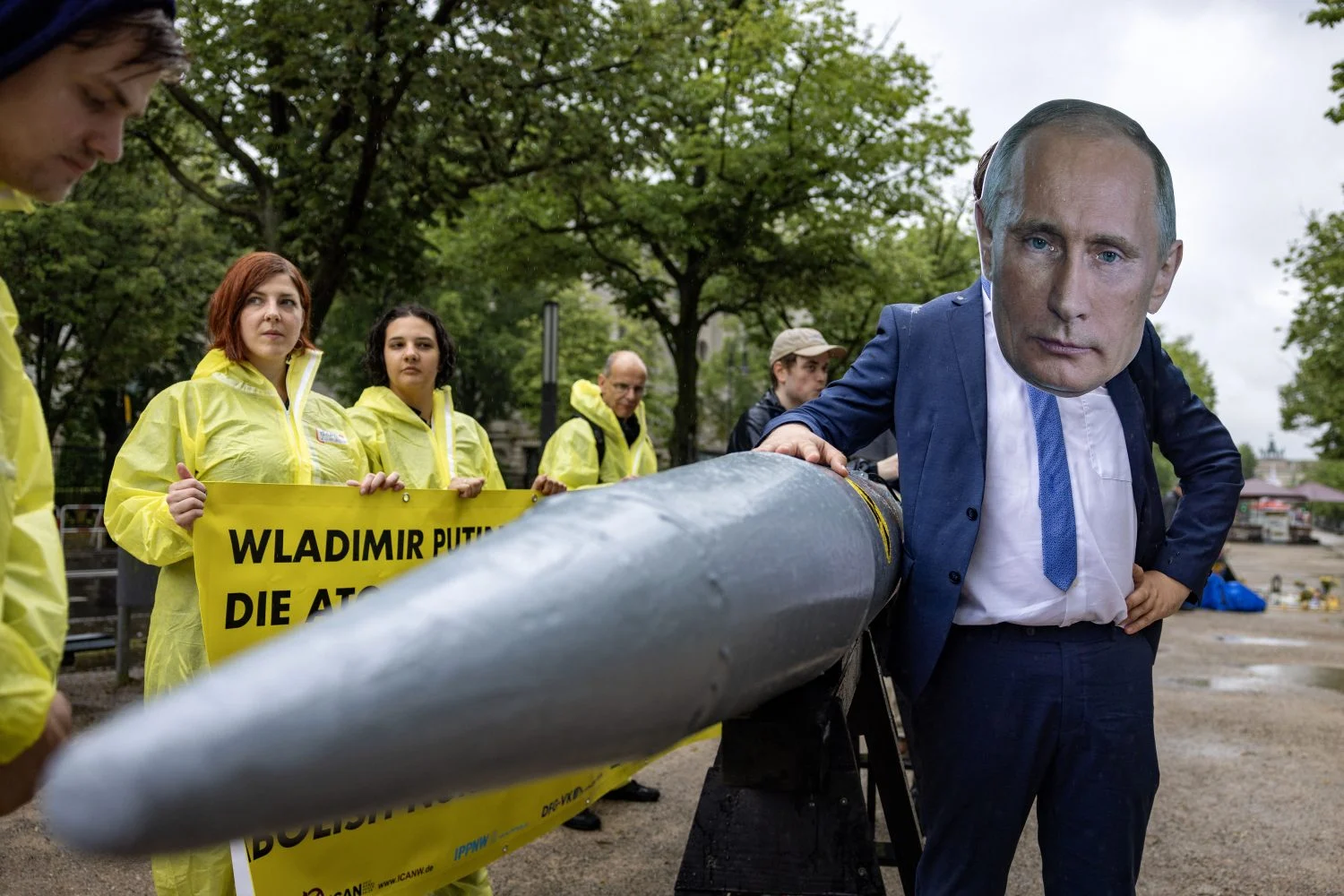
In Western debates about how to aid Ukraine—and how the war might end—there is a widespread view that Ukraine cannot and should not defeat Russia outright or fully expel it from its territory. Indeed, few Western politicians openly support Ukraine’s “victory,” instead using vague phrases like helping Kyiv “as long as it takes.” Since Moscow has nuclear weapons, so this line of thinking goes, it losing the war is not only impossible but, in fact, undesirable. To avert a humiliating defeat, Russia might risk Armageddon and use its nuclear arms, and surely Ukrainian territory and sovereignty are not worth that.
Having given up its nuclear weapons in 1994, Ukraine is doomed, in this narration, to accept at least some of Russia’s demands. Many prominent Western voices have promoted some version of this narrative. University of Chicago academic John Mearsheimer, who was adamant before February 2022 that Russia would not attack Ukraine and predicted a Russian victory multiple times since, warned the West not to push “a great power to the brink” because Russian President Vladimir Putin “might then turn to nuclear weapons.”
In Western debates about how to aid Ukraine—and how the war might end—there is a widespread view that Ukraine cannot and should not defeat Russia outright or fully expel it from its territory. Indeed, few Western politicians openly support Ukraine’s “victory,” instead using vague phrases like helping Kyiv “as long as it takes.” Since Moscow has nuclear weapons, so this line of thinking goes, it losing the war is not only impossible but, in fact, undesirable. To avert a humiliating defeat, Russia might risk Armageddon and use its nuclear arms, and surely Ukrainian territory and sovereignty are not worth that.
Having given up its nuclear weapons in 1994, Ukraine is doomed, in this narration, to accept at least some of Russia’s demands. Many prominent Western voices have promoted some version of this narrative. University of Chicago academic John Mearsheimer, who was adamant before February 2022 that Russia would not attack Ukraine and predicted a Russian victory multiple times since, warned the West not to push “a great power to the brink” because Russian President Vladimir Putin “might then turn to nuclear weapons.”
Similarly, Harvard University’s Stephen Walt has warned various times that Russia might resort to nuclear escalation. “There is the possibility it could escalate, particularly if Russia thinks it’s losing and believes that it would be a catastrophic defeat,” he said in 2023. “And that’s something that should worry all of us.” Indeed, the Biden administration slow-walked military deliveries to Ukraine—especially advanced weapons and anything that could be used to strike Russia—because it believed in the threat of nuclear escalation.
However, at no point did Kyiv or its Western partners remotely plan to impose a catastrophic defeat on Russia in the sense of Ukrainian troops marching into Moscow. Ukraine merely aims to liberate its own territory and restore the internationally recognized borders that Russia itself accepted in multiple treaties and agreements before 2014, when it began to invade, occupy, and illegally annex around one-fifth of Ukraine.
What’s more, Ukrainian President Volodymyr Zelensky does not even aim for complete liberation anytime soon. In 2025, Kyiv announced (and has since repeated) that it would accept a cease-fire agreement establishing the current front line as a future line of contact. In other words, Ukraine would accept a partial victory by Russia in order to achieve peace.
A brief history of war shows that apocalyptic thinking about a cornered great power resorting to nuclear escalation is misplaced. In the 1960s, nuclear-armed France lost a brutal colonial war in Algeria, which was not just any overseas colony but a fully annexed part of metropolitan France and home to 1.6 million European settlers. The United States lost in Vietnam, and the Soviet Union lost in Afghanistan—in each case, it was a humiliating defeat that neither superpower tried to prevent with nuclear escalation. China, too, lost a war against Vietnam that it did not choose to escalate, and neither did the United States when it, like the Soviets, lost in Afghanistan. Each time, a nuclear power faced an astounding defeat by a much smaller, non-nuclear enemy and did not press the red button.
Today, nine countries possess atomic arms, and most of them are fighting or have fought wars against non-nuclear states. Yet since the United States bombed Hiroshima and Nagasaki in Japan in 1945, why have these nuclear-armed states never again used weapons of mass destruction to achieve their war aims? Why have they not even credibly threatened to use them—if one discounts, as one should, Russia’s propagandistic saber-rattling since 2014?
In parallel to the technological advancement and proliferation of nuclear weapons since 1945, the world’s thinking about these weapons has evolved, too. As a result of intense international deliberation about the global consequences of atomic war and nuclear winter, an informal worldwide taboo on using these weapons has emerged. To be sure, nuclear arms continue to play a prominent role in national security planning and discourse—as instruments of deterrence and ultimate tools of national defense in case of truly existential, all-out war. At the same time, the strategic futility and moral irresponsibility of using nuclear weapons in the context of limited foreign interventions has become widely acknowledged.
The widespread belief in the strength of this taboo has even allowed non-nuclear states to attack nuclear-armed nations. In 1973, for instance, Egypt and Syria—neither of which possessed atomic weapons back then or possesses them today—attacked Israel, even though the latter was known to have an unofficial but fully developed nuclear arsenal by that point. In 1982, non-nuclear Argentina began a war with nuclear-armed Britain over the Falkland Islands.
The story of Ukraine’s disregard for Russia’s nuclear arsenal is both similar and different in some ways. Since the start of Moscow’s long war against Ukraine, which began with the invasion of Crimea in 2014, Russian officials have—in thinly disguised form—repeatedly threatened to use nuclear weapons. Not only have these intimidation attempts become shriller and more frequent since the start of the full-scale invasion in 2022, but Russia also demonstratively changed its nuclear doctrine in 2024 to lower the official threshold for nuclear escalation in a conventional war.
Moscow’s apocalyptic rhetoric since 2014 has been very effective in Europe and the United States. Among other factors determining Western hesitation in backing Ukraine, the Kremlin’s coded yet well-understood nuclear threats have led Western governments to provide weapons to Kyiv with much restraint, significant delay, numerical limits, and restrictions on their use.
In Ukraine itself, by contrast, the direct effects of Russia’s yearslong nuclear signaling have remained close to zero. Kyiv has continuously violated Moscow’s putative red lines, including the first ground invasion of Russian territory since World War II, drone bombing runs against Moscow and St. Petersburg, and the systematic destruction of strategic targets deep inside Russia. Some of the attacks on Russian territory were conducted with Western weaponry such as British Storm Shadow missiles.
These attacks negate even the new, lower-threshold nuclear doctrine. In 2024, Putin said , “We will consider such a possibility [of nuclear retaliation] when we receive reliable information about a massive launch of air and space attack assets and them crossing our state border.” Kyiv has been conducting increasingly massive drone and missile operations inside Russia with little attention to the Kremlin’s doctrinal specifications and its propagandists’ dark warnings.
There is no need to view Ukraine’s actions as hazardous. They are based on more rational calculations than reflexive Western fear of Russian nuclear escalation. To be sure, Kyiv is under no illusions that Moscow would be constrained in breaking the nuclear taboo by ethical considerations, given the Kremlin’s virulent Ukrainophobia.
Rather, there are high practical risks if Moscow were to use nuclear strikes to defend illegitimately captured foreign territory rather than its own legitimate homeland. The full range of aftereffects of such an unprecedented violation of international law, rules, norms, and customs is difficult to foresee—including for Putin and his entourage. These risks are magnified by reputational vagaries: Escalation could be seen as a sign of weakness, of a great power incapable of prevailing against a non-nuclear middle power with conventional means. (In their reluctance to capitulate after losing a conventional war to Iran, U.S. President Donald Trump and his inner circle now face a similar risk calculus that makes nuclear escalation by the United States unlikely.)
The net sum of strategic gains and losses for Moscow from the explosion of one or more atomic warheads in or over Ukraine is unpredictable. Unless Kyiv fully capitulates, Moscow is likely to lose more—perhaps far more—than it would gain from escalation. Given Ukrainian societal resilience and will to fight thus far, it is unlikely to simply back down in reaction to a nuclear hit. The rest of the world, including many non-Western countries like India, is not going to take a Russian break of the nuclear taboo lightly.
In contrast, Moscow has had much success by merely threatening to use nuclear weapons in Ukraine. Although the Ukrainians have ignored such threats, Moscow’s nuclear signaling greatly hurt Kyiv by way of nervous Western governments limiting their aid in reaction to Russian rhetoric. It was no coincidence that nuclear saber-rattling often peaked during Western debates about sending weapons to Ukraine—in the early days of the war, when it was about sending any weapons at all, and later, when it concerned battle tanks, fighter jets, or long-range missiles.
Oddly, the one residual likelihood of a potential nuclear escalation in the Russia-Ukraine war could emerge in the opposite scenario from what many Westerners fear. Mariana Budjeryn, a nuclear historian at the Massachusetts Institute of Technology, argued in the Bulletin of the Atomic Scientists that the Kremlin may feel encouraged to use atomic arms not to prevent some sort of humiliation but when it is already close to winning. Similar to how the United States decided to use atomic bombs to hasten its impending victory over a prostrate Japan in 1945, Moscow could go nuclear to transform an already advantageous military situation into a quicker success.
Russia would still incur global political costs from breaking the nuclear taboo, “but these costs could be better mitigated by a winning Russia than a losing Russia,” Budjeryn argued. Western countries, she wrote, might be disinclined to impose severe military costs on Russia in response if Ukraine looks like a lost cause. “Opprobrium from China will matter less to a Russia that won its war in Europe,” she continued. Finally, “Russia’s nuclear use is bound to make an impression in NATO capitals and allow Russia to shape the broader post-war settlement in Europe to its advantage.”
Both Western awe of Russia as an atomic superpower and fear of a Russian nuclear reaction to losing in Ukraine are misinformed. During the past eight decades, nuclear-armed states have repeatedly lost interventionist wars and even been attacked by non-nuclear countries.
If nuclear escalation was indeed likely or even inevitable should Russia begin to lose in Ukraine, then a similar scenario should long have happened in a previous case where an interventionist power was militarily cornered by the victim of its invasion. According to this logic, Russia should have already gone up the ladder of nuclear escalation since 2022, rather than merely talking about it.
Decisions about the degree, kind, and duration of support for Ukraine should not be guided by angst and strategic myopia. They should be informed by a concern for the victims of criminal aggression, solidarity among democratic nations, and a basic self-interest in the preservation of elementary international order. Moscow may not have any moral qualms about exploding a nuclear warhead in Ukraine. Yet history shows that such an escalation is unlikely, unless the mass of the Ukrainian army starts to advance deeply into Russia’s legitimate state territory. As long as the Kremlin believes that the world’s reaction to a Russian nuclear adventure will be resolute and have devastating consequences for Russia itself, it will continue to refrain from entering such an uncertain path.
