


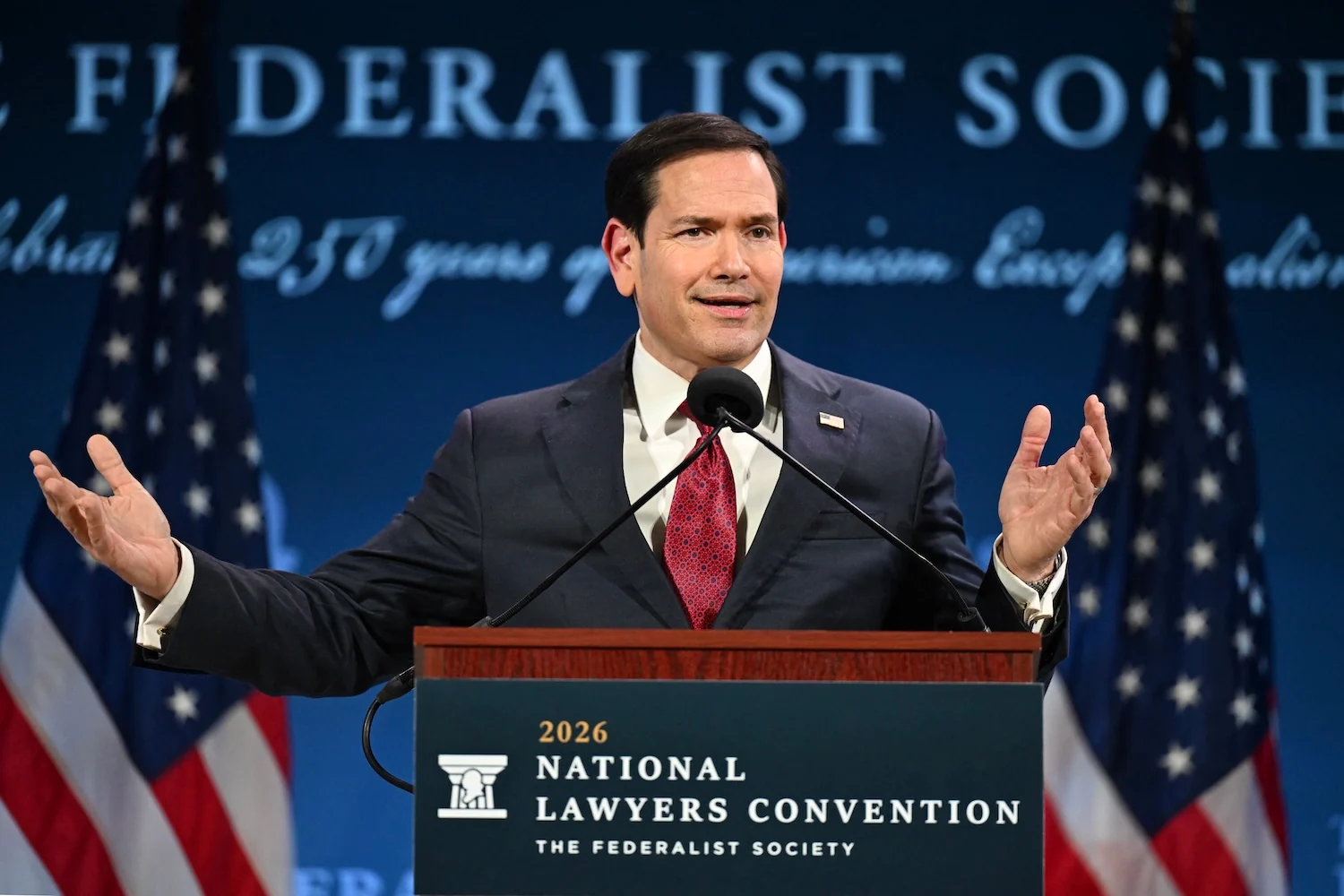
U.S. Secretary of State Marco Rubio’s speech last week excoriating the rule of law, and taking particular aim at the International Criminal Court, is a sharp reminder that the United States under the Trump administration has become a rogue state.
It was especially jarring to see America’s top diplomat attack the notion of international law just ahead of a three-power summit in China that will see the United States matched against—or in concert with—China and Russia. For decades, the United States has championed international law and respect for global norms as a way to contrast its behavior with rivals that carry out genocides and war crimes. That contrast is every day dimmer, by design.
“At the State Department, we have seen the same thing firsthand in the realm of what is called international law. We’ve heard the concept international law invoked against nearly every major foreign-policy decision or action of this administration,” Rubio said in a speech to the Federalist Society, a group of conservative lawyers. “For this global elite, international law is not a neutral body of rules; international law is an instrument, an instrument to advance their interests under the pretense of universal principles.”
Rubio focused much of his ire on the International Criminal Court (ICC), a body created more than two decades ago to prosecute the very worst transnational crimes, including genocide and crimes against humanity. Rubio called the ICC a “fake court which is an unelected world tribunal” and cheered U.S. President Donald Trump’s sanctions on members of the court. Those sanctions, which will be fully effective in the spring, are already creating havoc for judges and prosecutors on the court.
“If they’re foolish enough to try to enforce their paper decrees on Americans, our answer will probably be the same as the Roman general, Pompey, when he said to those who were trying to invoke their cities’ charters against his legions. He said, ‘Stop quoting laws to men with swords,’” Rubio said, a line later echoed by Defense Secretary Pete Hegseth. (Neither man got the quote, from Plutarch, quite correct.)
Read More
-
Hegseth, Trump, and Bondi sit at a table with the presidential seal affixed to it. All our dressed in business formal attire. Trump has his arms outstretched as he speaks. Hegseth, Trump, and Bondi sit at a table with the presidential seal affixed to it. All our dressed in business formal attire. Trump has his arms outstretched as he speaks. Has Trump’s America Gone Rogue?
The Trump administration’s cavalier approach to the rule of law is the end of an era.
-

A close-up shot shows a man dressed like a medieval court jester, with a shirt and dangly hat in an American flag pattern. The man’s face is pointed white with a red line down the middle and blue smudges around his eyes. A close-up shot shows a man dressed like a medieval court jester, with a shirt and dangly hat in an American flag pattern. The man’s face is pointed white with a red line down the middle and blue smudges around his eyes. The United States Has Become a Rogue State
Here’s what the rest of the world can do about it.

-

Ko Ko Hlaing, a middle-aged man in a suit and tie, sits at a desk behind a placard that reads “MYANMAR.” Other people in business formal clothing sit behind him or mill about the wood-paneled courtroom. Ko Ko Hlaing, a middle-aged man in a suit and tie, sits at a desk behind a placard that reads “MYANMAR.” Other people in business formal clothing sit behind him or mill about the wood-paneled courtroom. ICJ to Deliver Landmark Verdict on Myanmar
The Rohingya genocide case will have wide-ranging impacts, including for the court’s forthcoming judgment on Israel.
The jettisoning of even a modicum of respect for the rule of law was alarming to experts who have spent decades working to ensure that U.S. foreign policy upholds a rules-based system.
“I thought it was one of the most ignorant speeches given by a secretary of state I can ever recall,” said Harold Koh, who was the State Department’s legal advisor during the Obama administration and is now a professor at Yale Law School.
He noted that the opening lines of the U.S. Declaration of Independence justified the colonies’ rupture with England “out of a decent respect for the opinions of mankind.”
“They have no appreciation for how international law has made our lives better. Nobody ever talked about air-traffic control until it broke, but international law is air-traffic control for the entire world,” Koh said.
The actions taken by the second Trump administration had already raised concern about a rash of lawlessness in the U.S. government, as Rubio acknowledged in his speech. From the extrajudicial killings of alleged drug smugglers in the Caribbean, to the apparent targeting of civilian infrastructure in Iran, to the threats to annex Canada and Greenland, the Trump administration has long forsaken any pretense of legitimate behavior and support for international law, even when that would advance U.S. interests. Washington’s efforts to reopen the Strait of Hormuz, for instance, and prevent Iran from regulating traffic in the waterway depend on adherence to international maritime law (as Rubio has previously noted).
Rubio’s attacks on the ICC, which codified between 1998 and 2002 the architecture of international justice that was created and carried out by the United States in the aftermath of World War II, is particularly striking. The court was created specifically to prosecute the very worst crimes, limited to genocide, crimes against humanity, war crimes, and crimes of aggression.
The ICC, long a target of suspicion for U.S. conservatives who fear that a supranational body will usurp U.S. sovereignty (even though the United States is not a party to the convention or the court), has issued controversial arrest warrants for many world leaders, including two who are favorites of the Trump administration.
The ICC issued a warrant for the arrest of Russian President Vladimir Putin in 2023 for the alleged mass kidnapping of Ukrainian children during the Russia-Ukraine war and for Israeli Prime Minister Benjamin Netanyahu in 2024 for alleged war crimes related to the war in Gaza.
Ambassadors of the more than 120 countries that are parties to the Rome Statute that created the ICC met at The Hague on Wednesday to discuss how to deal with threats from the United States, among other countries. There are also fears that Washington will sanction additional international bodies, including the International Court of Justice, which is slated to rule on alleged genocide committed by the junta in Myanmar. Legal experts say that such a ruling could lower the legal threshold for genocide, which could put countries including Israel in the crosshairs of future judicial actions.
Rubio’s speech, which follows similar bellicose messages and policies from other officials such as Hegseth and U.N. Ambassador Mike Waltz, show the Trump administration’s disdain for the rules that underpinned the American century, Koh said.
“International law sets default patterns of behavior. It’s like driving on the wrong side of the road—that leads to car crashes, and this leads to conflicts with allies,” Koh said.
“How does attacking these institutions help us? Everybody knows the ICC is going to survive Marco Rubio,” he added.
