


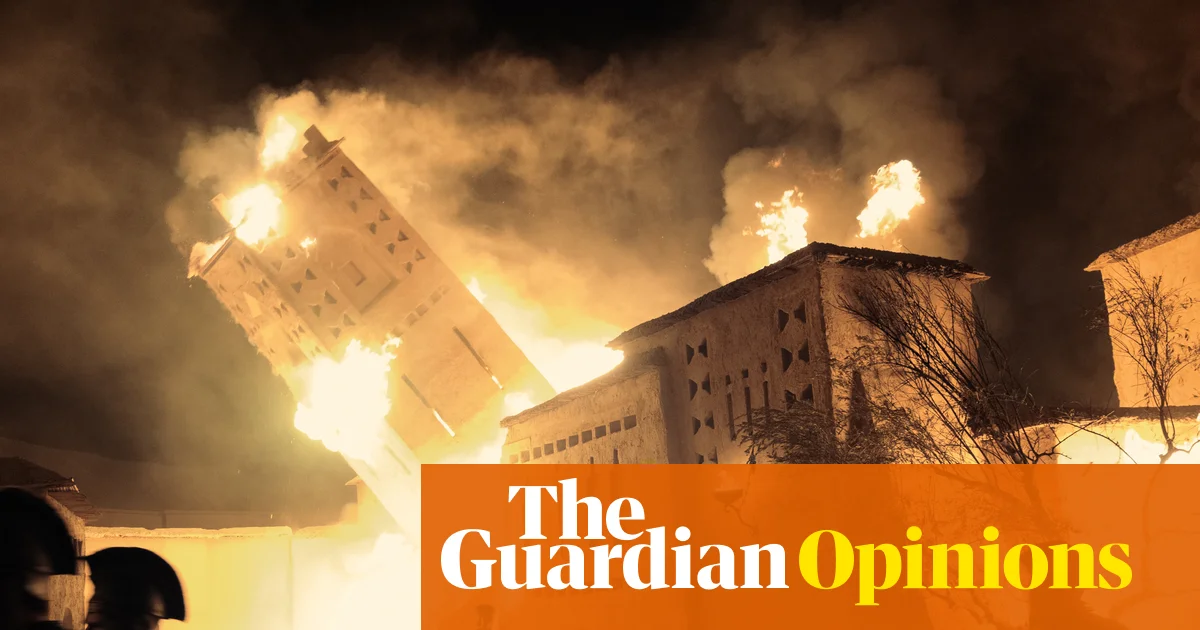
The biggest sales of poetry since records began are expected this year. The reason? The movies, of course. UK print sales of The Odyssey increased by 1,400% in the four weeks to 25 July compared with the same period last year. In the US, year-to-date sales of The Odyssey are up 76% so far. Christopher Nolan is doing miracles for Homer – whatever problems one might have with the movie (and Emily Wilson, who made the most popular recent translation, has a few).
Strip out the Odyssey factor, though, and poetry is still doing exceptionally well, driven by writers whose work is often mildly denigrated as “Instapoetry”, such as Lucas Jones. His is a kind of versifying that delivers immediate uplifting aphorisms rather than either the kind of dense, allusive play with language that might reward repeated reading; or the sort of limpid, performable music that propels a well-translated Homeric epic. But even so, the poets of Instagram reach for something that can’t quite be expressed through everyday speech. And readers respond to it.
Sales figures are a rough and insubstantial metric, though. They don’t tell us how someone feels when they read a good poem, what it expands for them, what memories it brings, what connections to other times and places. What shiver of alienation it offers; what moment (often) of puzzlement. Poetry can be baffling; it can refuse to unfurl all of itself to the reader. Better, I think, to sink into the sensations that a poem creates than always to worry at it like a puzzle. By its nature, poetry expresses what can’t be said in prose; it can be resistant, you can snag on it. Poetry is needed in an emergency, when ordinary ways of writing or speaking can’t get at the moment, or the feeling, or the thought.
What poetry is not, however, is peripheral to human life. What I have learned by reporting from Ukraine is that when catastrophe hovers overhead rather than looms from a distance, poetry seems more, rather than less, vital. The most rapt poetry reading I have ever attended was in the frontline city of Kharkiv, the border with Russia only 30km away, when one poet described scratching poems into the wall of her Russian prison cell and audience members silently mouthed the learned-by-heart words of writer Serhii Zhadan’s poems as he performed them.
The foreign correspondent Lindsey Hilsum, who has covered wars and humanitarian crises for decades, has long understood this, which is why I Brought the War with Me, her anthology of work by poets across time and geographies, accompanied by her stories, is such a treasure. The poetry emerging from Gaza, and from Palestinian poets scattered across the world – figures such as the young writer Haia Mohammed, or the Palestinian-American poet Fady Joudah – collectively provides the most arresting document of lives lived amid cataclysm: such poetry is composed with an urgency, vividness and compression that no other art form can quite achieve.
It is true, as the Ukrainian poet Halyna Kruk said in 2022, that “no metaphors work against a man with a machine gun … no poetry can save you from a tank”. It is true, as her fellow Ukrainian writer Kateryna Iakovlenko has put it, that the poetry created most obviously by war is asemic, ugly and inscribed into the very land: “Ruins and abandoned houses, devastated forests, burnt land and roads carved up by tanks and armoured personnel carriers began to resemble letters and unwritten sentences.”
And yet, with remarkable speed, and despite its failure either to deflect bullets, or keep its writers and readers physically safe, poetry quickly began to be written in Ukraine after the full-scale invasion. Poetry was the form that could grapple most effectively with the collapse in meaning brought about by the shock of violence, the feeling that time had ceased to carry significance, the future ripped away. Poems could be written relatively quickly, with limited means, and even in inhospitable places (the shelter, the trench).
The novelist Victoria Amelina, who was later killed by a Russian bomb that targeted the restaurant where she was eating, stopped writing novels (which both take time to write and contain time as an ingredient) and started writing poetry. Some of it denied its own status as poetry, as if it were just the shrapnel-hit remnants of language. One poem, Not Poetry, translated by Uilleam Blacker, contains the lines, “But the reality of war / devours punctuation / plot structure / structure …”
after newsletter promotion
Poems were written at the front. The young writer Artur Dron’, who served in the Ukrainian armed forces for more than three years, did not write about bravado or heroism, but made small, delicate memorials for fellow soldiers who had been killed. Or sometimes he built encapsulations of seemingly insignificant moments.
One of his poems is about a child in some unnamed village near the frontline, who becomes the unofficial mascot of the soldiers posted there. At Christmas, they leave the young boy “a bag with our crushed Snickers bars / and tangerines. / The ones with seeds, / but oh so sweet.” It was a fleeting incident: not newsworthy, not impressive, nothing for the history books – but it was material for a poem. Yaryna Chornohuz told me that her work as a soldier poet was the “documentation of feelings”.
In the midst of a cataclysm, poems survive, often stripped back to their most essential forms, which are surely universal and primordial human forms of expression: the lament for the dead, the lullaby for the child, the curse. In the end, humans need those things: those songs, those poems. They are proof of life. They may not be remembered; but poetry has a better chance at survival than much else that humans do or make. They may become memorials more lasting than bronze.
