


This story was originally published by Yale Environment 360.
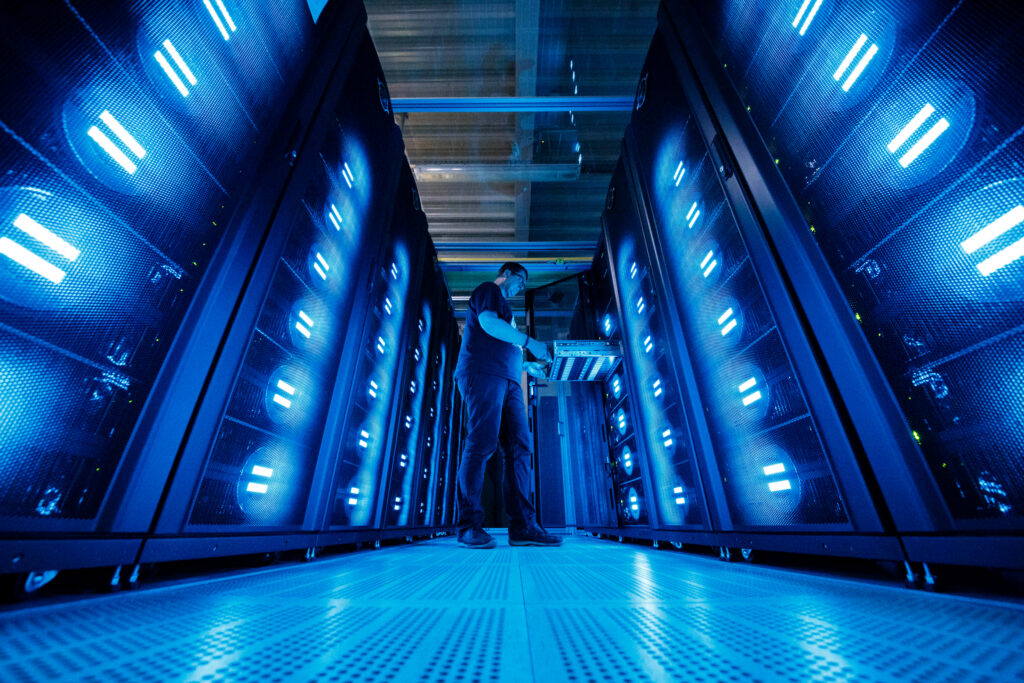
In a modern five-story building in the center of Hamburg, Germany, technicians are preparing to install several new “racks”—gray metal casings that hold computing hardware—alongside the scores that already line the narrow, dimly lit corridors of the German Climate Computing Center (DKRZ), one of the world’s largest repositories for climate simulation data. The new equipment will add about 5 petabytes of storage capacity to the 254 petabytes of data already stored here. One petabyte of data is equivalent to the storage space needed for roughly 200 million high-resolution images.
Under normal circumstances, the DKRZ’s mission is to provide computing power and storage to the German climate science community. But these new racks will serve a different and highly sensitive purpose: They will store backup versions of climate simulations from the other side of the Atlantic. The operation aims to ensure that essential work performed by U.S. scientists for the next major United Nations climate assessment, due in 2029, cannot be meddled with or compromised by the administration of President Donald Trump, which has slashed funding for climate research, buried scientific reports, removed references to human-caused warming from dozens of government websites and sought to prevent satellites from collecting key climate data.
Leaders of German science organizations publicly cite these actions as their primary motivation for creating backups. The German Research Foundation, the country’s main science funding body, believes that the Trump administration could block European access to data and research findings stored in the U.S. “The deletion of data has also become a possibility,” says the foundation’s program manager, Kathrin Winkler, “and there is a risk that [data] could be manipulated to skew findings in a desired direction.”
Trust in U.S. science policy has fallen to a low point in Europe, and fears of losing scientific data are mounting. The U.S. government quit both the U.N. Intergovernmental Panel on Climate Change (IPCC) and the U.N. Framework Convention on Climate Change in January, though U.S. researchers are still contributing to global climate science. To support them, the German Research Foundation in late 2025 set up a program, with a budget of $35 million, to provide a safe haven for permanently storing copies of U.S. data from public and open sources.
The DKRZ project is called “CMIP7-ark”—a lifeboat for the U.S. contribution to the seventh IPCC assessment. Six other projects for U.S. science datasets, with names like “SHIELD” and “SEND” (Secure Endangered Earth Data), have also received funding. Christopher Kadow, head of the data analysis division at the DKRZ, says, “We cannot simply accept that important contributions might be lost for technical or political reasons.”
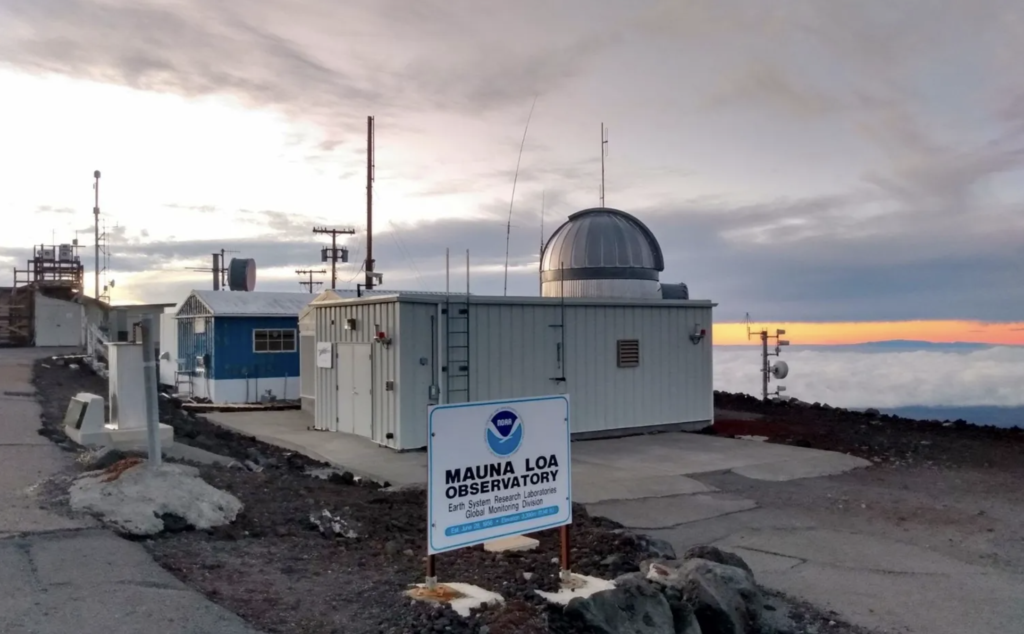
Data collections form the foundation of all empirical science. Climate, environmental and biodiversity research relies on countless historical and contemporary datasets. Some of these collections, such as the iconic time series of atmospheric carbon dioxide concentrations made at Hawaii’s Mauna Loa Observatory, have been ongoing for decades and are critical for tracking environmental change. (In 2025, the Trump administration tried to defund and close the observatory, but later Congress rejected its proposed cuts.)
While detailed datasets are essential for research, it is not standard procedure to back them up in alternate locations. Most scientific datasets are physically stored on hard drives or magnetic tapes at the universities or institutions where they are generated. One simple reason for this is that, until recently, the world seemed safe enough that scientists saw no need for offsite backups. Another reason is that transferring and storing such large amounts of information is complicated. Sending petabytes of data through the internet takes months, and renting faster fiber optic cables can be extremely costly. Often, the most cost-effective way to transfer large volumes of data is to put them on hard drives or far cheaper magnetic tapes and send them through the “sneakernet,” which means they are physically transported by car, plane, or ship.
Still, the process is expensive and arduous, so most datasets have been kept in just one place. But in a world where political upheaval, cyberattacks and armed conflicts are becoming more frequent, this practice is increasingly considered to be precarious. “If data is stored at only one site, there is a much greater risk of loss from events such as extreme weather or infrastructure failure,” says Eleanor O’Rourke, the U.K.-based director of the International Project Office of the Coupled Model Intercomparison Project, which coordinates global climate models for the IPCC’s assessments. Climate simulations for the IPCC are now considered so critical that overseas repositories are thought necessary for all contributions.
Until recently, the idea that the U.S. science community would have to track or rescue lost datasets was unthinkable. After all, environmental data generated or funded by U.S. government agencies was paid for by taxpayers and generally remains in the public domain. Yet these datasets exist in physical forms at specific locations and require dedicated experts to maintain them, which makes them vulnerable to human interference, as well as natural disasters, technical problems like short circuits or battery explosions and neglect. “The data repositories, digital asset management services, and preservation systems that ensure research data remains open and accessible are often overlooked—until they disappear,” data experts Jennifer Gibson and Kaitlin Thaney warned recently.
One example of political interference is the recent threat to 300 federally funded datasets carefully built up over decades by NASA’s Socioeconomic Data and Applications Center (SEDAC). Alex de Sherbinin, the former SEDAC manager, said the center was founded to “serve as a bridge between the Earth and social-science research communities,” integrating remote sensing data with information on human population, poverty and infrastructure.
In early April 2025, de Sherbinin was shocked to discover that SEDAC’s datasets had been completely removed by Elon Musk’s Department of Government Efficiency team. It took immense efforts by various institutions, quickly scraping datasets from active servers while they were still operational, to secure the information and transfer it to a new host: the Harvard Dataverse Repository. Assumptions that U.S. government agencies will store scientific data long-term “are proving tenuous at best, given the anti-science predisposition of the current administration,” de Sherbinin says.
Numerous similar projects aim to relocate or duplicate datasets within the U.S. But the U.S. is far from the only country where data is vulnerable, and political interference is not the only risk.
Several research institutions around the world, including a multidisciplinary scientific research center in Croatia and an institute for industrial engineering in Germany, have in recent years been the target of elaborate hacking operations, in which intruders block access to files and demand money to restore them. Victims of cybercrimes rarely disclose publicly which files were targeted, but it’s clear that such attacks can affect scientific data collections.
And then there’s war. Russia’s attacks on Ukraine have not only caused mass civilian death and suffering but also immense damage to the country’s science. “Universities and research institutes have been targeted by Russian bombardments, and in some cases they were completely destroyed,” says Anastasiia Lutsenko, a Ukrainian researcher at the Max Planck Institute for Innovation and Competition in Munich, whose work focuses on how her country’s science system is responding to the war. The Russians, she says, “know how much lasting harm they can inflict by attacking science.”
Lutsenko cites the transfer of data and samples to secure locations as an important step. Even before Russia’s 2022 invasion, a German-Polish-Ukrainian collaboration helped digitize records of early meteorological observations—conducted between 1808 and 1880 at eight Ukrainian meteorological stations—and transferred them to a server at the University of Giessen, Germany. This eliminated the risk of losing valuable historical data in the war. A similar transfer took place after missiles struck near the servers holding Ukraine’s contribution to the Global Biodiversity Information Facility’s records in Kharkiv at the start of Russia’s invasion.
“It would be ideal if, in the future, all climate data worldwide were connected via digital pipelines.”
— German scientist Christopher Kadow
The need for increased resilience—the ability to remain functional despite shocks and fully recover from them—was the focus of the American Geophysical Union (AGU) gathering held in Berlin this March. There, nearly 100 experts, primarily from the U.S. and Europe, discussed how to respond to the Trump administration’s attacks on science.
The AGU represents more than 60,000 Earth and space scientists worldwide, and it has emerged as a leader in efforts to protect science and scientists from the Trump administration’s politically motivated attacks. When the administration refused to send U.S. experts to IPCC meetings in 2025, the AGU formed the U.S. Academic Alliance for the IPCC and nominated nearly 300 U.S. scientists to be authors of the IPCC’s next assessment. And in the summer of 2025, it launched its Data Resilience Project, a global initiative to rethink how science is organized.
AGU president-elect Ben Zaitchik believes that science is at an inflection point. “We have engaged in triage efforts to ensure data remains usable and accessible,” he said at the Berlin meeting. “But we clearly now have arrived at a moment where we must fundamentally reimagine data organization and maintenance for long-term viability and growth.”

Creating backups of datasets and storing them in secure, distant locations was identified as a priority measure during the meeting, as was coordinating a global data community aimed at mitigating current and future risks. Such an effort was vital not only for scientists, an AGU spokesperson noted, “but also for engineers, public safety officials, health experts, policymakers, and a wide array of industries and communities globally,” which depend on scientific data. As a result of the Berlin meeting, a broad coalition of German national research centers was formed to offer safe storage for public domain information to scientists from the U.S. and other countries.
In addition to the DKRZ efforts, other initiatives have emerged across various fields. For example, the Senckenberg Natural History Museum, in Frankfurt, saves data from wildlife trail cameras in Ukraine and biodiversity data from war-ridden Yemen. “We want to ensure that biodiversity data remains usable even under crisis conditions,” a Senckenberg spokesperson says.
For such transfers, it is critical to store not only the data itself but also any specialized software required to read and analyze it. “We’re developing protocols and procedures for exchanging data, distributing multiple copies globally and ensuring that the data remains analyzable indefinitely,” says Frank Oliver Glöckner, a professor of earth systems data science at the University of Bremen and the head of Pangaea, a long-term data repository run by the Alfred Wegener Institute for Polar and Marine Research and the university, both of which are preparing to integrate data from a U.S. climate research center slated for closure.
Glöckner said he believes that Trump “has, to a certain extent, done science a favor by making it clear how important it is to not just hoard data in one place but to truly share it with the global scientific community.”
“It would be ideal if, in the future, all climate data worldwide were connected via digital pipelines,” says Kadow, of the DKRZ. “That way, in the event of a threat, we could simply flip a switch to secure it elsewhere.” In the future, he says, this could also benefit researchers in Germany, where the AfD, an extreme far-right party that denies climate science, recently won a state election for the first time. “We don’t know what political shifts may occur in Germany,” he says. “We aren’t completely protected from risks or developments like those in the U.S. either.”
About This Story
Perhaps you noticed: This story, like all the news we publish, is free to read. That’s because Inside Climate News is a 501c3 nonprofit organization. We do not charge a subscription fee, lock our news behind a paywall, or clutter our website with ads. We make our news on climate and the environment freely available to you and anyone who wants it.
That’s not all. We also share our news for free with scores of other media organizations around the country. Many of them can’t afford to do environmental journalism of their own. We’ve built bureaus from coast to coast to report local stories, collaborate with local newsrooms and co-publish articles so that this vital work is shared as widely as possible.
Two of us launched ICN in 2007. Six years later we earned a Pulitzer Prize for National Reporting, and now we run the oldest and largest dedicated climate newsroom in the nation. We tell the story in all its complexity. We hold polluters accountable. We expose environmental injustice. We debunk misinformation. We scrutinize solutions and inspire action.
Donations from readers like you fund every aspect of what we do. If you don’t already, will you support our ongoing work, our reporting on the biggest crisis facing our planet, and help us reach even more readers in more places?
Please take a moment to make a tax-deductible donation. Every one of them makes a difference.
Thank you,
