


- Independent journalism plays an often-overlooked role in conservation by providing credible information, exposing problems, amplifying local voices, and helping successful approaches gain recognition and support.
- Investigations in Malaysia, Peru, and Gabon illustrate how reporting can empower communities, inform government decisions, and strengthen accountability, often contributing to outcomes that emerge months or years after publication.
- Conservation philanthropy should invest more in independent journalism, which can strengthen the effectiveness of conservation efforts even when its impact is difficult to measure, argues Rhett Ayers Butler, founder and CEO of Mongabay, in this commentary.
- This text is a commentary and does not necessarily represent the views of Mongabay.
In 2021, we received a tip from a source in Sabah, Malaysia, about a proposed carbon credit deal. We received this tip because we’d developed a relationship with the source over 15 years. They trusted us to protect their identity and verify what they gave us. And if we covered it, they knew the information would reach the people it needed to reach. The reporting would also enable local outlets in Malaysia to pursue the story because they could deflect blame to Mongabay for breaking the news.
The deal was a big one. It covered some 2 million hectares (5 million acres) of rainforest in the state of Sabah in Malaysian Borneo. But that was only part of the story. The more troubling issue was that a group of senior Sabah officials was negotiating with a Singapore company incorporated just two years earlier with only $1,000 in paid-up capital and no demonstrated track record of managing a conservation project on anything approaching this scale. Indigenous communities whose customary rights could be affected had not been meaningfully consulted. Their ancestral land was potentially being locked up in an opaque contract with largely unknown operators for more than a century.
When the story broke, it immediately made headlines in Malaysia and beyond. The timing was important. A Malaysian delegation had been planning to market the project’s carbon credits to investors at the U.N. climate conference in Glasgow, Scotland. Those plans fell apart. Back in Malaysia, Indigenous leader Adrian Lasimbang took the government to court.
In February 2022, the agreement was declared legally unenforceable in its existing form. By 2024, it had been effectively blocked.
Many people helped bring this about. Our part was dragging a deal made behind closed doors into public view.
Conservation organizations spend billions of dollars every year on fieldwork and advancing policy. That work is often the difference between a habitat being saved and destroyed.
Far less goes to independent reporting, even though it’s often how local voices get elevated and problems that matter come to light. I think that’s a mistake.
Philanthropic foundations often judge grantees on quantitative metrics like hectares conserved, people trained, animals vaccinated, and trees planted. Scientists can measure changes in tree cover, the complexity of a soundscape, the number of tigers detected, or the recovery of water quality in a river. These are important measures of progress, but they reveal little about who made the decisions, how those decisions were reached, who was engaged, or what happens when the interests of conservation organizations, governments, and communities diverge.
The entities doing the work understand these issues better than most, but they face pressures to show results, simplify complications, maintain donor funding, and reassure their supporters. Even with the best intentions, that can lead to problems being understated or going unrecognized. Or ignored.
I have seen variations of this throughout my more than quarter of a century at Mongabay. Much of our reporting is done in places where governance is weak, public information is scarce, decisions about land and resources are made with limited scrutiny, and impunity is common. Sometimes the problems are egregious, but more often the circumstances are complicated.
For example, in 2024, we learned that companies had persuaded Indigenous communities in Peru, Bolivia, and Panama to sign agreements giving up their economic rights connected to more than 9.5 million hectares (23.5 million acres) of ancestral forests. The promises sounded attractive on paper: the companies had pledged jobs and grants, and the U.N. had seemingly endorsed the projects. But Mongabay’s reporting led by Gloria Pallares undermined these claims. The communities were surrendering important rights, and the U.N. had not endorsed the projects. After learning of these findings, the Matsés community in Peru terminated its agreement, and Conservation International ended a memorandum of understanding with one of the companies.
Had dogged journalists not taken the time to chase the paper trail and talk to people ranging from community members to international financiers, some of these arrangements might have escaped scrutiny until they were much harder to challenge. Journalists asked the hard questions and published findings that reached the right audiences, from those affected to people with the authority to intervene.
Ecological gains alone aren’t enough when conservation depends on the cooperation of communities living in and around protected landscapes. If a project leaves local people feeling excluded or mistreated, that resentment can eventually undermine the conservation area itself.
Local journalists are usually the best equipped to spot these tensions because they understand how local politics, customary rights, past disputes, and traditional practices shape current decisions. They are often the first to notice when an official explanation clashes with what residents are seeing on the ground, or when a new initiative repeats the mistakes of a project that failed a decade earlier. Reporting those stories relies on relationships built over years with people who would never speak to an outsider, and on reporters returning again and again until they get the details right.

For philanthropists, independent journalism has value well beyond “raising awareness.” It can identify risks before they become more serious, and reveal shortcomings in approaches that have become widely accepted. The findings may be uncomfortable, but if the goal is to effect change, funders need to know what is actually working on the ground.
Foundations can fund coverage of subjects they care about, but they cannot dictate which stories get pursued or what those stories conclude. Once a funder can steer coverage away from its own investments, the reporting stops being useful.
The independence that allows journalists to expose problems also makes their accounts of conservation successes more credible. Public coverage of conservation tends to focus on extinctions and Amazon fires, so practical successes rarely get noticed outside specialist circles. Some are the result of decades of patient work by scientists, park staff, NGOs, microenterprises, and local communities. Independent coverage gives those efforts credibility because it isn’t coming from an organization’s marketing team. It also lets other practitioners and funders see what is working, helping good ideas spread.
One of my favorite recent examples comes from a forest in the Central African country of Gabon. There, the community of Massaha had been campaigning to protect its ancestral forest from a logging concession operated by a foreign company. That forest, known as Ibola Dja Bana Ba Massaha, or “the reserve of all Massaha’s children,” was a place the community relied on for hunting and forage. It held sacred sites, ancestral villages, and the graves of community members.
Despite the forest’s significance and the community’s efforts to protect it, the campaign had stalled. After a scientist who had worked with the community reached out, Mongabay asked a Gabonese journalist to look into the situation. Benjamin Evine-Binet’s story brought the dispute to an international audience and prompted the country’s environment minister to visit the site. He found irregularities in the logging company’s permit and revoked it. The community is now working through the process of having its forest officially recognized as a community-conserved area.
The villagers organized the campaign, and government officials made the decisions that followed. Our reporting helped their concerns reach people with the authority to respond. Usually our part is harder to pin down. A story might inform a regulatory decision months later or provide evidence for a court case. It could prompt a prosecutor to investigate malpractice, or introduce a local wildlife association to an approach developed elsewhere. Sometimes we see nothing after publication.

At Mongabay, we try to understand what happens after a story is published. We track readership and republication, but we also follow up with reporters and sources, sometimes years later, to learn whether anyone used the information. Attribution is rarely straightforward, and there are important stories whose effects we will never be able to measure.
Funders accustomed to numerical targets and fixed deadlines often find this hard to evaluate. We can count stories and readers, but we have little control over what happens afterward. And results may not emerge until long after a grant has ended, sometimes through decisions made by people who never contact us.
Much of the reporting we do takes place in regions where there are few independent journalists covering environmental issues. Some of our investigations require months of work and reach relatively small audiences. We still commit the resources to pursue them, even with no guarantee of where the reporting will lead. We hope funders will do the same.
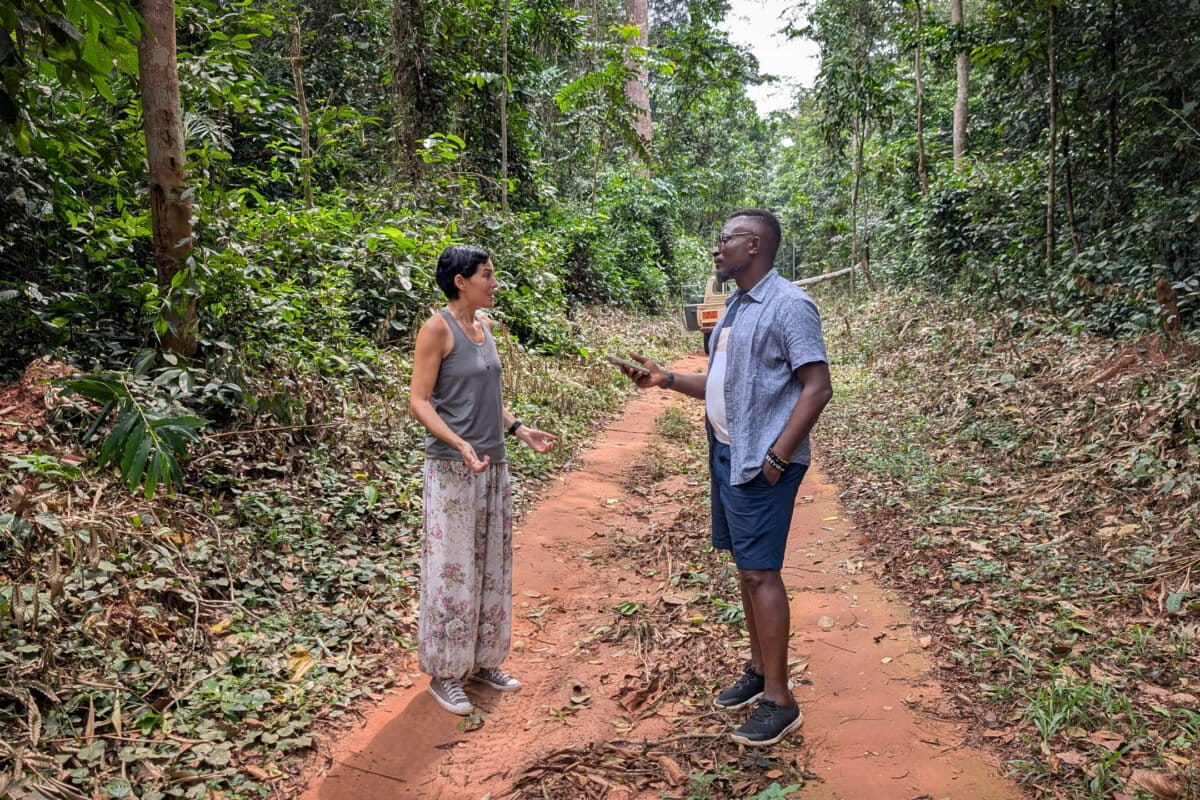
Banner image: Mongabay Africa’s David Akana interviewing researcher Ivonne Kienast in the Central African Republic.
