


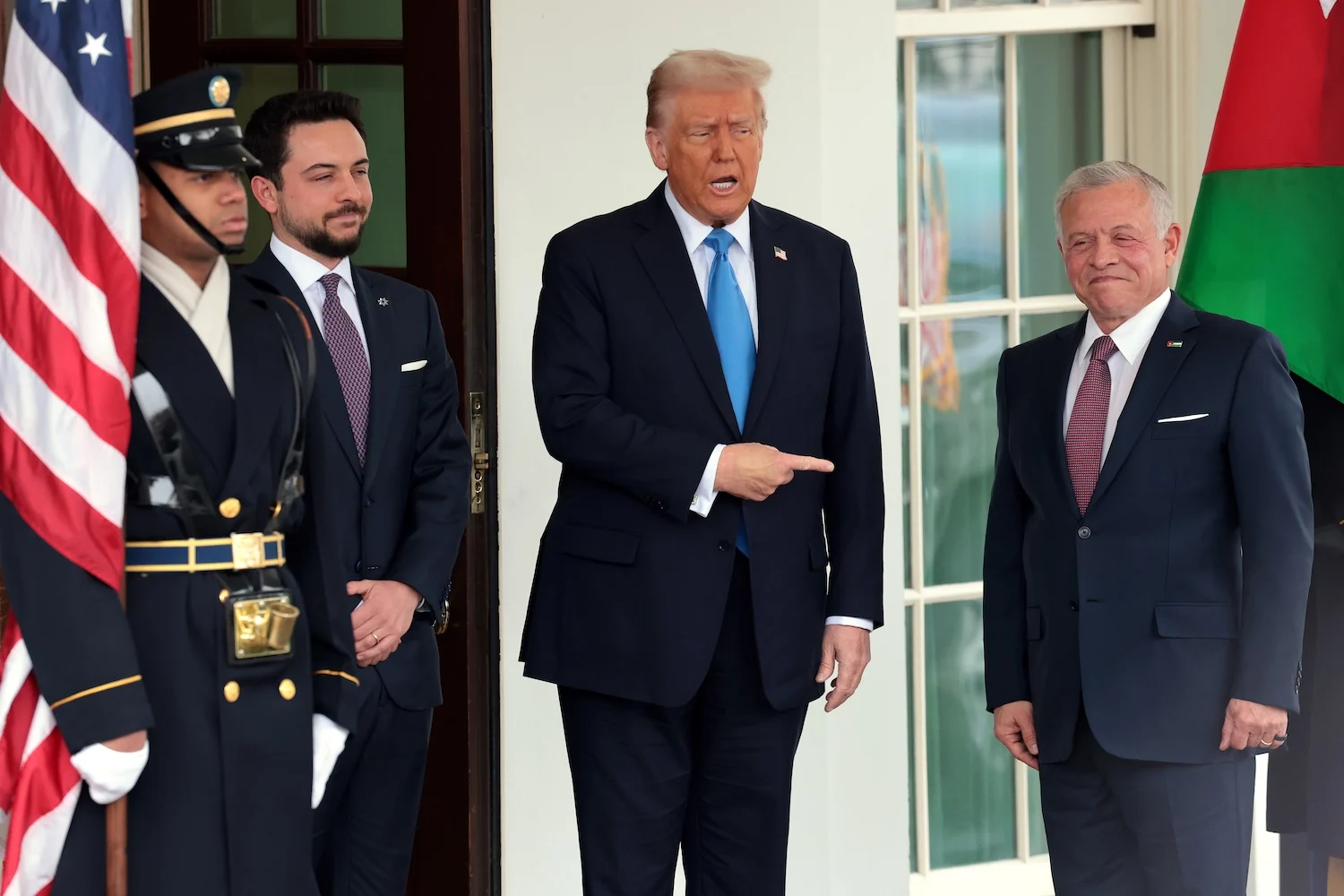
In the largest attack by a nation-state targeting Jordanian soil in 50 years, Iran has fired hundreds of ballistic missiles and drones at the Hashemite Kingdom since February. Fatalities were recorded on July 17 when an Iranian strike killed three U.S. soldiers at Azraq’s Muwaffaq Salti Air Base. King Abdullah II declined to give a speech or hold a press conference about the killings. In fact, amid an intensifying debate over Jordan’s security partnership with Washington, the king still has not commented on the attack or offered a public defense of his policies. Instead, Abdullah left Jordan for a week in July and visited the United Kingdom—without even meeting the country’s premier. This week, Abdullah is touring China.
What explains the king’s distant approach, which stands in stark contrast to his high-profile governing strategy after coming to power in 1999? It may be that, committed to maintaining strong ties to an unpopular ally, the king has concluded that keeping quiet is the best strategy.
In the largest attack by a nation-state targeting Jordanian soil in 50 years, Iran has fired hundreds of ballistic missiles and drones at the Hashemite Kingdom since February. Fatalities were recorded on July 17 when an Iranian strike killed three U.S. soldiers at Azraq’s Muwaffaq Salti Air Base. King Abdullah II declined to give a speech or hold a press conference about the killings. In fact, amid an intensifying debate over Jordan’s security partnership with Washington, the king still has not commented on the attack or offered a public defense of his policies. Instead, Abdullah left Jordan for a week in July and visited the United Kingdom—without even meeting the country’s premier. This week, Abdullah is touring China.
What explains the king’s distant approach, which stands in stark contrast to his high-profile governing strategy after coming to power in 1999? It may be that, committed to maintaining strong ties to an unpopular ally, the king has concluded that keeping quiet is the best strategy.
Many Jordanians are critical of Abdullah’s willingness to host thousands of U.S. troops. Led by former minister Amjad al-Majali, hundreds of people signed a July letter demanding the expulsion of U.S. forces, asserting that foreign soldiers unnecessarily drag Amman into regional conflict. A mere 12 percent of Jordanians view U.S. President Donald Trump’s foreign policies favorably, according to a recent survey. When lawmaker Ali al-Khalayla requested that the legislature offer condolences for the soldiers’ deaths, his proposal was rejected; members of parliament called U.S. troops a “group of murderers” for Washington’s support of Israel during the Gaza war.
This, of course, is the reaction that Iran seeks to provoke with its missile attacks and taunts against Amman. For now, there is little evidence that it will succeed. For decades, Abdullah’s alliance with Washington has recently provided him with around $1.5 billion in annual aid and sophisticated weaponry. It is improbable that he would take the extraordinary measure of expelling U.S. forces and risk Trump’s ire, even as public frustration rises.
King Abdullah is not going anywhere. But his low profile reflects the fact that the monarchy has no good solutions to the mounting problems that Jordan faces.
Abdullah’s avoidance did not begin with the Iran war. Last year, Jordan took the unprecedented step of banning the Muslim Brotherhood. Accusing the kingdom’s most influential opposition organization of harming national security, Jordanian authorities seized the Muslim Brotherhood’s assets and raided its headquarters. The Islamic Action Front, historically considered the Brotherhood’s political wing, won the most seats in the 2024 parliamentary election. Yet, Abdullah has not publicly addressed the 2025 crackdown on the organization, nor clarified to Jordanians why this escalation was necessary.
The Hashemite ruler was not always so evasive. In 1999, his first year as monarch, Amman expelled senior Hamas operatives from the kingdom, a controversial move since roughly half of Jordan’s population is of Palestinian origin. Abdullah did not shy away from explaining the policy, telling the Beirut-based magazine Al-Hawadeth that the restrictions against Hamas were implemented after locating weapons in the Palestinian militant group’s offices.
Shortly before the Bush administration’s 2003 invasion of Iraq, the Hashemite ruler gave a principled address outlining his opposition to the Iraq war despite his country’s dependence on U.S. assistance. A decade ago, Abdullah offered condolences after the killing of three U.S. Special Forces soldiers in Jordan, a step that he did not take this summer.
Abdullah has given only one press interview in 2026, a softball media appearance with the Chinese state-run media outlet Xinhua. For comparison, the king sat for more than 15 media interviews in 2002, confidently discussing the era’s conflicts. Earlier in his reign, the Hashemite leader even appeared on Comedy Central with Jon Stewart. But as Abdullah has aged, he has reduced his unscripted interactions with the media, especially after his explosive 2013 interview with the Atlantic, in which he criticized local tribal leaders and Turkey’s prime minister.
Even the king’s scripted appearances have been reduced. Instead of video addresses, the vast majority of Abdullah’s public engagement now consists of prepared written statements or curated photos. An exception was a February 2025 White House meeting, where Washington reporters accompanying Trump saw Abdullah “blinking heavily” and appearing “nervous.” Some commentators suggested that the king’s unusual blinking stemmed from tensions with Trump over his proposal to transfer Gazans to Jordan. However, Abdullah’s frequent blinking has been observed on other occasions and may be due to a tic or any number of possible conditions.
The king is also traveling abroad with increasing frequency. Abdullah has spent more than half his time outside of Jordan since June 10. The king remained in the United States for nearly five weeks this summer on a “private visit” and did not hold talks with Trump or any cabinet official. The only meeting with a politician announced by the Royal Court during Abdullah’s trip was a July sit-down with a mayor in Texas. A 2021 Pandora Papers leak revealed that the king owned luxury properties totaling more than $100 million, including on California’s Malibu Coast and in Washington, D.C., even as poverty rates soared for Jordanians thousands of miles away.
During his third decade in power, Abdullah has earned few policy victories. In 2013, the king pressed for a “full parliamentary government” in a paper on the importance of democracy. But in last year’s rating of democracy levels worldwide, the Economist classified Jordan as “authoritarian,” with the legislative branch remaining toothless.
Abdullah succeeded early in his reign by privatizing state-owned firms to slash unemployment to 12.7 percent in 2008. Yet, he was unable to maintain progress on the economic front; now, the unemployment rate among Jordanians stands at approximately 21 percent. A recent Arab Barometer poll revealed that nearly two-thirds of Jordanians run out of food before having the money to purchase additional groceries.
The Gaza war launched in 2023 added further stress for the monarchy. Thousands of protesters hit the streets in Amman, demanding that the government cancel the 1994 peace treaty with Israel. Demonstrators tried storming a border region with the Israeli-controlled West Bank before Jordanian police forcibly dispersed them. Tourism declined, damaging the kingdom’s already weak economy.
At the same time, Abdullah’s rule has remained secure. He maintained the Jordanian security forces’ loyal support and defied some analysts’ prognosis that the Gaza conflict posed an “existential threat” to Jordan. According to Amnesty International, Jordanian officers arrested more than 1,500 pro-Palestinian activists between October 2023 and April 2024. Although some activists were frustrated with his nuanced policy, no genuine, tangible threat to his power emerged.
Sympathizing with citizens’ anger, the Hashemite Kingdom recalled its ambassador from Israel in November 2023 while suspending a trilateral water-for-energy accord with Israel and the United Arab Emirates. But Abdullah declined to implement the protesters’ far-reaching demands and preserved ties with Israel, a delicate balancing act to ensure that billions in U.S. aid continued to flow.
As Abdullah steps back from the limelight after more than a quarter-century on the throne, the Royal Court has accelerated its efforts to promote Crown Prince Hussein. The 32-year-old Georgetown University graduate has engaged in high-profile diplomacy, meeting German Chancellor Friedrich Merz and Qatari Emir Tamim Al Thani this year without Abdullah present. The heir apparent’s picture is plastered across Jordan, and he has spearheaded his country’s artificial intelligence strategy. However, the tense regional environment—missiles fired from Iran, around 70,000 killed in Gaza, and the ousting of the neighboring Syrian president—has made it more difficult for Abdullah to advance the transfer of power to his eldest son. The transition to a new ruler may provoke instability in Jordan, and the authorities in Amman would likely prefer to choose a moment without such intense strife across the Middle East.
Abdullah told the Atlantic that he had mulled leaving his post in 2009, given the struggles in implementing his agenda. After pushback from relatives, Abdullah reconsidered and is now currently the longest-serving Arab leader. Abdullah has not publicly proposed leaving the throne again. Nonetheless, the king has shown clear signs of diminished leadership: declining to engage on Jordan’s most sensitive challenges, avoiding the media, and spending increased time abroad. Abdullah is fortunate that, unlike former U.S. President Joe Biden, he does not have to face a domestic political rival in an unscripted public debate.
