


After the Pennsylvania Department of Health announced two cases of measles-related deaths in one county, the local coroner appeared to contradict the account. And in an ongoing spat with Pennsylvania Gov. Josh Shapiro, Health and Human Services Secretary Robert F. Kennedy Jr. has alleged that a Shapiro staffer may have even “fabricated” the deaths. We’ll lay out what we know.
The saga brings to mind a pandemic-era falsehood that the vast majority of people classified as dying from COVID-19 did not die of the disease, but died of other causes while they happened to be infected. And when two children died of measles complications in Texas last year, Kennedy, along with activists in his former nonprofit, baselessly alleged that the kids did not die of measles, despite evidence to the contrary.
The situation in Pennsylvania is less clear. One of the deaths appears to be of an infant that tested positive for measles and died of a ruptured spleen. It is possible that the rupture was due to infection with measles, but the coroner has said the pathologist determined measles was not involved. There is no information about the second death. Meanwhile, the state has acknowledged that the term it has used to describe the deaths – “measles-associated” – includes cases in which measles infection is detected but “may not be assessed by the medical certifier or coroner to be the immediate cause of death.”
As we’ll explain, that statement may not mean as much as it appears to, since measles deaths would not be expected to have measles listed as an immediate cause anyway. But without more information about the cases, it is difficult to say what has happened, leading many – including Kennedy – to speculate that the deaths were not measles-related after all.
“Pennsylvania created its own information vacuum and then seemed surprised when someone else filled it,” Dr. Amesh Adalja, a senior scholar at the Johns Hopkins Center for Health Security, and an infectious diseases attending physician in Pittsburgh, told us in an email. “The coroner’s account and the state’s account are not necessarily in conflict — they are two offices answering two different questions — but nobody in Harrisburg explained that, so the public was left to choose between fraud and incompetence.”
Timeline of Events
On Aug. 25, the Pennsylvania Department of Health announced that it had confirmed two cases of “measles-associated” deaths. Other than noting that the individuals were both unvaccinated and residents of Lancaster County, the department did not provide any further details, citing privacy concerns. The release strongly implied the deaths were at least partially due to measles, referring to them twice as “related” to measles.
“These mark the first deaths related to measles within the Commonwealth in 35 years,” the department’s press release noted.
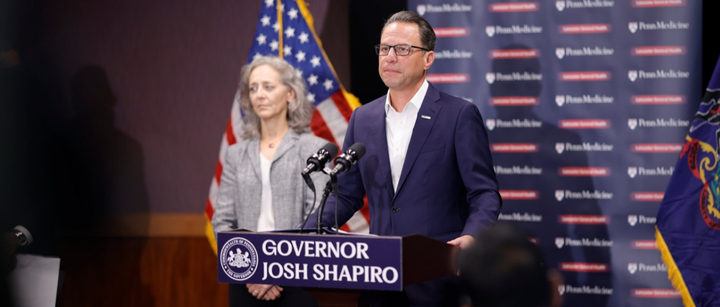
Later in the day, Shapiro held a press conference with the health department in Lancaster County to share the announcement and to encourage vaccination.
“We hope and we pray that those deaths will be the last,” he said of the two deaths. “I want to be clear. This illness and death from measles is completely preventable.”
Local and national news outlets then picked the story up, with many stating that the two people died from measles.
Initially, the main story from the press conference was a quarrel between Shapiro and Kennedy about whether the measles, mumps and rubella, or MMR, vaccine contains fetal tissue, and whether Kennedy has spread vaccine misinformation. Kennedy has – and the vaccine does not. (The rubella component of the vaccine is manufactured with and was initially developed with fetal cells derived from an elective abortion in the 1960s. While trace amounts of cell components from the cell strain can persist in the purified vaccine, whole cells do not. The Catholic Church has said the shot can be used “with a clear conscience.”)
But soon, questions swirled about how much the two announced deaths were related to measles.
Josh Parsons, a Lancaster County commissioner, posted on X the day of the press conference that the county coroner’s office was not aware of any measles deaths, although there was one baby that had tested positive for the disease but did not die of it.
“They have one case where a person died WITH measles, but not FROM measles,” he wrote. “Measles was definitely NOT the cause of death in that case.”
The following evening, Aug. 26, Kennedy had picked up on the controversy, writing on X, “The announcement appears to have been premature, and the deaths may even have been altogether fabricated by one of the Governor’s hopeful staffers. The Lancaster County Coroner says that it has no record of any measles deaths. State law requires that all measles deaths be reported to the coroner.”
Pennsylvania Health Secretary Dr. Debra Bogen responded to Kennedy on X, saying she had “thoroughly reviewed the case investigation information and sadly can confirm that there were two recent measles-associated deaths in Lancaster County.”
That same day in Florida, Kennedy had also said, citing the Lancaster County commissioner, that “they cannot find any measles deaths in Lancaster County.” He added: “The press is all covering this as if those measles deaths actually happened. But nobody’s doing … the little bit of critical inquiry to find out. We’re trying to figure out, you know, who those deaths were and whether they actually happened, and we can’t figure that out yet.”
Meanwhile, in the late afternoon of Aug. 26, DOH issued a statement that appeared to say that one of the two deaths was the baby the coroner’s office was aware of and gave more information on the definition of “measles-associated.”
“PA DOH uses the term ‘measles-associated’ when laboratory or epidemiologic evidence of measles is present, but the disease may not be assessed by the medical certifier or coroner to be the immediate cause of death,” the statement read. “Not all deaths are referred to a coroner under Pennsylvania law. Accordingly, one of the two measles-associated deaths is under investigation by the county coroner — as confirmed by the Lancaster County Coroner, who stated publicly their office is reviewing an infant death with a positive measles test.”
(Online during this period, a fake screenshot of a news headline circulated a rumor that the two deaths were both men in their eighties. There is no evidence for this, and according to the state’s dashboard, no measles cases have occurred in anyone 65 years or older this year.)
Multiple news outlets have reported more details on the infant case over the last several days. On Aug. 26, the Philadelphia Inquirer said that Lancaster County Coroner Dr. Stephen Diamantoni told them that the child, a newborn who died shortly after birth, died of a spleen laceration, and that the pathologist who did the autopsy “did not feel it was related to measles.” He said the infant contracted measles before birth, tested positive for measles after death based on a test of lung tissue and that the case was still being investigated.
TribLive, a news outlet covering western Pennsylvania, reported on Aug. 27 that Diamantoni said the cause of death was a “traumatic laceration of the spleen” and that the forensic pathologist who conducted the autopsy, Dr. Wayne Ross, determined that measles was not a contributing factor to the death.
“Diamantoni later acknowledged, however, that measles was listed under Part II of the infant’s death certificate, which reports ‘other contributing conditions contributing to death but not resulting in the underlying cause,’” the outlet reported. “Diamantoni said he still does not believe that measles contributed to the child’s death, but the disease was listed to offer ‘a broader view of the general health of the child.’”
Another local news source, citing the coroner, said the child that died was a male newborn who died at home and tested positive for measles via a PCR blood sample. An earlier version of the Inquirer story suggested there was a positive antibody test. Diamantoni, a family physician who was elected to his coroner post as a Republican, also told the TribLive that the baby was born with the assistance of a midwife at a birthing center in Lancaster County. He specified to LancasterOnline in an Aug. 27 story that the child died on Aug. 14 at a birthing center in Strasburg Township, and that the mother was alive, contrary to rumors that the second death was the baby’s mother.
As a newborn, the child would not have been eligible yet for routine measles vaccination, which begins at 12 months of age. However, if the baby contracted measles in utero from the mother, it is highly likely that the mother was unvaccinated.
An Information Gap
Much attention has focused on the newborn’s death from the lacerated spleen and whether it was ultimately due to measles infection. Measles is known to cause enlargement of the spleen, which during birth, could plausibly lead to a rupture.
“Given that congenital measles infection can cause splenic enlargement and thinning of the splenic capsule, it is likely that the child ruptured the spleen during birth,” Dr. Paul Offit, a pediatrician and vaccine expert at Children’s Hospital of Philadelphia, wrote in an Aug. 28 Substack post.
A 2024 study of children hospitalized for measles at a Polish hospital found that of the 26 infants under 13 months of age, four, or about 15%, had an enlarged spleen.
The coroner, however, said that the pathologist did not note an enlarged spleen during the autopsy, telling LancasterOnline that measles was not considered contributory because “there was no swelling or enlargement whatsoever” of the spleen and there was “massive blood loss.”
But Offit told the Philadelphia Inquirer that it is difficult to tell whether a spleen was enlarged after it ruptures, and that there should be an explanation for the rupture if it wasn’t caused by measles. The coroner has said the cause of the rupture is still under investigation, but no foul play is suspected.
Adalja said that measles “could be the reason an otherwise survivable delivery wasn’t survivable. It could also be incidental. I don’t think anyone outside that forensic center can say yet, and I’d be skeptical of confident assertions in either direction.”
The coroner’s office did not reply to our request for more information.
It’s worth noting that some of the confusion could come down to different definitions and processes that have not been adequately explained.
For example, Adalja said, the coroner or medical certifier produces the official death certificate, but state epidemiologists look at “deaths for outbreak surveillance under case definitions.” Those definitions are set by the Council of State and Territorial Epidemiologists in coordination with the Centers for Disease Control and Prevention.
The latter is “a faster, looser standard designed to flag that a death occurred during and plausibly in connection with an outbreak, so the state can act in real time rather than wait months for a final certificate,” he said. “The failure here is that Pennsylvania never told anyone two systems were running, so the coroner saying he had no measles deaths in his log and the state saying it had two looked like a lie rather than two people describing different databases.”
Similarly, DOH’s statement about “measles-associated” deaths not necessarily being assessed “to be the immediate cause of death” is almost meaningless, Adalja said, since almost no measles deaths would list measles as the immediate cause.
Death certificates show a causal chain, listing the immediate cause as well as the sequence of events that led to it, including the underlying cause that started the sequence. In measles deaths, measles is the underlying cause, but the immediate cause would be something such as pneumonia or encephalitis, which are complications of measles, he explained.
DOH’s statement, then, he said, “is technically accurate” but “functionally uninformative. Worse, to a lay reader it sounds like a concession — as though the state were conceding measles is being blamed for something it didn’t do.”
Another major question is the second measles-related death. The Lancaster County coroner has said he doesn’t know who this is, and told LancasterOnline that while there are several reasons why he might not know, by law, it should be reported to him. Kennedy and others have also said that it is state law for the measles deaths to be reported to a county coroner.
DOH, however, has said that not all deaths need to be referred to a coroner. Dorit Reiss, a vaccine law expert at University of California Law San Francisco, told us that as far as she can tell, the health department is correct.
State law specifies that one of the conditions requiring a coroner’s investigation is a “death known or suspected to be due to contagious disease and constituting a public hazard” – and both parts of the clause would need to be met.
“This would not be a death that is a public hazard,” she told us. “Measles is spreading unrelated to it, so I don’t see any way to see it as meeting this requirement.”
Offit told us that he had talked to people “high up in the Pennsylvania Department of Health who have said they are comfortable” saying that “because of measles, two people in Pennsylvania died.”
DOH, however, has not shown why it thinks that is the case. The department did not respond to our questions after it sent us its statement. Shapiro’s office also did not respond to an inquiry.
Both Offit and Adalja have said it would be helpful if the department had released more information.
Offit’s concern is that regardless of what happened in these two cases, the measles outbreak in the state could very well be much larger than is currently known, and could be poised to grow as kids return to school and the seasons shift.
“This outbreak is much worse than they’re saying,” he said. “It’s probably closer to 2,000 cases. And it’s August” – not measles season, which is usually winter and spring. As of Aug. 28, Pennsylvania has recorded 460 measles cases, nearly half in Lancaster County.
Adalja told us he does not see a reason why the state couldn’t have provided more information that still kept private the identities of those who died.
“Secretary Kennedy suggesting the deaths may have been fabricated is inexcusable on its own terms. But he was handed the opening,” he said. “Even if measles is definitively established as the underlying cause in both deaths, this week already taught a slice of the public that when officials say ‘outbreak death,’ they might mean something else. That lesson outlasts the case. In an outbreak, institutional credibility is a consumable resource — and Pennsylvania spent a great deal of it protecting information that Texas released last year without incident.”
Editor’s note: FactCheck.org does not accept advertising. We rely on grants and individual donations from people like you. Please consider a donation. Credit card donations may be made through our “Donate” page. If you prefer to give by check, send to: FactCheck.org, Annenberg Public Policy Center, P.O. Box 58100, Philadelphia, PA 19102.
