


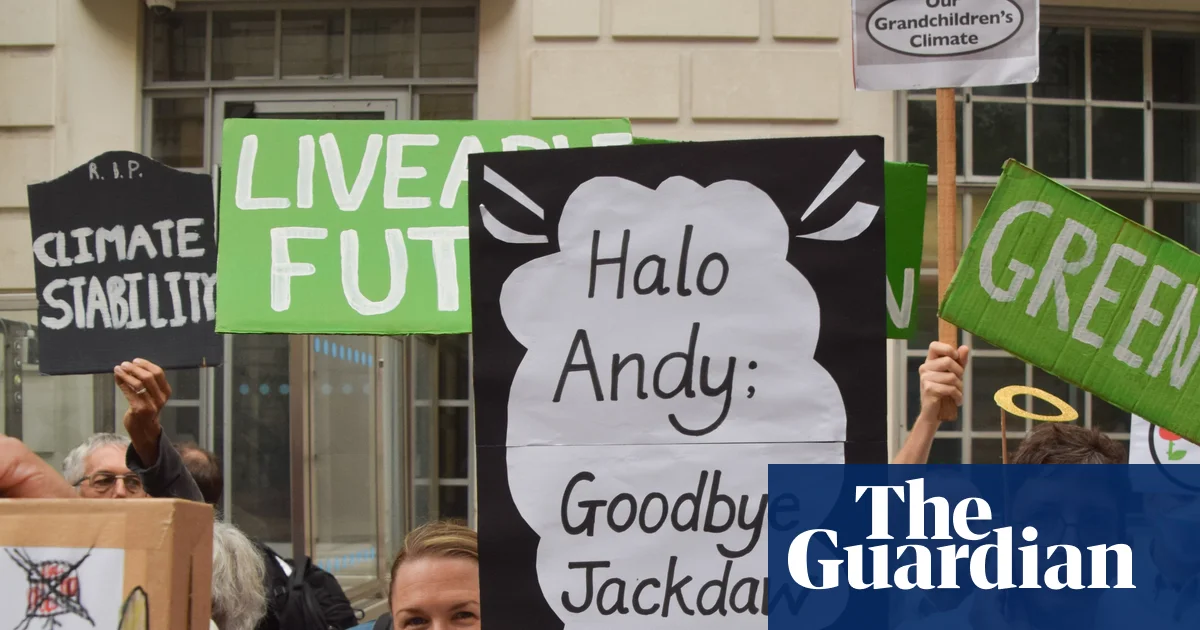
About four years and six energy secretaries after it won the green light, the Jackdaw gasfield has been given consent to begin production 150 miles east of Aberdeen.
So what does this long-awaited decision mean for the Labour party, household bills, the economy and the climate crisis?
Is Labour breaking a manifesto promise?
No, because although the party vowed to “not issue new licences to explore new fields” in the hydrocarbon-rich basin, it made clear it would honour licences granted before it came to power.
These fields include Jackdaw, which was granted a licence in 2022, and the larger Rosebank oilfield west of Shetland, which was approved the following year.
Oil and gas licences give broad permission to explore an area for fossil fuels but consent is still needed to extract them. Although Jackdaw and Rosebank had both, they were blocked from starting production after a legal challenge by campaigners at Greenpeace and Uplift early last year.
That ruling compelled the companies behind the project to resubmit their applications with extra information on the climate impact of the fuels produced.
Jackdaw is owned and operated by Adura, a joint venture between Shell and Norway’s state oil company, Equinor. It also hopes to develop Rosebank in conjunction with Ithaca Energy. A decision on Rosebank’s new application for consent is expected soon.
Will the decision lower energy bills?
Probably not. Household bills are based on the price of gas in the UK wholesale market, which is determined by international prices that have surged amid disruptions to global supplies.
These have included the loss of Russian flows to Europe and disruption to Gulf exports to buyers around the world – shocks far too big for the relatively small output from Jackdaw to outweigh.
The Tories have claimed drilling could still help to lower bills under their plans to use tax revenues to cut VAT on gas and electricity bills for three years. However, this does not mean energy costs are fundamentally lower – or sustainable.
Meanwhile, Labour has cut VAT from electricity bills from this month until next March and ministers are understood to be planning to offer billions in energy bill support for low-income households at next week’s budget.
What about the UK’s carbon emissions?
Gas from Jackdaw could release between 23.6m and 35.8m tonnes of CO2 equivalent over its 11-year operational lifespan, but the carbon impact of new North Sea fields is “not clearcut”. That’s the view of the Committee on Climate Change (CCC), which advises the government on meeting its legally binding climate targets.
There are two sorts of emission to consider: firstly the “scope 1 and 2” kind, created from getting fossil fuels out of the ground and transporting them to users. These are relatively low in the UK North Sea and make up about 3% of the UK’s total. In fact, the CCC has said there might be “emissions advantages” to the switch, because scope 1 and 2 emissions from UK gas are by some estimates four times lower than from US and Gulf fossil gas imports.
The second, far bigger impact is from the “scope 3” emissions created from burning the fossil fuel. Although Jackdaw’s gas would release CO2 when used in homes, businesses, factories and power plants, there is no evidence it would lead to higher overall gas consumption.
As Andy Burnham, the prime minister, said in July: “The question isn’t whether Britain will still be using oil and gas, the question is where does it come from.” A better way to reduce UK emissions is to replace gas boilers and fossil fuel vehicles with electric alternatives powered by low-carbon sources.
What about the impact on global emissions?
Here too, the answer is unclear. Some academics have suggested that more UK oil and gas would push up fossil fuel production globally unless output fell elsewhere.
In 2024, the CCC said new fossil fuel developments would have a “minimal impact on UK carbon budgets” but if others followed the UK’s lead in increasing production the cumulative impact could lead to “an oversupply that would pose a risk” to international targets.
It urged the UK government to “reassess whether further exploration for new sources of fossil fuels” was aligned with its global climate obligations. This supports the government’s ban on new licences but would not rule out Jackdaw – which is not a new source.
Moreover, a global oversupply of fossil fuels does not necessarily lead to greater emissions. In 2025, China’s crude oil imports hit a record 11m barrels a day but its emissions continued to fall because it was building its crude stocks to a record high of 1.4bn barrels.
In short: emissions are largely due to energy consumption, not energy production. So if consumption continues to decline, emissions will fall regardless of the amount of fossil fuels made available in the global market.
Where does this leave the UK’s climate agenda?
Green groups have argued that allowing North Sea developments to move ahead would undermine the UK’s role as a climate leader and weaken its ability to use climate diplomacy to encourage other nations to adopt green energy policies.
However, their opposition has been focused less on Jackdaw and more on the impact of the larger Rosebank scheme, which Ed Miliband, the former energy secretary turned foreign secretary, described as “climate vandalism” while he was in opposition. If the government goes on to also give consent for this project it could fuel accusations of climate hypocrisy at the top of the cabinet, undermining the UK’s ambition to be a global climate leader.
John Gummer argued as CCC chair in 2022 that an end to UK exploration “would send a clear signal to investors and consumers” and “help the UK in its diplomatic efforts to strengthen climate ambition internationally”.
So what might the economic benefits be?
The North Sea is an ageing hydrocarbon basin in terminal decline but supporting new projects still offers economic benefits, including higher tax revenues from oil and gas companies, income tax from well-paid workers and job creation within the industry and its supply chain.
Offshore Energies UK, an industry body, has promised the government that approving both Jackdaw and Rosebank could provide £1.4bn in tax revenues by 2029, rising to £3.8bn by 2034. It has also claimed the fields could support a peak of more than 3,500 jobs during the construction phase and 880 jobs with an average salary of £85,850 over the lifetime of the fields.
Green groups reject these figures, arguing they overstate the economic benefits. Regardless, they are still relatively modest in the context of the broader economy.
Given the disputed impact, why is the debate so febrile?
The North Sea has become a totemic issue. For some, the basin is steeped in nostalgia for a long-gone period of British economic success and innovation, while for others it is a reminder of the UK’s longstanding contribution to the climate crisis and its responsibility to take action.
“It has sucked all the oxygen out of the debate around what to do about climate change,” the CCC’s former chief executive, Chris Stark, told the New Statesman in 2024. “Because all the oxygen has been sucked out of the debate, it means we haven’t got the political capital to deploy on the heat pump story, or the electric vehicle story. That’s where the action needs to be.”
