


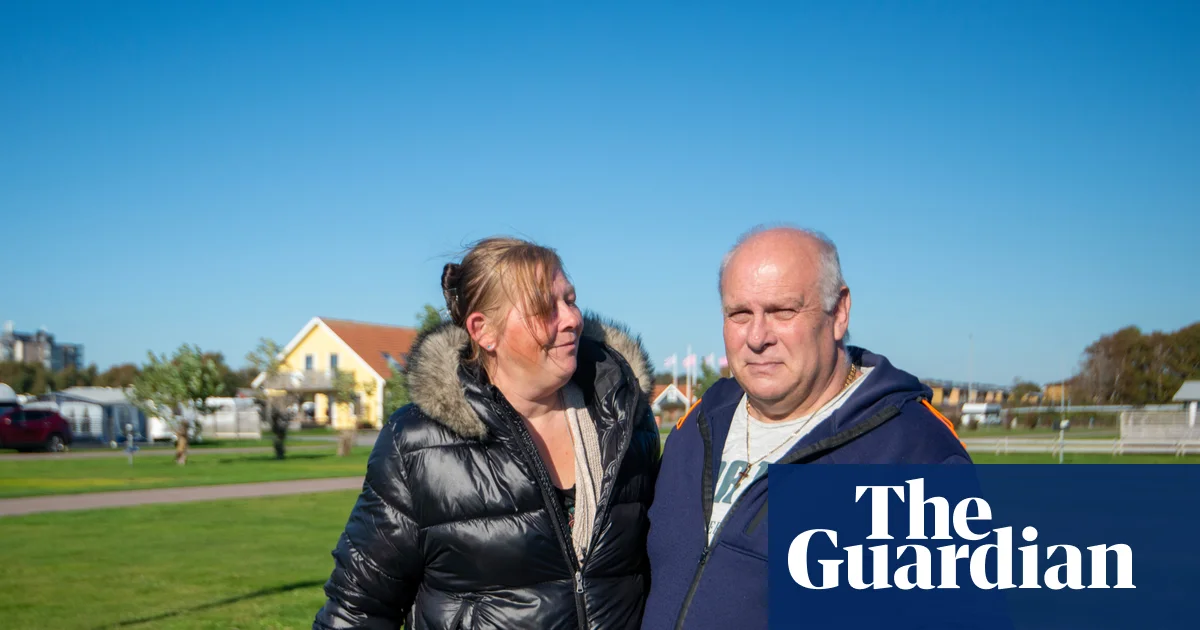
A seriously ill British man living in Sweden has been forced into hiding amid fears he will be deported as a result of what he says is a government Brexit residency error.
Mark Smith, 60, who has had hearts attacks, strokes, severe headaches and chronically high blood pressure that has been difficult to treat, was told on the phone he should leave Sweden by 17 October as he was an “alien” without permission to stay.
Terrified of deportation, he and his wife have moved out of their home in Falkenberg, in south-west Sweden, to a caravan park. “We are in hiding, we daren’t go back to our apartment. We are scared to go out as we don’t know if the police will come and take us,” Smith said.
A court ruled on 12 October that a decision on deportation would not be suspended but gave him until 20 October to “submit his application for a retrial” in relation to “the grounds for the decision on indefinite deportation”.
Smith has been in Sweden since 2017 and says he was told by authorities he did not need to do anything to stay after Brexit in 2020. He worked, had private health insurance, supported his wife and registered on the population register administered by the national tax authority, as required under Swedish rules.
He was unaware, however, that Sweden was among 13 of the 27 EU member states that required Britons living in the country before Brexit to make a formal application to remain. Other countries, such as Spain, did not opt for that system and just required Britons to declare they were a resident.
Smith said: “I asked the tax authorities three times on different occasions if I had to do anything because of Brexit and they said no, telling me I had to wait for five years to apply for permanent residency.
“Because it was the tax authority, a government body, I took it for granted that what they told me was correct,” he added.
David Milstead, a British-Swedish volunteer citizens’ rights activist working through the Brits in Sweden group, said Smith’s case was typical of many Britons living in Sweden.
Milstead said: “Mark’s experience is far from unusual. I have encountered many British citizens who actively sought information from the Swedish authorities about their residence rights after Brexit, only to receive vague, unhelpful answers, sometimes being told that they needed to do nothing.”
They include the 78-year-old widow Joyce Thomas, whose husband also inquired about Brexit residency and was told by the tax authorities there was nothing to do, and who is now fighting a removal order.
Smith had a minor heart attack on Wednesday night but wanted his situation publicised because he said the British government needed to know what was happening to expats in Sweden, “not just to me but others”.
His wife, Petra, said his health conditions had left him so vulnerable she was not sure “if he will last until Christmas”.
She said: “He has been told he can’t drive, he can’t fly – what do they expect him to do? Get up and walk to England? Come on, Sweden, we need to step back from all of this and be better.”
After 12 years together, she said deportation would be devastating for her and her 15-year-old son who has special needs, who Smith co-parents. “It is wrong what they are doing, I feel ashamed to be Swedish. What they are doing is racist to British people,” Petra said.
Milstead said Smith’s case was “depressingly familiar” and should warrant the urgent attention of the European Commission, which has previously said Sweden was not breaking any laws.
“A gentleman with Mark’s serious health conditions should not be having to fight deportation. It is difficult to understand how the European Commission has concluded that Sweden’s treatment of late applications under the [Brexit] withdrawal agreement does not warrant a challenge,” he said.
“Sweden stands out so starkly from other EU countries, and there are serious questions that remain unanswered, particularly about proportionality and the treatment of vulnerable people. These are precisely the kinds of cases where the protections of the withdrawal agreement ought to matter most.”
The Scandinavian country has found itself under mounting pressure over its approach to the withdrawal agreements having deported 458 Britons, including one man who had been in the country since he was 10 years old, and a 65-year-old man married to a Swede with no family or property in the UK.
after newsletter promotion
Sweden has also issued removal orders to a man with dementia who is in 24-hour care and who has been in the country for 25 years.
Under the legally binding treaty, it was agreed governments would communicate the Brexit residency rules, consider late applications on reasonable grounds, and exercise “proportionate” decisions including in the case of vulnerable people.
Smith’s troubles began in 2021 when he started to get ill and applied for sickness benefit. He was told by officials that he should have applied for post-Brexit residency. The couple immediately did so; they recall making the application at the end of 2021, in time for Sweden’s 31 December 2021 deadline.
They waited more than two years to hear back and when they did it was a rejection on the grounds that they were not married and therefore did not have a family connection to merit his residency in Sweden.

They were married in 2023 and had been living together since 2017.
It is not clear if Smith applied for the specific Brexit residency or through the usual immigration route, an important difference and one that may not have been made clear to British protected by the withdrawal agreement. Family connections are not a criteria under free movement rights, which apply to any individual regardless of marital status, so campaigners believe they have a strong case.
Smith said: “We were so much in love, we lived together, we did everything together, even now we hold hands walking down the streets. We wanted to get married, we wanted to do it the right way. I wanted to ask Petra’s father for permission and have him give her away, but two weeks after he gave me permission to marry his daughter, he passed.
“So we were looking into marriage but things just kept happening. But we don’t understand why this matters.”
They also said they had not been given the full court paperwork from the first case appealing against the migration agency’s decision, so they appealed to a higher courtwithout the full arguments against them.
After speaking to a judge this week, Petra has had assurances that all the paperwork will be sent to them by post, but they feel angry that they were not apprised of the information that the migration agency was arguing before the courts.
Sweden’s migration agency has said there is no evidence Sweden has taken an extreme approach to the withdrawal agreement.
The UK Foreign Office has raised concerns about Sweden’s approach to the withdrawal agreement with the European Commission on numerous occasions, but has been told Sweden is not breaching the agreement.
A spokesperson said: “We are in touch with Mr Smith and are providing consular support. We know this is a distressing and challenging time for those concerned and we are urgently raising the situation with both the Swedish authorities and the European Commission.”
The Foreign Office welcomed a statement by Sweden’s former migration minister Johan Forssell in August that Sweden would examine “additional measures” that would address the issue of Brexit deportation, and a similar declaration by Magdalena Andersson, who is on track to form the new government.
