


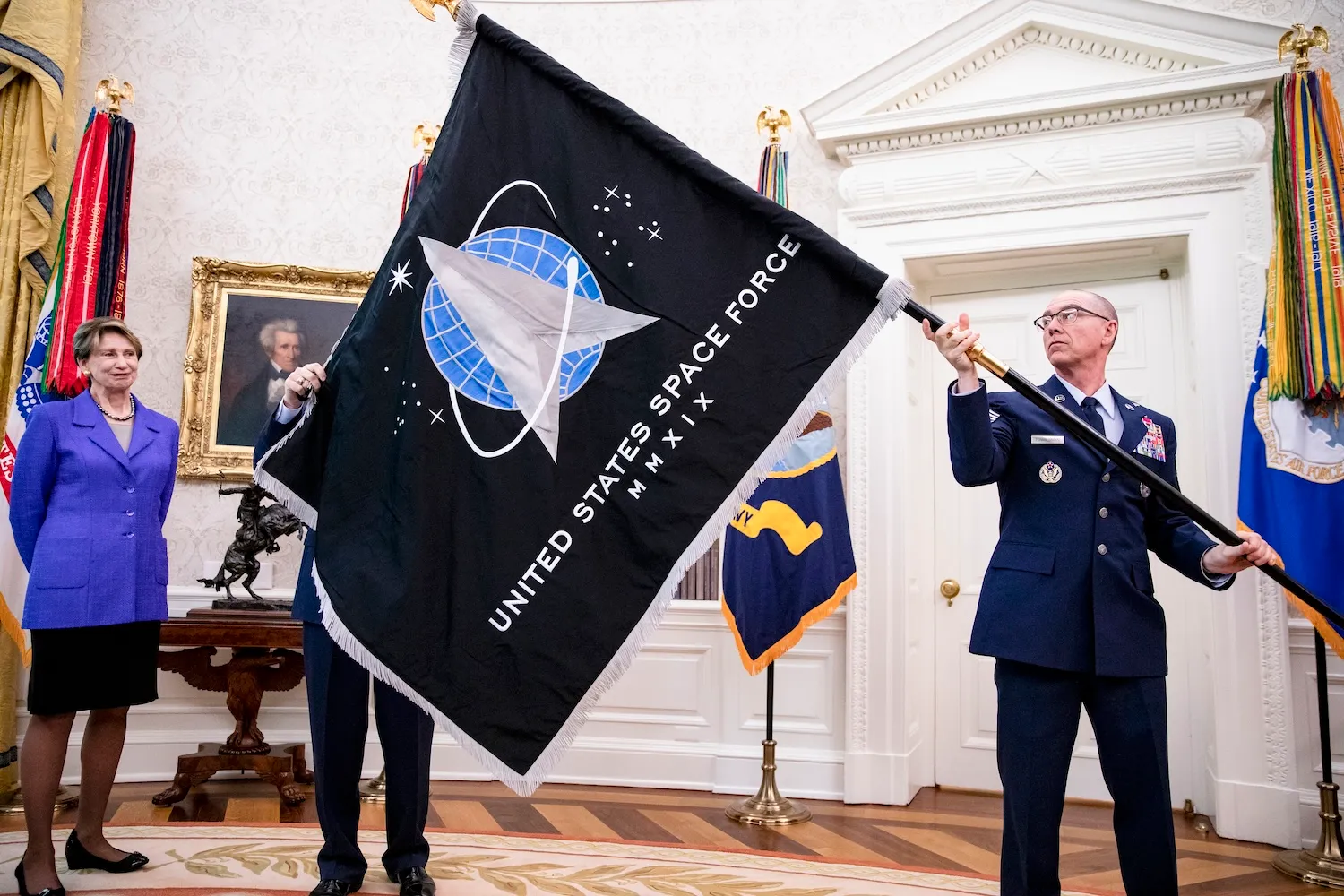
Earlier this month, U.S. President Donald Trump unveiled his vision for new “next generation” U.S. Space Force uniforms to critical reviews. Derek Guy, for example, the menswear guy on X, quipped, “This is the kind of design costume designers make to tell you who are the bad guys in a space movie.”
The sartorial criticism, however, cloaks a deeper and much more important deliberation about the future of America’s space strategy.
Last week, the U.S. government revealed for the first time that it had deployed weapons in space. Air Force Secretary Troy Meink said the U.S. had fielded “on-orbit space control weapons capable of defending the Joint Force against hostile adversary action.”
The announcement has already led to expressions of concern from some experts, but, in fact, Washington is right to deploy weapons in space.
I recently participated in a debate, convened by the Aerospace Corporation, on whether the United States should embrace or avoid space warfare. I embraced the embrace position
Of course, it would be wonderful if nations could cooperate and avoid competition and conflict, in space and other domains. But, alas, we are too late for that. The militarization of space is underway, and the United States and its allies must prepare to defend their interests and, ultimately, maintain the peace.
Space is already weaponized. Since the 1950s, the major powers have possessed weapons, like intercontinental ballistic missiles (ICBMs), designed to travel through space. Since the 1960s, they have also utilized space-based assets, such as the Missile Defense Alarm System, or MIDAS, and Corona surveillance satellites, to assist their terrestrial military activities. The Pentagon’s earthly military activities, in particular, are very dependent on space-based assets for command, control, computing, communications, intelligence, surveillance, and reconnaissance (C4ISR). To counter these capabilities, U.S. adversaries have developed ground-based weapons to destroy satellites in orbit. China, for example, conducted a direct-ascent anti-satellite test in 2007.
One line that did hold, until recently, concerned placing weapons in orbit. Governments avoided deploying systems in space that could either hit targets on the ground or other satellites. But this is also changing. Amid a proliferation of possible space weapons, Washington can no longer count on other countries’ restraint.
In 2021, then-Chairman of the Joint Chiefs of Staff Mark Milley declared that China test-launching a so-called fractional orbital bombardment system (FOBS) was “very close” to a “Sputnik moment.” In other words, Beijing used a rocket to launch a hypersonic boost-glide weapon into orbit, after which it traveled almost all the way around the world before descending toward a test range in China. This means that, moving forward, any country with a space program could put weapons into orbit to hold at risk terrestrial targets.
FOBS makes for a perfect first-strike decapitation weapon. From launch to detonation, the United States has about 30 minutes to identify, track, and decide how to respond to an incoming ICBM. In contrast, there would be much less warning time if a nuclear payload dropped on the White House from directly overhead.
Finally, countries are putting offensive weapons in orbit to target other satellites. Any maneuverable satellite can be crashed into another satellite, and is, therefore, a potential weapon. China and Russia are demonstrating this capability by conducting rendezvous and proximity operations, steering satellites very close to American satellites before changing course.
The television show Space Force, a short-lived Netflix comedy, featured a Chinese satellite with a robotic arm that comically disabled an American satellite while Steve Carell and his team watched in horror from ground control. In fact, this is a real-life possibility. Satellites could also be armed with projectiles that could be shot at other satellites. There are also non-kinetic options. Satellites could be equipped with directed energy, lasers, microwaves, or electronic warfare to zap enemy satellites, interfere with their communications, or render them inoperable.
Most disturbing are reports that Russia could put a nuclear weapon in orbit, in violation of the 1967 Outer Space Treaty. Detonating a nuclear weapon in low-Earth orbit could disable thousands of satellites and render the orbital region inoperable.
The United States is still the world’s leading space-faring nation. But this also means that Washington’s reliance on space-based assets makes it uniquely vulnerable. In the early stages of a war (say after China invades Taiwan or Russia attacks NATO), Beijing and Moscow would have a huge incentive to strike first in space to knock out American satellites and render the U.S. military blind and unable to communicate.
The consequences could be catastrophic. Deprived of space-based C4ISR assets, Washington would be less likely to prevail in a major war over China and/or Russia. One of my co-panelists in the above-mentioned debate even argued that Washington, with its satellites degraded, might be tempted to employ nuclear weapons first to stave off defeat.
The economic fallout would also be enormous. Most satellites are dual-use in nature. GPS, for example, was developed by the Pentagon for military purposes but is now utilized in a wide range of commercial applications, including Google Maps, Uber, and more. A space war would grind commercial space activity to a halt, and the debris generated could ruin entire orbits for years to come.
How should Washington respond to this threat?
Some argue that arms control is the answer: Washington should engage in diplomacy with other nations to come up with treaties, agreements, and commonsense guardrails on military competition in space.
It’s a nice idea, but effective arms control requires a partner willing to negotiate in good faith. China refuses to engage in serious arms control talks, and Russia has repeatedly cheated on the major arms control agreements it has signed. Moreover, a robust arms control regime in space would mean locking in U.S. space superiority—something Moscow and Beijing have no interest in doing.
U.S. diplomats should pursue arms control in space, but they should be realistic about its limits. They can work with like-minded allies to develop appropriate standards for other responsible countries. They can also put forward proposals for arms control deals—banning FOBS, for example—that would advance American interests. They should not have any illusions, however, that these proposals would constrain China and Russia. Rather, the purpose would be to shine a spotlight on Chinese and Russian bad behavior and make it clear to all that Beijing and Moscow, not Washington, are the problem.
Another proposal is for Washington to engage in space defense, but not offense. This was the original purpose of setting up the Space Force and reestablishing Space Command in 2019. Indeed, there is much the United States can and should do to defend its satellites in space. One obvious approach involves resilience and redundancy. Instead of possessing a handful of large, exquisite satellites that make big, juicy targets for the nation’s enemies, Washington has been moving toward constellations of many smaller, cheaper satellites. This makes the adversary’s targeting job much harder.
But defense is not enough. China and Russia are “aggressively testing” offensive space capabilities. And given that Washington cannot see inside every Chinese and Russian satellite, it is possible, if not likely, that these nations have already deployed space weapons. Why should Washington alone fight with one hand tied behind its back? In no other domain, say air or sea, would strategists argue that the Air Force and Navy should only plan for defensive, but not offensive, operations. And, moreover, the distinction between offense and defense is always clearer in theory than in practice.
To take one concrete scenario, imagine Russian President Vladimir Putin invades a NATO country and the United States has credible intelligence that Russia has placed a nuclear weapon in orbit to knock out U.S. and NATO satellites. Why should Washington wait to take the hit? Wouldn’t it be better to have offensive capabilities in space that could render the Russian satellite inoperable before the nuclear weapon is detonated?
Washington is right, therefore, to develop and deploy space-based weapons now. Sometimes, the best defense is a good offense. This is why the U.S. Space Command has recently been more forthcoming about its desire to establish offensive “orbital warfare” and “integrated space fires.”
At the Aerospace Corporation’s debate, one of my fellow panelists expressed concern that publicly carrying out offensive space operations, such as by conducting proximity and rendezvous operations against rival satellites, could lead to accidental war. But it is hard to tell a plausible story about how a satellite crash leads to World War III. Equipment would be broken, but people would not be dead. There would not be an intense public outcry or other pressures on leaders to respond to a damaged satellite with lethal force.
The much more plausible and dangerous scenario, given Chinese President Xi Jinping’s and Putin’s stated goals, is that these dictators choose to engage in aggression against their neighbors. A vulnerable U.S. space posture makes these scenarios more, not less, likely.
Another panelist asked about opportunity costs. Given constrained resources, he argued that Washington’s defense dollars could best be spent elsewhere. But, as noted above, when the entire U.S. military is already dependent on orbital assets, space deterrence is a high priority. Further, Washington is planning for a $1.5 trillion defense budget, its largest in history. There are more than enough resources for the highest-priority missions.
A final objection invoked the specter of a space arms race. But an arms race is not the worst outcome—deterrence failure and war is. Moreover, Washington is a financial superpower. China and Russia are not. If space superiority requires outspending rivals, then this is a competition Washington should welcome and Beijing and Moscow should fear.
New technology produces new military domains, from land and sea to air, cyberspace, and now space. But the enduring logic of military strategy remains constant. In space as on Earth, if you want peace, prepare for war.
