


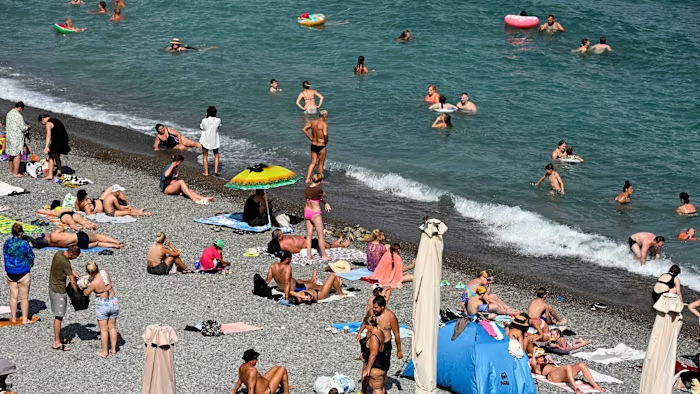
“Good morning from Sochi. We’re getting ready to go to the sea,” Antonina Kirsanova, a Moscow hairdresser in her thirties, says cheerfully in a video posted on Instagram.
The jarring note in an otherwise typical holiday tableau is the wail of an air-raid siren in the background. “But actually, it’s not too bad . . . No risk, no reward,” Kirsanova added.
A week after she posted the video, a drone fell on a beach in Arkhipo-Osipovka, another Russian resort on the Black Sea coast, killing four children and three adults and injuring another 40.
Air-raid sirens, drone interceptions, fires, fuel in the water and queues for petrol have all become part of summer holidays for many Russians. The Black Sea coast is one of the country’s most coveted summer destinations, but also a home to oil refineries and tanker terminals, making it the target of repeated Ukrainian attacks.
Ukrainian military officials say they target only Russia’s military and energy infrastructure. They say drones that come down in civilian areas have been intercepted by air defences or electronic warfare before reaching their targets.
With drones hovering above and oil spills in the water, tourist numbers have declined by 10.8 per cent year on year, according to Dmitry Bogdanov, chair of AMOS, a hoteliers’ association in southern Russia.
The threat also appears to have scared off the region’s most famous holidaymaker, Russian President Vladimir Putin, who maintains an official residence in Sochi as well as a lavishly appointed palace allegedly built for his use near Gelendzhik.
Putin visited Sochi 24 times in 2021, the last year before his full-scale invasion of Ukraine, but just twice in 2024 and 2025, according to the Kremlin’s website.
He last appeared in public in Sochi last October and has since largely confined himself to Moscow and St Petersburg as well as another residence on Lake Valdai in northern Russia.
Ahead of parliamentary elections next month, Putin has stepped up his regional travel but spent most of it east of the Urals — out of the reach of Ukraine’s drones.
But ordinary Russians keep coming. Beaches and seaside cafés on the Black Sea coast remain packed — underscoring how daily life and war have become increasingly entwined in Russia as the war grinds on in its fifth year.
Alexey, a manager from Voronezh, travelled to Sochi in June with his pre-school daughter. Worried about water pollution and drone attacks, they avoided the sea and swam in the hotel pool instead. The trip was far from ideal, but Alexey had limited options: his employer is now classified as part of the military-industrial complex and, like a growing number of Russians, he is barred from leaving the country.
A tourist boat captain in Arkhipo-Osipovka told the FT that before this month’s deadly beach incident the “sirens were barely ever on”; now they scream “several times per day”. Beachgoers appear largely unmoved by the alarms, with few seeking shelter when they sound.
“When I go out to the seafront in the evening, I feel this strange dissonance — music, dancing,” said Maria, an owner of a guesthouse in Kabardinka, another Black Sea resort in Krasnodar region.
Maria said her bookings for this summer were at last year’s level, and some people “did not even ask what things were like here”. Even after the strike on the Arkhipo-Osipovka beach, she received only two cancellations.
“If there is a heaven on earth, it’s the Krasnodar region,” ran a popular advertising slogan from the early 2000s. The pitch still has force: for many Russians, a holiday on the Black Sea is one of the few attainable destinations.

More than 65 per cent of Russia’s 146mn people have never been abroad and 30 per cent have never left their home region, according to recent polling data.
After Russia launched its full-scale invasion of Ukraine in 2022, many western countries stopped issuing tourist visas to Russians, airlines suspended flights, and even international payments on a Russian card became impossible.
Now, more than 80 per cent of Russians’ travel is domestic, according to Ostrovok, one of Russia’s leading holiday booking operators. Krasnodar region accounts for 11 per cent of all bookings.
This stretch of coastline has also been a magnet for Ukrainian drones. Novorossiysk is home to a crucial port for oil exports and the destination for the CPC pipeline, carrying 80 per cent of Kazakhstan’s oil exports.
Neighbouring Tuapse hosts one of Russia’s largest refineries, much of whose capacity Ukraine destroyed this spring. The strikes also prompted two large oil spills, with black traces visible in seawater even on satellite images.
Beaches in Anapa, a Soviet-era resort lined with summer camps along its shallow coast, were closed after an oil tanker sank in the Sea of Azov in 2024. Volunteers helped clean the shoreline, which reopened only in June after authorities brought in hundreds of thousands of tonnes of new sand. But ecologists fear fuel oil may still lie beneath it.
The spills and the drone attacks have hit tourism. Some hotels recorded booking declines of up to 20 per cent, while ticket bookings to Sochi, the main airport serving Russia’s Black Sea resorts, were down 40 per cent year on year, according to a person with access to data from Russia’s largest holiday booking platform.

It took Zhupar Oserbayeva, her husband and two daughters more than 20 hours to get from their central Kaluga region to Arkhipo-Osipovka in late July. Along the way, they had to queue for petrol. Still, she was delighted: “everything was as great as in previous years,” she said, adding that they left before the attack. “We were going on holiday in our favourite country.”
In Ukraine’s nearby Crimean peninsula, annexed by Russia in 2014, fuel, water and electricity are rationed under state-of-emergency rules amid frequent Ukrainian attacks. Russians seeking a domestic beach holiday by a warm sea have few alternatives.
“Drones are flying all over the country,” said Maria, the guesthouse owner in Kabardinka. “But people are so tired of living through this fucking nightmare that they just don’t care any more. They simply want a change of scenery.”
Additional reporting by Max Seddon in Berlin and Christopher Miller in Kyiv. Cartography by Steven Bernard and May Bancoyo
