


Reading Time: 7 minutes
This story is part of a collaboration between Wisconsin Watch and Door County Knock, exploring the factors that make pet ownership in Door County a pricey challenge. Read Knock’s story here.
Click here to read highlights from the story
- Rural residents, like those in Door County, bear the brunt of the veterinarian shortage, which leaves local clinics overbooked and unable to offer emergency services.
- The nearest emergency veterinarian is in Appleton, though one will soon open in Bellevue.
- The demand has placed increasing pressure on veterinary professionals, with burnout a common problem and high suicide rates among veterinarians.
- UW-Madison’s School of Veterinary Medicine is the only training program for vets in the state. It only accepts 100 students annually due to a lack of physical space.
- UW officials hope to renovate the vet school’s facilities to expand the class size.
Right after Wisconsin’s historic snowstorm in March, Jessica Chase’s dog started seizing on the floor of her Sturgeon Bay home. In five-minute intervals, the episodes grabbed control of Capri, a shepherd, husky and Rottweiler mix.
Panicked, Chase called the nearest emergency veterinary hospital: BluePearl in Appleton. The 24-hour vet is roughly a 90-minute drive for Chase on a good day — and likely much more that day, given more than 2 feet of snow blanketing the streets.
Chase couldn’t fathom driving that far while her dog lay seizing in the back seat. She also didn’t know if she’d survive that long. Then, staff warned she could be waiting several more hours upon arrival, as the hospital was at full capacity.
Less than 12 hours after her first seizure, Capri died on the kitchen floor.
“It was the most mortifying experience ever,” Chase said. “It’s basically like my baby.”
For Door County pet owners like Chase, options are slim when crisis hits. The nearest emergency veterinarian is between one and three hours away, depending on how far north on the peninsula they reside.
The dearth of options means residents must forgo care or make nail-biting drives with sick pets. Sometimes they arrive too late.

Thanks to veterinarian shortages and Wisconsin’s limited capacity for training new vets, the problem is getting worse. And it’s not just an issue in emergencies: Many rural pet owners must also look far or wait long for routine vet care.
There’s no easy solution. Existing Door County vet clinics are too overwhelmed to offer emergency services, and there are likely not enough doctors or patients to justify opening an ER facility.
“I feel like if we had a clinic near us, even a half-hour away, it would have been much more reasonable to have someone look at her, than just having to sit there with our dog dying and there’s nothing we can do,” Chase said. “There was nobody to really call and talk to. Nobody walked us through it. No one gave us advice.”
Overwhelming demand
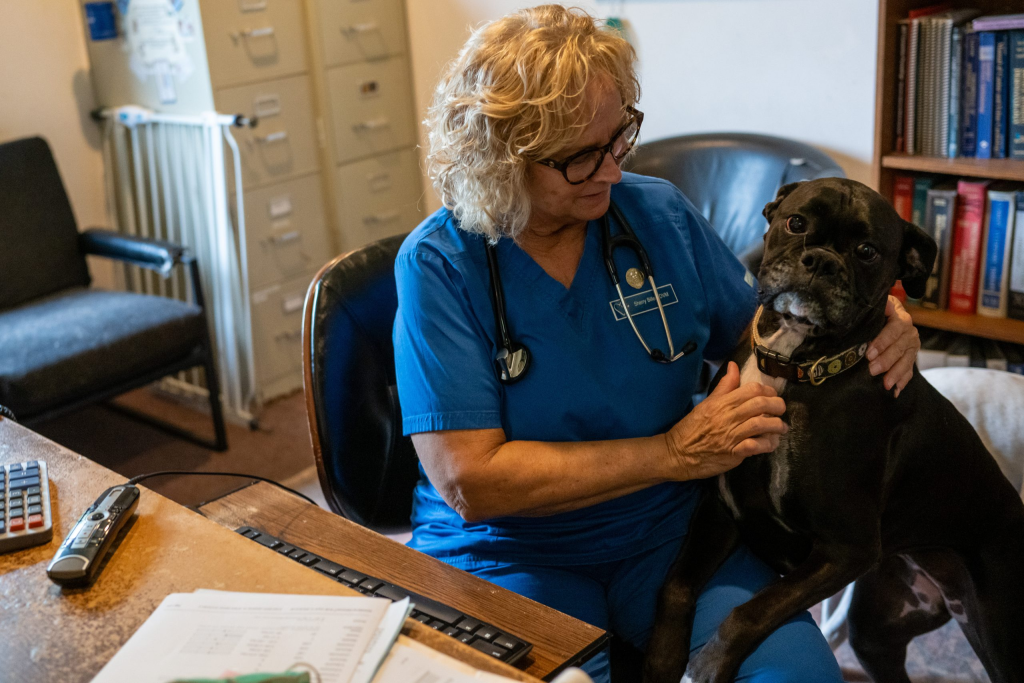
Peninsula Veterinary Hospital in Sturgeon Bay receives at least five calls a day from people who need emergency care. Staff work patients into the schedule if they can. But often, they’re not equipped to treat the issues, lacking the proper tools or staff.
“It’s like going to your family doctor with a broken leg,” said Amy Hults, a certified veterinary technician at the clinic.
It was easier for residents to get by when BluePearl operated a facility in Green Bay, about 35 miles closer than Appleton. But the facility closed in early 2025. The company never offered a reason why.
Nowadays, residents regularly complain about the issue to one another and on social media. The discourse gets louder in the summer months, when an influx of vacationers arrive, many unaware of the limited care options.

The chorus of complaints just may not be large enough. Research has shown that it takes a population of 100,000 people to have enough clients to sustain a round-the-clock facility, Door County vet Dr. Sherry Billett said. Door County is home to 30,000 year-round residents and welcomes more than 2.5 million visitors annually.
Other barriers stand in the way: Specialized equipment is pricey. The facility would need enough doctors and support staff to cover the clock — a notoriously difficult thing to find.
Peninsula Veterinary Hospital has been trying to find a new vet for “a long time,” to no avail, Hults said. With high housing costs serving as a barrier — the average home value is nearly $440,000 according to Zillow — it’s challenging to get new hires to move to the county.
“Because of the overwhelming demand, we need to schedule appointments several weeks in advance, and sometimes even months in advance,” Billett said. “We hear from callers on a regular basis that other clinics are not taking any new patients, which adds to our case load.”
They’ve gotten creative to fit in more patients, including overlapping bookings and having owners drop their pets off for the day, so they can work them in between appointments.
Burnout is a constant battle, Billett said. It’s stressful to juggle treating different species daily and handle the emotions of animals’ caretakers, she said. Suicide rates among veterinarians are high.
“That said, it is also an incredibly emotionally and psychologically rewarding profession for the right people,” Billett said.

Where are the vets?
So where are the right people?
There’s only one training program in the state: the University of Wisconsin-Madison’s School of Veterinary Medicine, where roughly 2,500 students vie for 100 open seats yearly. About half of the graduates will stay and practice in Wisconsin.
The school isn’t churning out enough graduates to make a serious dent in the state’s shortage. And its lecture halls and laboratories don’t have enough physical space to expand enrollment.
“We are capped out at the number of students we can admit because … the facilities just literally cannot fit any additional folks,” said Dr. Jonathan Levine, dean of the vet school.
“More and more people want to do this career, which is wonderful. It’s a terrific career,” he said. “The challenge is having enough spots to accommodate qualified, excellent applicants.”

To someday change that, UW-Madison is beginning to examine how it can renovate buildings and “expand our class size to meet the needs of Wisconsin and the region,” Levine said.
Student debt also plays a role in where veterinarians choose to practice, said Dr. Jen Quammen, president of the American Veterinary Medical Association. AVMA data shows veterinarians’ average student debt upon graduation climbed to nearly $175,000 in 2025.
“Food-animal, rural and public health careers typically pay less than companion-animal practice in metro areas, so many graduates find themselves balancing where they feel called to practice with where they can realistically afford to practice,” Quammen said.
Not all of these graduates work in emergency facilities or pet clinics. There’s demand for vets in many fields, Levine said, including research, at drug development corporations or in pathology.

“It’s all those things that have sort of combined over the last decade to drive very high demand, and the supply of veterinarians is limited,” Levine said. “In rural communities it’s been particularly challenging, and that is not a new story. It’s … a decades-old story.”
Solutions elusive
JoAnne Rosenfeld believes her Boston terrier, Butch, would still be alive if Door County had an emergency vet.
In April, Butch began seizing while he slept, spinning his body in “jerky spurts” and yelping in pain. Rosenfeld and her son scooped up Butch, limp and struggling to breathe, and brought him to the car for the 90-minute haul to Appleton.
Butch, almost 4 years old, died 18 miles from the destination. Rosenfeld pressed on, hoping CPR could save him, to no avail.
“Heartbroken, despondent, anguished, heartsick and sad beyond belief,” Rosenfeld wrote in a letter with other local advocates, asking that county leaders and vets come together to find a solution.

She offered one: Door County vets rotating weekends to be on-call for emergencies.
“If there are 10 vets willing to help, their duties would be just once every 10 weeks, about five times a year, only nights and weekends, which would not interfere with daily activities,” she wrote.
Local clinic workers say such an arrangement isn’t realistic, as they’re already fighting burnout.
“There is no way that a doctor or nurse could work their full 40- to 50-hour workweek and still be capable and fresh for after-hours or weekend emergencies,” Billett said. “This would add to the stress and the burnout that it is already a constant battle.”

While emergency care inside county limits seems unfeasible, closer help could soon be on the way. National chain Veterinary Emergency Group (VEG) will soon open a new 24-hour emergency location in Bellevue, about 40 miles closer than BluePearl in Appleton. Its website says the Brown County location is “coming soon,” and a ribbon-cutting will be hosted on Aug. 27.
VEG’s site offers no contact information for the new branch. The company did not respond to a request for comment.
But closer care would be a welcome relief for Sister Bay resident Nancy Treleven, who has driven a six-hour round trip to get care for her French bulldog, Winston.
“It’s just scary when you’re in the car with a pet that’s not well,” Treleven said. “I’m focused on driving, but I’m completely stressed because I’m worrying about how my dog is doing, and if I’m gonna get there in time, and what happens if everything’s not OK, and I can’t make it back home tonight. Where am I staying? What am I doing?”
Nationally, legislation addressing the problem is in the works. AVMA is advocating for Congress to pass the Rural Veterinary Workforce Act, which would offer $120,000 in student loan relief to veterinarians who commit to three years of service in rural shortage areas.
Miranda Dunlap reports on pathways to success in northeast Wisconsin, working in partnership with Open Campus. Find her on Instagram and Twitter, or send her an email at mdunlap@wisconsinwatch.org.

Wisconsin Watch is a nonprofit, nonpartisan newsroom. Subscribe to our newsletters for original stories and our Friday news roundup.
Vet shortage overwhelms clinics, leaves owners to drive hours for emergency care is a post from Wisconsin Watch, a non-profit investigative news site covering Wisconsin since 2009. Please consider making a contribution to support our journalism.
