


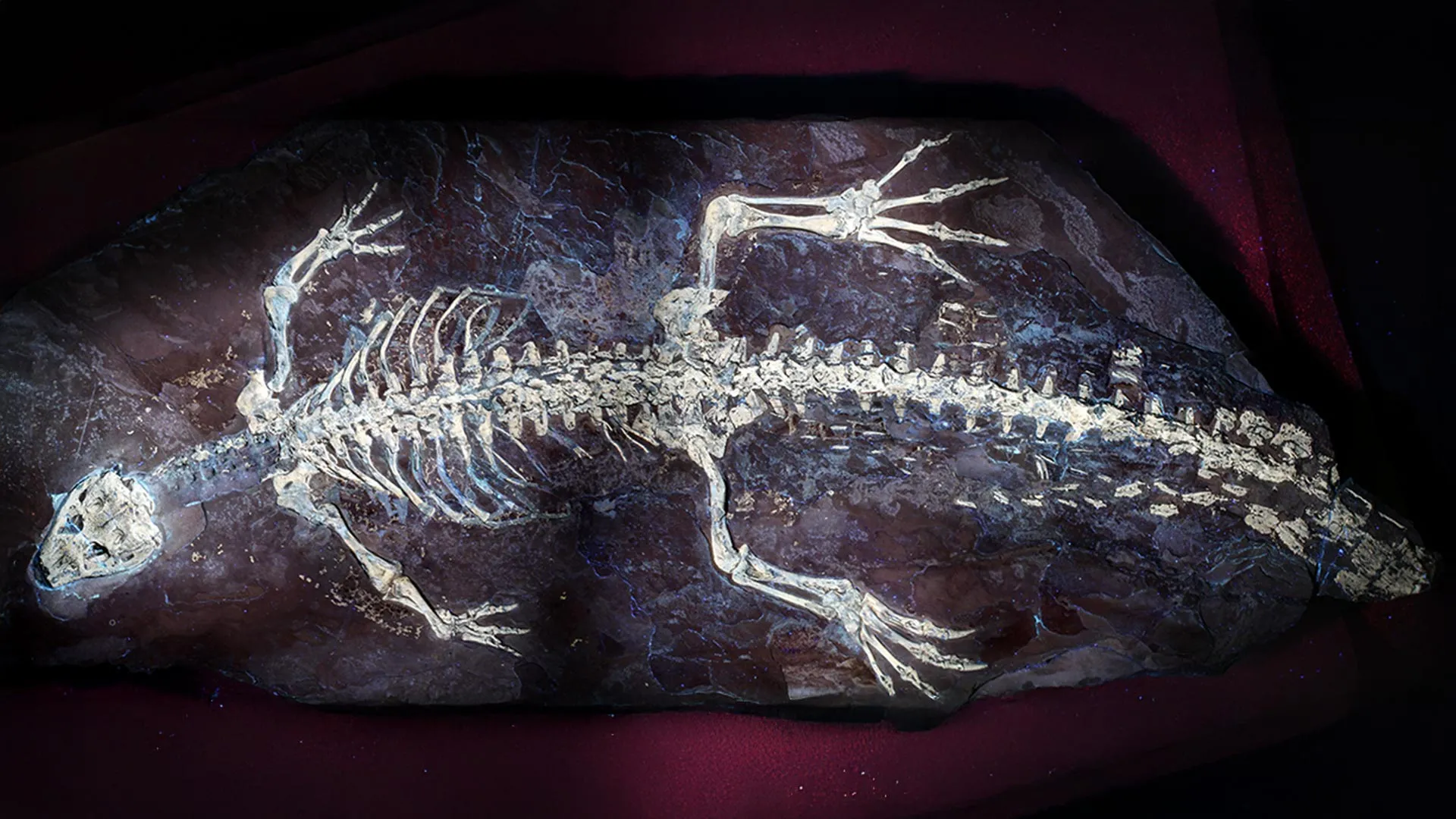
A remarkably preserved fossil from northeastern Spain is giving scientists a rare look at the skin, soft tissues, and possible coloration of an ancient crocodile relative that lived about 125 million years ago.
The new study, published in the Zoological Journal of the Linnean Society, provides the first detailed description of soft tissues preserved in Montsecosuchus depereti, a Lower Cretaceous crocodylomorph discovered at the Pedrera de Meià site in the province of Lleida (Catalonia, Spain). By examining the fossil under ultraviolet light, researchers uncovered new evidence about its skin, sensory structures, respiratory anatomy, and possible color pattern. The work was led by the Institut Català de Paleontologia Miquel Crusafont.
A Tiny Crocodile Preserved for 125 Million Years
Approximately 125 million years ago, a small crocodile died in a karstic lake close to the coast of what is now the Catalan Pre-Pyrenees. Its body settled into fine lake sediments, where unusually favorable conditions helped preserve it in exceptional detail. Over time, those sediments became the lithographic limestones of the Pedrera de Meià, now part of the UNESCO Orígens Global Geopark.
The fossil, cataloged as MGB-512, is about 50 centimeters long and is housed at the Museum of Natural Sciences of Barcelona. It was discovered more than a century ago and received some scientific attention in the 90s, but researchers have now extracted information that had remained hidden since its discovery, including the shape and distribution of its preserved soft tissues.
The breakthrough came while paleontologists Oscar Castillo and Jesús Serrano were building a database of fossils from the lithographic limestones of Montsec held in Catalan and European museums. When they examined the holotype of Montsecosuchus depereti under ultraviolet light, they noticed structures that appeared to be remnants of soft tissue.
Ultraviolet light can cause fossilized tissues and the surrounding rock to respond differently, making otherwise invisible structures stand out.
“UV light allows us to see details that would otherwise remain completely hidden in the rock,” explains Oscar Castillo-Visa, first author of the work.
Ancient Skin Revealed Under UV Light
Using this technique, the team documented several kinds of soft tissue, including epidermal scales. Although Montsecosuchus depereti has been known to science since the early 20th century, the new analysis provides the first detailed picture of what its skin looked like.
The scales varied considerably in shape and size across different parts of the body. The researchers also found that the animal lacked the high caudal fin seen in modern crocodiles.
The fossil may also preserve evidence of sensory organs in the skin. The possible structures appear within some scales, particularly around the neck, limbs, and along the sides of the trunk and tail.
In living crocodiles, similar sensory organs can detect touch and changes in water pressure, while also responding to temperature and chemical signals. In Montsecosuchus, these possible sensory structures appear only in small scales located around the edges of the body. That distribution could suggest that such organs first evolved in specific localized areas before becoming more widespread across the skin in later crocodylomorph lineages.
Clues to an Advanced Respiratory System
The ultraviolet analysis also exposed cartilaginous structures in the chest. These features indicate that Montsecosuchus already possessed an efficient respiratory system that shared certain similarities with those of modern crocodiles.
The discovery suggests that sophisticated thoracic anatomy had evolved surprisingly early in crocodylomorph history.
“These traits indicate that, despite being a primitive animal, it was already very well adapted to a semi-aquatic lifestyle,” concludes Castillo-Visa.
A Possible 125-Million-Year-Old Color Pattern
Perhaps the most striking discovery involves the animal’s tail.
Under ultraviolet light, some scales in the caudal region show alternating light and dark bands running across the tail. Researchers interpret these bands as possible evidence of the animal’s original coloration.
The pattern may have served as disruptive camouflage, visually breaking up the outline of the crocodile and making it more difficult to distinguish from its surroundings. If that interpretation is confirmed, Montsecosuchus would become the oldest known crocodylomorph with preserved evidence of coloration.
Scientists cannot yet determine the exact colors that produced the pattern.
“At the moment we cannot say for sure what color the crocodile’s tail was, but it would be expected that it was not so different from current species, which also show different coloration patterns,” explains Albert G. Sellés, co-author of the article.
The findings offer new clues about the early evolution of crocodylomorph skin, respiration, and external anatomy. They also highlight the scientific importance of the Catalan fossil record for reconstructing the evolutionary history of vertebrates.
In addition to Oscar Castillo-Visa and Albert G. Sellés, Àngel Galobart (Institut Català de Paleontologia Miquel Crusafont and director of the Conca-Dellà Museum) and Phil Bell from the University of New England participated in the research.
The research has been mainly funded by the VEBPI, PLEC2021-007903, and ARQ001SOL-173-2022 projects, with support from the Ministry of Science, Innovation and Universities, the NextGenerationEU/PRTR program, the Department of Culture of the Generalitat de Catalunya, and the CERCA program.
La Pedrera de Meià, an Exceptional Fossil Site
The Pedrera de Meià is considered a Konservat-Lagerstätte, a term used for fossil sites with extraordinary preservation. At such locations, fossils may retain not only bones and other hard tissues, but also delicate soft structures that are usually lost during fossilization.
That exceptional preservation has made Pedrera de Meià an important site for studying Lower Cretaceous fish, amphibians, reptiles, and plants. More than 8,000 fossil specimens have been recovered there so far.
Fossils from the site can be seen at the Montsec de Meià Interpretation Center in the town of Vilanova de Meià, where more than 100 exceptionally preserved specimens are on display. The Orígens Geopark has also created a website featuring many of the site’s most representative fossils.
The fossil record includes spiders, flies, wasps or beetles, insect larvae, crustaceans, vertebrates such as fish and amphibians, and a remarkable diversity of plants. Among them is Montsechia, the first known angiosperm in the world. The center is also part of the “Dinosaurs of the Pyrenees” project, a network of museums and interpretation centers showcasing the rich paleontological record of the Catalan Pyrenees.
