


“>
Unsloth: kernel-level gains on a single GPU
Unsloth’s published benchmarks show 2x training speed for Llama 3.1 8B and Llama 3.3 70B. The setup used the Alpaca dataset, batch size 2, and gradient accumulation 4. QLoRA ran at rank 32 on all linear layers.
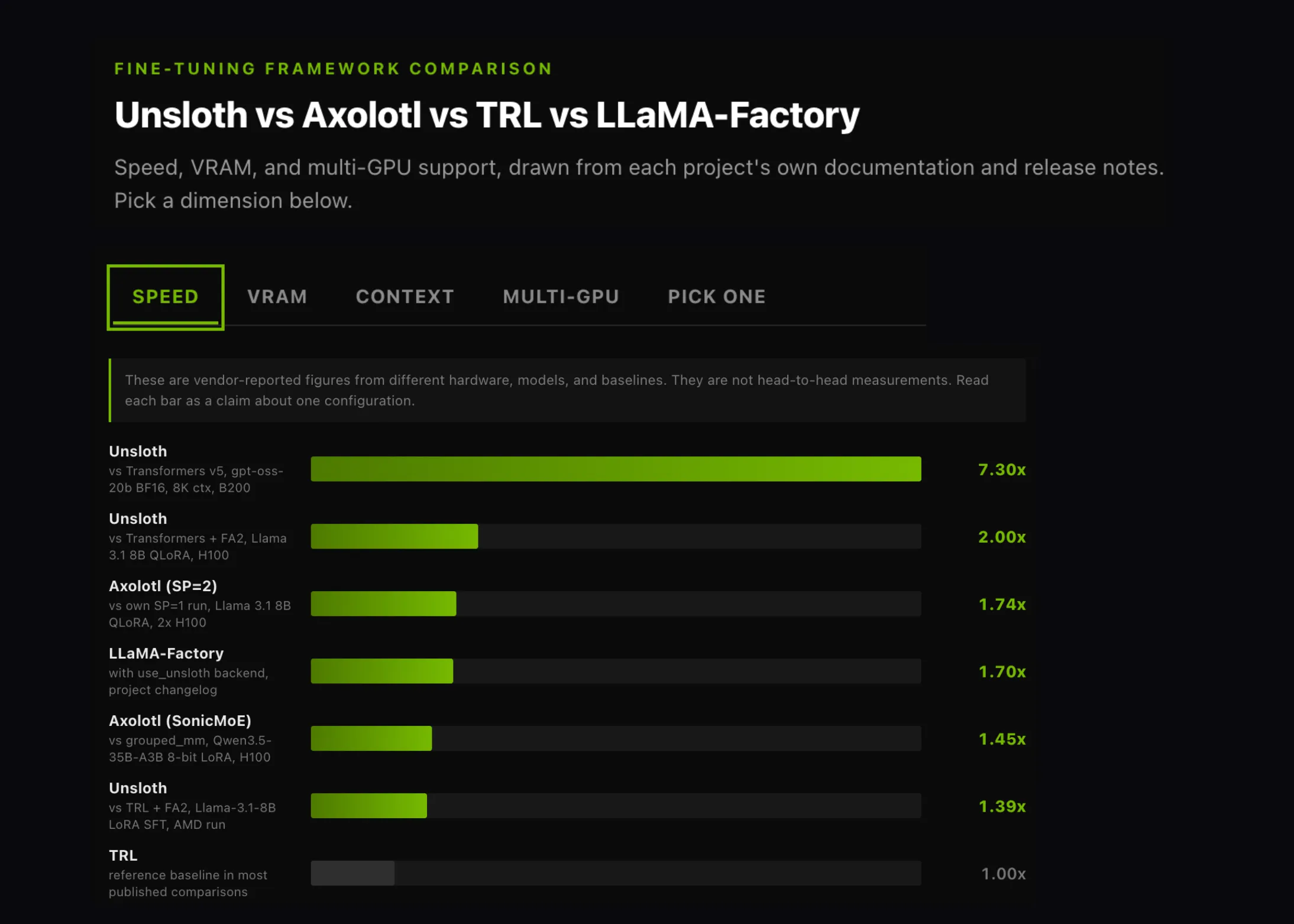
The MoE results are larger. Unsloth fine-tuned unsloth/gpt-oss-20b-BF16 on an NVIDIA B200. It reports 712.33 ms per step at 8K context, versus 5,226.86 ms for Transformers v5. That is a 7.3x gap. At 4K the gap is 4.82x, and at 1K it is only 1.37x.
The trend direction is model-dependent, and Unsloth’s docs scope this claim to gpt-oss. There, the speedup grows with sequence length, credited to Flex Attention and the MoE kernels.
Qwen3-30B-A3B on B200 runs the other way. Its reported speedup falls from 1.7x at 1K to 1.1x at 16K. Memory savings move the opposite direction, rising from about 2% to 15%.
Qwen3-30B-A3B on H100 reaches up to 1.77x. GLM-4.7-Flash on RTX PRO 6000 reaches 2.1x. A collaboration with AMD measured Llama-3.1-8B LoRA SFT at 2.07 s/step. TRL plus FlashAttention-2 took 2.87 s/step, a 1.39x gap with matching loss curves.
Axolotl: kernels borrowed, parallelism native
Axolotl added custom Triton kernels and autograd functions for LoRA in February 2025, explicitly citing Unsloth as inspiration. They are opt-in through lora_mlp_kernel, lora_qkv_kernel, and lora_o_kernel.
Recent release notes add SonicMoE LoRA support. It delivers up to 1.45x speedup and 30% memory reduction over a grouped_mm baseline. That figure is for Qwen3.5-35B-A3B 8-bit LoRA on a single H100 SXM.
Axolotl also ships FlashAttention 2/3/4, xFormers, Flex Attention, SageAttention, Liger Kernel, Cut Cross Entropy, and ScatterMoE.
TRL: the baseline everyone measures against
TRL is usually the reference point rather than the winner on raw single-GPU throughput. It compensates with breadth of memory and speed levers documented in Reducing Memory Usage and Speeding Up Training.
Those levers include packing, padding-free batching, truncation, Liger Kernel, and vLLM sleep mode for GRPO. TRL also has a first-party Unsloth integration, so the two are not mutually exclusive.
LLaMA-Factory: speed by delegation
LLaMA-Factory does not write its own kernels. It exposes other people’s work through config flags.
Setting use_unsloth: true activates the Unsloth patch. The project’s changelog reports 170% relative speed from that path. Unsloth’s long-sequence training is listed at 117% speed and 50% memory. It also supports enable_liger_kernel: true and FlashAttention-2 via flash_attn: fa2.
Reported memory floors
Unsloth publishes a VRAM requirements table sorted by parameter count. It lists 6 GB for an 8B model in 4-bit QLoRA and 41 GB for 70B. LoRA at 16-bit costs 22 GB and 164 GB for the same models.
LLaMA-Factory’s README hardware table covers the same regime for 4-bit QLoRA. It lists 6 GB at 7B, 24 GB at 30B, and 48 GB at 70B. Full bf16 fine-tuning of 70B is listed at 600 GB.
Both tables describe minimums. Batch size, sequence length, and optimizer choice move the real number.
Context length is the sharper differentiator
Peak VRAM at a fixed context is less interesting than the maximum context a given VRAM budget allows. Unsloth’s context length benchmarks for Llama 3.1 8B QLoRA at rank 32 and batch size 1 are stark.
| GPU VRAM | Unsloth context | Transformers + FA2 context |
|---|---|---|
| 8 GB | 2,972 | OOM |
| 16 GB | 40,724 | 2,551 |
| 24 GB | 78,475 | 5,789 |
| 48 GB | 191,728 | 15,502 |
| 80 GB | 342,733 | 28,454 |
Unsloth attributes this to its gradient checkpointing algorithm combined with Apple’s Cut Cross Entropy. For Llama 3.3 70B on an 80 GB A100, it reports 89,389 tokens. The FA2 baseline reaches 6,916.
The MoE memory story
MoE training is where memory behavior has shifted most in 2026. Unsloth reports gpt-oss-20b fine-tuning inside 12.8 GB, while Qwen3-30B-A3B at 16-bit LoRA needs 63 GB.
Its B200 gpt-oss run used 47.43 GB at 8K context where Transformers v5 used 73.80 GB. At 16K, Transformers v5 went out of memory and Unsloth used 55.13 GB.
The mechanism is a split-LoRA formulation. PEFT materializes the LoRA delta across all experts before the MoE matmul. Unsloth reorders the operations instead, which is mathematically identical but avoids the materialization.
Axolotl attacks the same problem differently. Its MoE expert quantization quantizes expert weights during model loading, freeing the original bf16 tensor immediately.
The reason is a Transformers v5 change. Expert layers moved from nn.Linear to fused nn.Parameter 3D tensors. bitsandbytes could no longer quantize them on load. Axolotl’s docs report GLM-4.7-Flash QLoRA dropping from roughly 127 GiB to roughly 23 GiB reserved memory with quantize_moe_experts: true.
This is where the ranking inverts. Unsloth’s single-GPU lead does not carry over.
Axolotl: the deepest parallelism matrix
Axolotl’s multi-GPU guide offers three mutually exclusive sharding strategies: DeepSpeed ZeRO stages 1 through 3, FSDP, and DDP. FSDP2 is the recommended path, and FSDP1 is deprecated.
On top of those, its N-D Parallelism guide composes data, tensor, context, and expert parallelism through PyTorch’s DeviceMesh. The documented support matrix confirms FSDP+TP, HSDP+TP, FSDP+CP, FSDP+TP+CP, and FSDP+EP.
Two combinations are explicitly unsupported. Expert parallelism cannot compose with TP or CP in v1. Pure DDP cannot compose with them either.
Axolotl’s sequence parallelism uses the ring-flash-attention library. Its published H100 benchmark for Llama 3.1 8B QLoRA supports the tradeoff.
| SP degree | Max context | Context scaling | Tokens/sec | Speedup / GPU count |
|---|---|---|---|---|
| 1 | 17,408 | 1.00x | 9,104 | 100.0% |
| 2 | 34,816 | 2.00x | 15,806 | 86.8% |
| 4 | 66,560 | 3.82x | 12,314 | 33.8% |
| 8 | 129,024 | 7.41x | 11,096 | 15.2% |
Context scales close to linearly. Throughput efficiency collapses. On 4090s at SP degree 8, the same benchmark records 0.88x speedup. Training got slower while context reached 32,768 tokens.
Axolotl also supports multi-node training through torchrun and Ray.
TRL: two sequence-splitting backends
TRL’s distributed training guide draws a clean distinction. Context Parallelism means Ring Attention on FSDP2. Sequence Parallelism means ALST/Ulysses on DeepSpeed.
Ring Attention needs Accelerate 1.11.0+, uses cp_size with cp_backend="torch", and currently supports SDPA only. FlashAttention is not supported on that path. Sequences must divide by cp_size * 2.
ALST/Ulysses needs DeepSpeed 0.18.1+ and Accelerate 1.12.0+. It uses sp_size with sp_backend="deepspeed" and works with FlashAttention-2. It is bounded by attention head count, requiring num_heads >= sp_size.
TRL’s guidance is specific. Ring Attention suits 1M+ token sequences and limited network topology. Ulysses suits NVLink or InfiniBand interconnects and sequences up to roughly 500k tokens.
TRL’s own Ring Attention benchmark fine-tuned Qwen3-8B across 1, 2, 4, and 8 H100 GPUs. At 8 GPUs, context lengths above 300k tokens became trainable.
LLaMA-Factory: standard engines with Megatron
LLaMA-Factory’s distributed training docs cover DDP, DeepSpeed, and FSDP, including FSDP2 and Ray for single-node and multi-node runs. The docs also describe DeepSpeed AutoTP, which combines tensor parallelism with ZeRO.
Its most consequential 2025 addition was a Megatron-core training backend through mcore_adapter. That opens a genuine large-scale pretraining path.
The FSDP+QLoRA path fine-tunes a 70B model on two 24 GB GPUs. That is the cheapest documented route to 70B in this comparison.
The friction point is the interface. Distributed configuration lives in YAML and CLI, not in LlamaBoard. Dev teams that adopted LLaMA-Factory for its zero-code UI lose that property when they scale past one GPU.
Unsloth: the open gap
Unsloth’s multi-GPU documentation states that multi-GPU works through Accelerate and DeepSpeed, giving access to FSDP and DDP. It also states the process is complex and requires manual setup, with official support still being announced.
The practical route is accelerate launch train.py or torchrun --nproc_per_node N_GPUS train.py. For models too large for one GPU, device_map = "balanced" splits the model across devices.
Unsloth’s PyPI listing marks multi-GPU as available with major improvements pending. The Studio changelog describes preliminary automatic multi-GPU allocation for inference and training as of March 2026.
Read together, the position is clear. Unsloth supports multi-GPU. It does not yet offer the composable parallelism matrix that Axolotl and TRL document.
- Unsloth breaks when you need tensor, context, or expert parallelism as first-class config. It also breaks when your model is not in its supported list, since gains come from architecture-specific kernels.
- Axolotl breaks on the learning curve. You configure FSDP2 versus DeepSpeed, SP degree, and divisibility constraints. Those constraints span GPU count, sequence length, and attention heads.
- TRL breaks on defaults. It gives you correct primitives, not tuned ones. You supply the Accelerate config, the memory optimizations, and the parallelism plan.
- LLaMA-Factory breaks at the UI boundary. Its abstraction is excellent up to one node and thin above it.
- Single consumer GPU, supported architecture, LoRA or QLoRA: Unsloth. The context-length headroom alone justifies it.
- Two to eight GPUs, long context, full fine-tuning or RLHF pipelines: Axolotl. FSDP2 plus sequence parallelism is the best-documented path.
- Custom training loops, novel post-training algorithms, tight Hugging Face coupling: TRL. You are building on the layer the others wrap.
- Broadest model coverage, non-engineer operators, fastest first run: LLaMA-Factory. Then move to CLI when you scale.
- These choices are not exclusive. LLaMA-Factory can run Unsloth as a backend. TRL ships an Unsloth integration. Axolotl calls TRL trainers internally.
- Unsloth wins single-GPU speed and context length; multi-GPU remains its documented weak point.
- Axolotl ships the deepest parallelism matrix: FSDP2, DeepSpeed, TP, CP, and EP composable via DeviceMesh.
- TRL is the primitive layer others wrap, now with Ring Attention and ALST/Ulysses sequence splitting.
- LLaMA-Factory trades depth for breadth: 100+ models, zero-code UI, Megatron backend, CLI-only distributed setup.
- Sequence parallelism scales context near-linearly but throughput efficiency drops sharply past four GPUs.
Asif Razzaq is the CEO of Marktechpost Media Inc.. As a visionary entrepreneur and engineer, Asif is committed to harnessing the potential of Artificial Intelligence for social good. His most recent endeavor is the launch of an Artificial Intelligence Media Platform, Marktechpost, which stands out for its in-depth coverage of machine learning and deep learning news that is both technically sound and easily understandable by a wide audience. The platform boasts of over 2 million monthly views, illustrating its popularity among audiences.
