


It was with boyish excitement that I clambered down the narrow stepladder and into the control room of FNS Pori, one of four fast attack crafts in the Finnish navy. The commander explained the latest missile systems to our small group: Sailors are taught to operate the ship not just from state-of-the art sensors, but also from paper, in the event of GPS denial. All eventualities are being rehearsed in the gray zone of almost-war.
These vessels spend most of the time patrolling the Gulf of Finland and the archipelago of small islands that straddle the Russian, Estonian, and Finnish borders. Russia is constantly testing how far it can go. The top brass of Finland’s military wants you to understand the acuteness of the danger.
It was with boyish excitement that I clambered down the narrow stepladder and into the control room of FNS Pori, one of four fast attack crafts in the Finnish navy. The commander explained the latest missile systems to our small group: Sailors are taught to operate the ship not just from state-of-the art sensors, but also from paper, in the event of GPS denial. All eventualities are being rehearsed in the gray zone of almost-war.
These vessels spend most of the time patrolling the Gulf of Finland and the archipelago of small islands that straddle the Russian, Estonian, and Finnish borders. Russia is constantly testing how far it can go. The top brass of Finland’s military wants you to understand the acuteness of the danger.
Undersea War: The Battle to Control the Cables and Pipelines That Connect Our World, Elisabeth Braw, PublicAffairs, 368 pp., $34, October 2026
I was at the Helsinki Security Forum, a gathering of government and industry representatives and military experts from around the world, earlier this month as it focused on the war in Ukraine and the Kremlin’s many open provocations across Europe and into the Arctic. Among this group, “hybrid warfare,” as a term, is now frowned upon.
It hasn’t worked in terms of galvanizing publics into appreciating the acuteness of the danger: It seems too remote and does not impart immediacy. Even the discovery in August of a drone carrying explosives at Leipzig airport, which the German government directly blamed on Russia, has yet to convince the public in many European countries to be more alert to the dangers, according to defense experts.
The preferred term is shadow war, which encompasses the gamut of actions designed to undermine liberal democracy and the rule of law, from disinformation to election interference to cyberattacks. These hostile actions are taking place on land, in space, and, as a new book dramatically explains, they are taking place all the time, and often with impunity, at the bottom of the sea.
The Undersea War, by security analyst and Foreign Policy columnist Elisabeth Braw, begins in November 2025 with the then-U.K. defense secretary, John Healey, making public a confrontation between the British armed forces and a Russian navy subsurface boat called Yantar, a frequent visitor to Western European waters. The deployment of such vessels (whether military or under the guise of research or merchant shipping) on spying missions isn’t new; what is new is their use for cutting undersea cables.
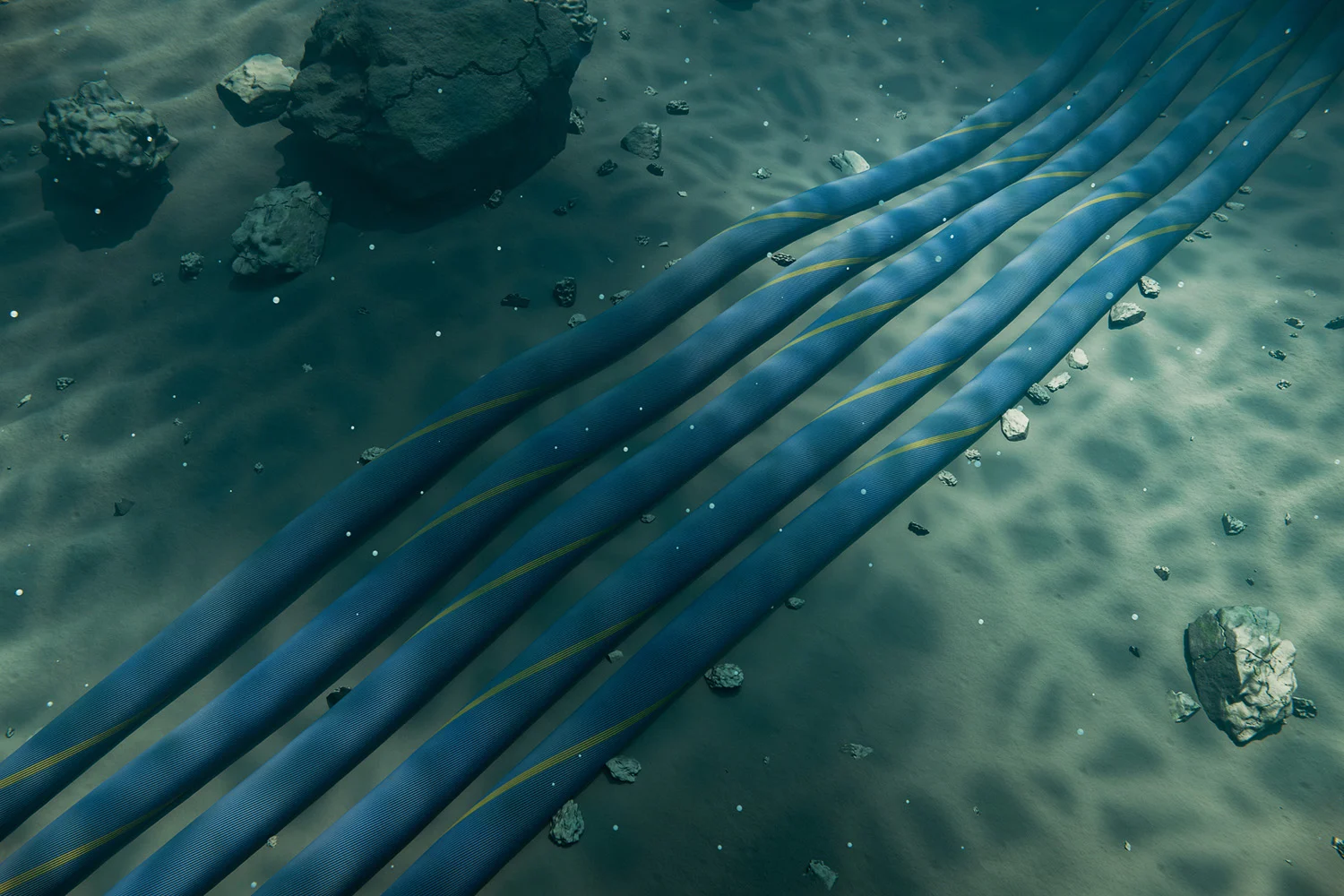
The author travels from the Red Sea to the Pacific, from the Baltic Sea to Taiwan, seeing the extent to which they are being destroyed, damaged, and threatened. It is a growing threat, and it is taking place in all oceans. The ramifications are enormous—for communication, for energy, indeed for most aspects of modern life. Between 95 and 99 percent of global internet traffic is carried along these cables. They “don’t form the orderly paths suggested by the colorful graphics on global cable maps”; instead, they “take squiggly paths” and are sometimes precariously perched and directed, described by one marine engineer as “a spider’s web.”
The seabed may be uninhabitable for humans, but it controls the functioning of our world. And yet, as Braw points out, the vulnerability is little discussed and public awareness is low. “We assume ‘the cloud’ is in the sky, but it’s underwater,” she notes. “Ever since Queen Victoria sent the world’s first transoceanic message in 1858, undersea cables have served humanity.” The cables remained intact even at the height of the Cold War, and their scope has expanded rapidly in recent decades.
In shallow waters, submarines can glide right on top of pipelines; even if they are without hostile intent, they can cause damage, as can natural causes (there are multiple recorded incidents of tropical cyclones and undersea volcanoes severing cables). It is sometimes hard to determine motivation, which benefits malicious actors, who commission merchant vessels using flags of convenience. Given the time lag, it is difficult to link a damaged cable with a particular crew. Even if its members are identified and caught in the act, they can claim it was an accident, they didn’t realize they had dropped anchor for so long. Even in the unlikely event of evidence being produced, many of the incidents take place in international waters. Beyond the 12 nautical miles of a country’s territorial waters, the law of coastal states no longer applies, so policing is tough, if not impossible.
Intelligence experts estimate that Russia is deploying a shadow fleet of at least 600 ships. Many are old, requisitioned tankers from developing countries that fly the flags of unlikely countries, from Guinea-Bissau to the Cook Islands to landlocked San Marino and Eswatini. They are being used mainly to carry oil in defiance of international sanctions, but they are also put to a variety of other uses: from intelligence gathering to scraping the surface of the sea floor to slash cables to various forms of communications interference. They manipulate their own GPS signals to seek to avoid detection, and they attempt to manipulate the signals of naval ships seeking to track them.
Braw runs through a series of underwater or seafaring incidents concerning the Balticconnector, Nord Stream, C-Lion1, the Arelion cables, the Elisa cables, and more.
It’s not just the Russians at work.
The Matsu Islands is an archipelago with stunning clifftop scenery just off mainland China that belongs to Taiwan and, as a result, is extremely vulnerable. Braw tells a story that begins on Feb. 8, 2023, when life on Matsu “came to a standstill. Suddenly, information could only be obtained by word of mouth. The only office work that could be done was typing, since nothing could be shared beyond the device. Touch screens became useless. Digital payments could not be processed. The backbone enabling modern life was simply not there anymore.” An underwater cable had been snapped. Pure and simple. It was that easy.
It took a while for the government in Taipei to be made aware of the crisis, and nearly two months for the cable to start to be repaired and life for Matsu’s 13,000 inhabitants to return to a modicum of normality. The incident has taught policymakers—those directly affected, and those observing from elsewhere—about the importance of crisis management and early response, but the danger has not lessened. Not just in Taiwan, but in many pinch points around the world, including in the high north and the Arctic, great power tensions are increasing.
The Trump administration, far from seeking to strengthen international cooperation in this lawless arena, is doing what it always does and looking for economic benefit. In a bid to take on China, in April 2025, the president signed an executive order allowing deep-sea mining for rare-earth materials, including in waters outside U.S. jurisdiction. In this complex and fragile underwater ecosystem, there is manganese, iron, aluminum, nickel, copper, cobalt, and potassium—or at least that is the hunch. And yet no one has any idea what damage mining them would do.
How far will any of the protagonists go? The author recalls a question asked of German Chancellor Friedrich Merz at the NATO summit in June 2025: How could world leaders, a reporter asked, distinguish between a provocation and an act of war?
“[W]hat does the word war actually mean?” Merz replied rhetorically, before attempting to answer the question: “We experience attacks every day, for example, on our data networks. We see the damage and destruction of submarine cables … We have a completely different dimension and a completely different transition between peace and war. It’s no longer a digital zero or one, but rather a fluid transition, and that’s happening.”
Braw concludes: “Merz had conveyed the frightening new reality of war. And in this new world, the defenders had no manuals, because no manuals existed.”
