


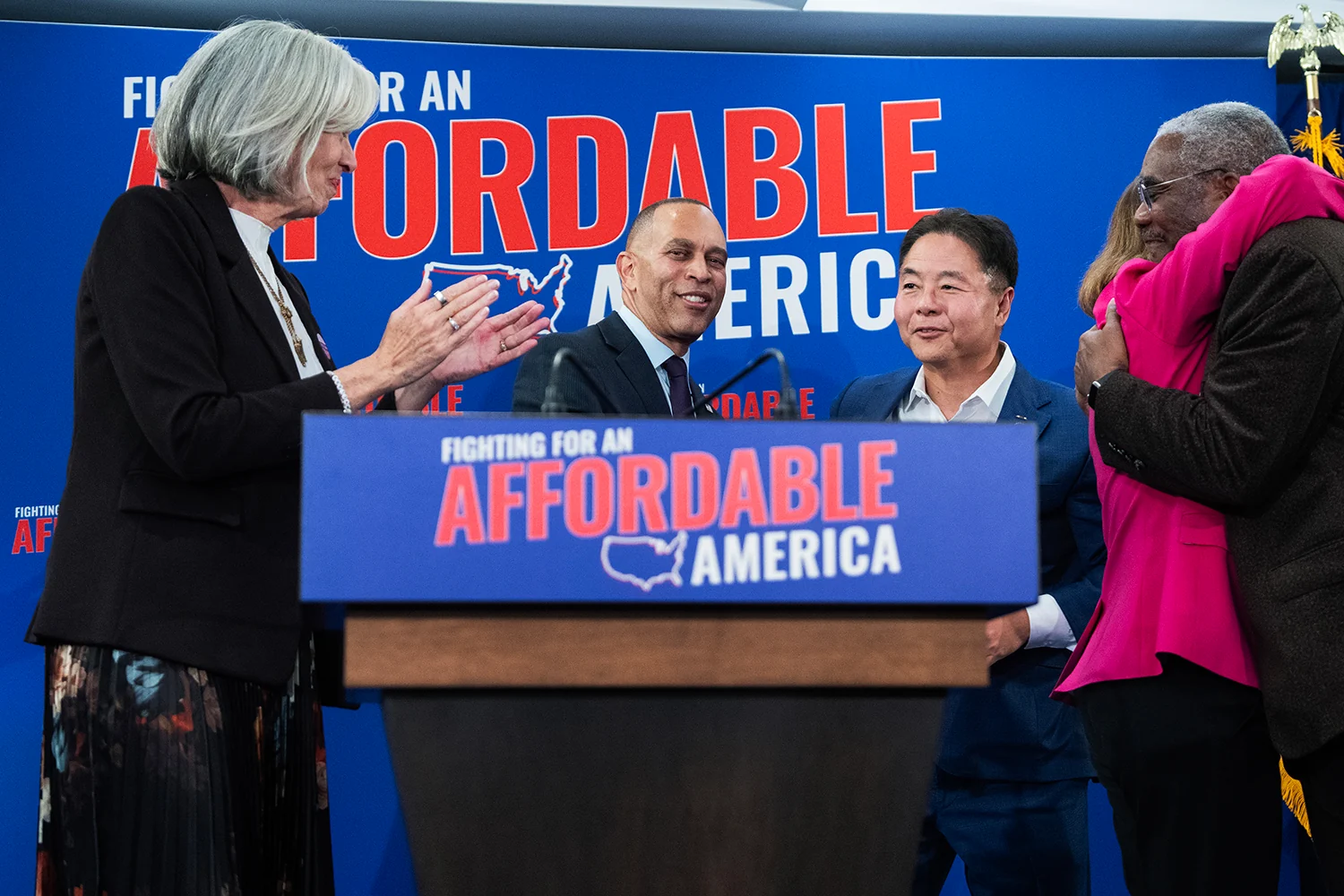
Dissatisfaction with U.S. President Donald Trump’s disastrous, expensive, and self-defeating trade policies were a big reason for the sweeping Democratic victory in the U.S. midterm elections—and may turn tariffs and trade into one of the crucial battlegrounds of the next Congress.
Concern over the economy was far and away the most pressing issue for voters, according to exit polls, and those concerns were mainly about inflation and stubbornly high prices. While higher energy prices were caused in part (as Trump acknowledged) by the war in Iran, Trump’s tariffs on friends and foes alike have for two years raised costs for businesses and consumers. Overall, about two-thirds of all voters said Trump’s tariffs had hurt them economically, with the pain sharpest among Democratic voters.
What’s more, it’s not just a rejection of tariffs, erroneously sold by Trump as a tax on foreigners, but a broad-based rejection of the notion that one man and his whims can hijack American wallets. According to one September poll, 70 percent of Americans believe that the president should seek congressional approval before levying new tariffs.
Now, with a large and unassailable majority in both chambers, and with ever fewer Republicans bound in fealty to a lame-duck president, lawmakers have a real chance to claw back the constitutional power over trade and taxation that they have dribbled away over the last century. And Trump himself has suggested that he does not want to spend his last two years of relevance “vetoing everything,” which opens the door to congressional fixes that could actually become law. Rep. Richard Neal, the ranking member and soon-to-be-again chair of the House Ways and Means Committee—the main conduit for trade legislation—indicated the tenor of the incoming Congress in his fulminations this fall against the latest Russian sanctions bill, which controversially gave Trump even more power to use tariffs. (Trump embraced the tariffs but waived the sanctions on Russia.)
“This bill is a tariff tyrant’s fantasy come true,” Neal said in a September speech. “Congress has a job to do. Do it. Don’t give it away.”
Congress tried earlier in Trump’s second term, with timid efforts, to restrain the president’s power to unilaterally raise taxes on Americans. None of those congressional efforts bore fruit, but that was a different Congress.
“The Americans have spoken: Affordability is a major issue, and that is tied into tariffs, which are very unpopular,” said Alan Wolff, a former U.S. Treasury Department official who has worked on trade issues since the Nixon administration.
“Among those who look at trade statutes, these conversations are becoming quite lively right now,” added Wolff, who is now at the Peterson Institute for International Economics.
With Congress in Democratic hands starting early next year, Trump’s bullying tactics on trade may face a check that could embolden victimized countries to take a page out of Canadian Prime Minister Mark Carney’s playbook and push back against the U.S. executive branch’s abuse of its delegated authorities.
But the real action may come on the domestic front.
There are actions Congress could take even during the lame-duck session, before most of the new lawmakers take their seats in January. Trump’s trade war with Canada, for instance, is wildly unpopular in border states and is predicated on the flimsiest of foundations. (Those tariffs, like all his others, are currently being litigated.)
“As far as I know, there is zero sentiment in Congress, on either side of the aisle, for the Section 338 tariffs” used against Canada, Wolff said. “That could be one place you could pick up some Republican votes even during the lame duck.”
The court challenge to that latest Trump tariff has two arguments. One is that the 1930 statute Trump invoked, for the first time ever, has been overtaken and superseded by subsequent trade legislation in the 1960s, 1970s, and 1980s. It’s a valid argument, backed by Supreme Court precedent, but it’s nebulous.
Congress could quash the debate entirely.
“They could explicitly say that Sec. 338 has been superseded,” Wolff said.
Looking ahead, that strategy—making trade law more explicit, with an eye to making judicial review easier—may be the clearest path forward for Congress. Trump has already been dealt several court defeats on his tariffs, but if Congress weighed in to clarify what trade powers have been delegated and under what conditions, it would make the courts’ job easier.
Two additional statutes could be in the crosshairs. Section 232 of the 1962 Trade Expansion Act allows the president to slap tariffs on imports on national security grounds. That has been a favorite of Trump’s since his first term; in his second, he has expanded national security concerns to include bathroom fittings and lumber. Section 301 of the 1974 Trade Act allows the president to take targeted action against individual countries that discriminate against U.S. commerce; Trump used it against nearly every U.S. trading partner, on the grounds that they don’t adequately enforce laws against the use of slave labor. (That, too, is currently in court.)
One simple fix, suggested Simon Lester, a trade lawyer, would be to amend those statutes so that they would comply with international trade law. That would require any tariffs under those statutes to comply with World Trade Organization rules, which they currently don’t. Such measures, he argued, would make it easier for courts to see what are valid uses of presidential trade authority and what are abuses.
Of course, the tug of war between Congress and the executive branch has gone on for at least a century. The reason that Congress began delegating trade authority to the White House, which culminated in Trump’s impulsive reign of trade terror, was because Congress made such a hash of tariff policy in the 1930 Smoot-Hawley bill—the very thing that Trump leaned on for his Canada tariffs.
The issue for the next Congress is how far to let the pendulum swing.
“The Sec. 301 actions and Sec. 232 actions—that is low-hanging fruit,” Wolff said. “The question is how far they want to go without having a close look at all the trade authorities and see where they went wrong.”
Wolff was in the trenches for the last big comprehensive trade overhaul that sought to balance the president’s need to have some power over tariffs and trade (for foreign-policy purposes) and Congress’s right to oversee taxation. That was the 1974 Trade Act. But that took two years. So it is unlikely that, Trump’s veto pen aside, the next Congress will be able to entirely rebalance the trade relationship back toward constitutional equilibrium.
It should, though. Much as the undeclared Iran war hovered over the minds of midterm voters, congressional abdication on trade did as well. Both stem from the same root, and both have the same solution.
“A declaration of war requires an act of Congress,” Wolff said. “So why shouldn’t the declaration of a trade war?”
