


Welcome back to World Brief, where we’re looking at a potential plan to reopen the Strait of Hormuz, Myanmar’s junta’s pursuit of political legitimacy, and domestic mining in the Democratic Republic of the Congo.
No Deal Yet
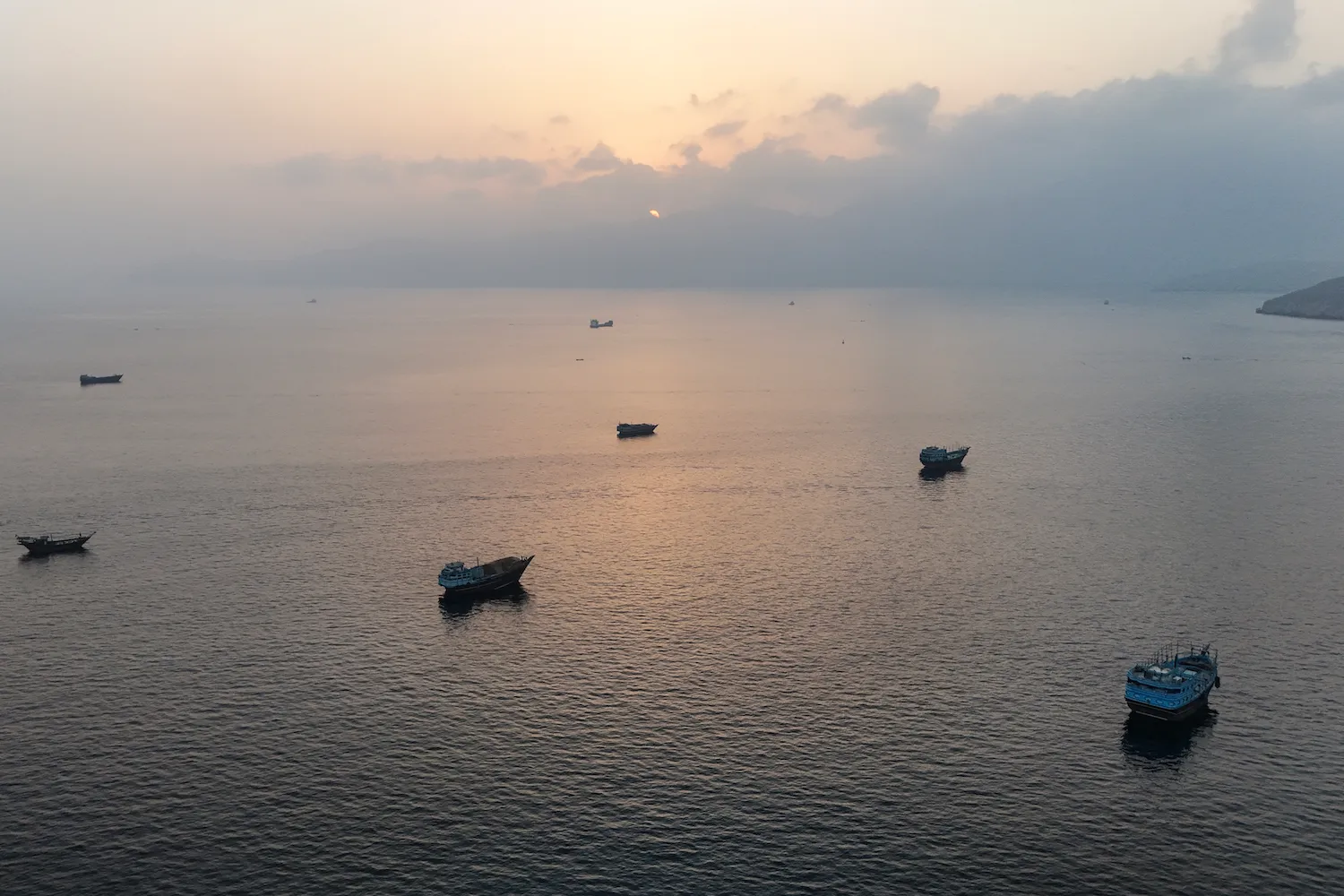
An agreement to reopen the Strait of Hormuz remained in the works on Thursday, as mediators separately urged U.S. and Iranian officials to come to a consensus on control of the strategic waterway. With Tehran claiming that it is in the “final stage” of drafting a deal with Oman, all eyes are now on Washington to determine what happens next.
Welcome back to World Brief, where we’re looking at a potential plan to reopen the Strait of Hormuz, Myanmar’s junta’s pursuit of political legitimacy, and domestic mining in the Democratic Republic of the Congo.
No Deal Yet
An agreement to reopen the Strait of Hormuz remained in the works on Thursday, as mediators separately urged U.S. and Iranian officials to come to a consensus on control of the strategic waterway. With Tehran claiming that it is in the “final stage” of drafting a deal with Oman, all eyes are now on Washington to determine what happens next.
Regional sources told Reuters that the proposed deal between the two Middle Eastern countries would give Iran oversight over all traffic entering the Persian Gulf through the strait. It is unclear how control would be defined; Tehran demands the right to board and charge commercial vessels, but Gulf mediators insist upon their right to supervise inspections and maintain that payments should be voluntary.
Either way, any level of Iranian control over the strait would mark a major geopolitical shift in Tehran’s favor, as prior to the onset of war in February, ships could pass through Hormuz freely and without facing tolls.
The 60-day framework reportedly under discussion would also require outbound traffic to pass through Omani waters rather than Iranian territory. Parties would have 30 days to begin de-mining the strait’s median lane, and ships would eventually be cleared to use this route in both directions. Analysts remain uncertain as to what extent Tehran has mined the thoroughfare and just how long it will take to clear the area for safe use.
Yet no deal has yet been reached, and previous efforts to reach a durable agreement have failed—in no small part due to confusion, misunderstanding, and differing interpretations of what exactly has been agreed to.
Signs of similar issues plaguing this latest round of negotiations arose on Thursday, with Iran’s semi-official Fars News Agency, which is closely linked to the country’s hard-line Islamic Revolutionary Guard Corps, publishing a purported initial draft of the Iran-Oman deal that included much more stringent restrictions on shipping through the strait: U.S. and Israeli ships would be banned from transiting the waterway, and other nations that have harmed Iran would also not be allowed to do so until they pay compensation to the country. Such terms are almost certain to be nonstarters for the United States.
Despite major diplomatic and military setbacks, U.S. President Donald Trump appears confident in Washington’s ability to win the war. “Iran, where the country has been decimated for the purpose of NOT ALLOWING IT TO EVER HAVE A NUCLEAR WEAPON, is going very well!” Trump wrote on Truth Social on Thursday in a post defending the actions of U.S. Defense Secretary Pete Hegseth.
The White House also denied reports that U.S. munitions stockpiles are running low, telling ABC News that “[w]e have far more munitions than anyone in the world, and far more than we need.”
These assurances directly contradict Trump’s past arguments that the United States can no longer provide Ukraine with Patriot interceptors because of its own focus on Iran. According to the Center for Strategic and International Studies, U.S. inventories of Patriot interceptors and anti-ballistic THAAD missiles have been reduced by two-thirds and one-half, respectively, since the Iran war began.
Today’s Most Read
What We’re Following
Seeking legitimacy. The leader of Myanmar’s junta regime traveled to Thailand on Thursday to pursue political legitimacy and reengagement with the Association of Southeast Asian Nations (ASEAN). During the two-day state visit, President Min Aung Hlaing is expected to try to convince Thai Prime Minister Anutin Charnvirakul that Myanmar is a stable country working toward democracy and that its leadership should be welcomed back to the world stage.
“Myanmar has now reestablished itself on the path to democracy and is moving toward a better future,” Min Aung Hlaing said. “As the new government, we have now begun working on national stability, peace, and national reconciliation.” Anutin confirmed that the two countries are prepared to enter a “new chapter of economic cooperation that is built upon mutual trust.”
In February 2021, Min Aung Hlaing led a military coup that ousted democratically elected leader Aung San Suu Kyi. Since then, the junta has tried to establish itself as a legitimate government by holding a phased presidential election that began late last year. However, allegations of a rigged vote, deadly government crackdowns on political dissidents, and the imprisonment of Aung San Suu Kyi has stopped Min Aung Hlaing’s government from gaining the trust of Western states and ASEAN members.
Critical mining. The Democratic Republic of the Congo has banned cobalt and copper concentrate exports, Reuters reported on Thursday, though one-year export waivers may be granted on a case-by-case basis. The June 29 government order reviewed by Reuters also introduced new taxes on significant mining byproducts, affecting a wide range of minerals. The ban took effect immediately, but the tax regime has a three-month transition window.
Congo is the world’s largest cobalt supplier, Africa’s top source for copper, and a major producer of other critical minerals, such as tantalum, lithium, tin, and gold. By imposing export bans on cobalt and copper, Kinshasa is hoping to force more domestic processing and retain a greater share of the wealth; Congo’s mining sector accounts for roughly 40 percent of the country’s annual GDP.
“Resource-rich countries have been used as extractive giants,” Heidi Crebo-Rediker, who was the U.S. State Department’s first chief economist under the Obama administration, told FP’s Christina Lu in June. Many “have not seen the benefits of the extraction of many resources over many decades.”
Massive rescue operation. Nigerian authorities rescued more than 300 people who were kidnapped during a series of recent abductions in Niger and Kwara states, according to the office of President Bola Ahmed Tinubu on Wednesday. “The successful execution of this intelligence-led operation demonstrates the growing efficiency and collaboration among our security services,” Tinubu said. This was the largest single-day rescue operation carried out by Nigerian security forces in the country’s history.
Of those freed were 145 individuals abducted from Niger state and 163 people abducted from Kwara’s Woro community. Kidnapping for ransom has become a major crisis in Nigeria, with Islamist insurgents often linked to Boko Haram or Islamic State West Africa Province targeting vulnerable rural community centers, such as schools and places of worship.
These attacks have placed added pressure on Tinubu, who plans to seek reelection in January. On Tuesday, Abuja approved pay raises of up to 80 percent for Nigerian armed forces in an effort to boost troop morale. Tinubu hopes that doing so will improve citizens’ views of ongoing security efforts and reaffirm his commitment to modernizing the military.
Odds and Ends
A book on ancient Greece was returned to an Australian public library last week—a whopping 150 years late. Antiquities of Athens, first published in 1858, was recently discovered inside a sealed fireplace during home renovations. Taking inflation into account, the late fee would be around $19,500, according to the library manager. However, the library’s records of borrowers from the 1870s, which is when the book is thought to have been checked out, have been lost, so the culprits (or their descendants) are probably off the hook.
