


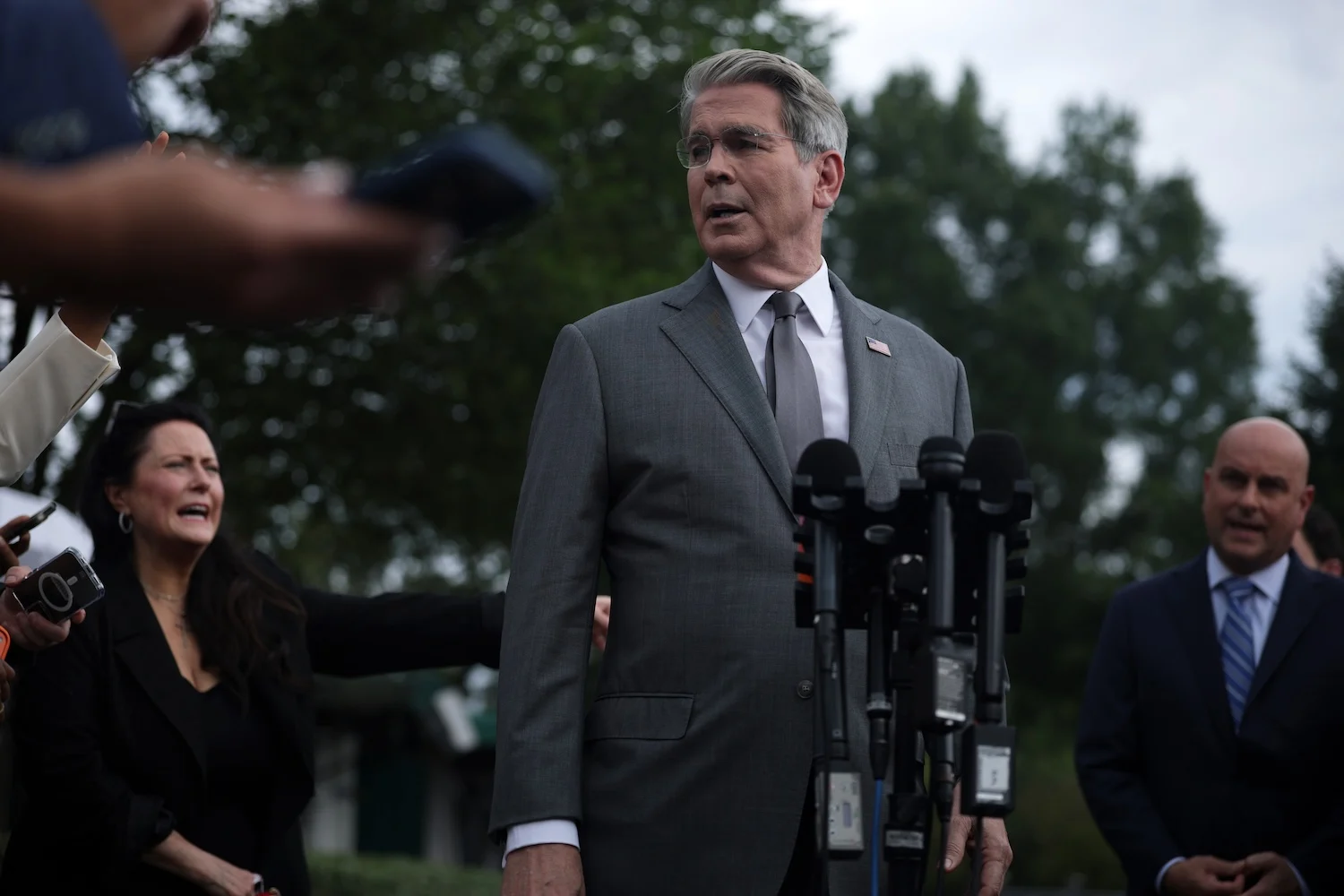
U.S. Treasury Secretary Scott Bessent, in a move befitting the most economically interventionist U.S. administration in half a century, announced his intention Wednesday to intervene to artificially cap runaway yields on U.S. government debt.
The move, which had a tiny positive impact that lasted less than an entire day, is a sign of the Trump administration’s rising panic over rising yields on its long-term debt. Yields on 10-year and 30-year Treasury notes remain at about 20-year highs. That is an indicator that buyers need serious incentives to dip their toes into the increasingly toxic waters of U.S. government debt.
U.S. Treasury Secretary Scott Bessent, in a move befitting the most economically interventionist U.S. administration in half a century, announced his intention Wednesday to intervene to artificially cap runaway yields on U.S. government debt.
The move, which had a tiny positive impact that lasted less than an entire day, is a sign of the Trump administration’s rising panic over rising yields on its long-term debt. Yields on 10-year and 30-year Treasury notes remain at about 20-year highs. That is an indicator that buyers need serious incentives to dip their toes into the increasingly toxic waters of U.S. government debt.
Why are the interest rates the U.S. government is paying on its bonds higher than they have been at any time since the great financial crisis? It’s largely because the U.S. fiscal and budget situation is a train wreck, with runaway budget deficits, gobsmacking levels of government debt, and no apparent plans by Republicans, who control Congress, and the White House to do anything about it.
“I don’t think it really offsets the longer-run worries about any plan for the deficit or the uncertainties about monetary policy. It’s like spitting in a bucket,” said Maurice Obstfeld of the Peterson Institute for International Economics.
Most of the debt increase in recent years has come from U.S. President Donald Trump’s first-term tax cuts, topped off by an even bigger tax cut in the second term’s One Big Beautiful Bill; another big chunk came as the Biden administration responded with emergency stimulus to a historic economic slowdown during the COVID-19 pandemic.
Total U.S. national debt topped a record $40 trillion this week, and it is not slowing down. The federal budget deficit—how much of an overdraft the federal government has on its checking account, basically—for fiscal year 2026 to date (the fiscal year started last October) is $1.8 trillion and counting.
What that means is that interest payments on that debt—think of a credit card with a decent interest rate but a really, really big balance—are ballooning, with expenditures of around $1 trillion so far this fiscal year. That will likely double over the next decade, if trends hold.
The U.S. national debt has risen by $4 trillion since Trump took office last year. Debt has doubled since Trump took office the first time in 2017, going from just under $20 trillion then to $40 trillion today. That is to say, half of all the outstanding debt incurred by the United States since 1789 has come since Trump’s first election.
That is one big reason that bond buyers have been souring on U.S. debt. Bessent’s cosmetic and small-scale interventions beginning next month won’t fix the underlying problem, which is spend-now and hope-to-grow-out-of-the-hole. But it will muddy the waters by making it harder to discern what the “true” yield is on long-term government debt. Bessent’s intervention may throw a wrench into Federal Reserve Chair Kevin Warsh’s plan to have the markets give the Fed unvarnished feedback on what the real state of the economy is.
“Nobody is talking about the fundamental problem, which is not that markets are worried for no reason, but that markets have reason to be worried,” Obstfeld said.
Another reason for the spiking bond yields is the people who are buying the debt aren’t the same ones that bought it a decade-plus ago.
As recently as 2015, nearly half the holders of long-term U.S. government debt were foreign countries, mostly central banks, who just wanted a risk-free place to stash their money and earn predictable returns; they didn’t care much about the price. Today, however, the overwhelming purchasers of government debt are hedge funds, banks, and other institutional investors who are, in industry parlance, “price-sensitive.” Perhaps that explains the lukewarm reception to the Treasury’s latest auction of 30-year bonds.
The United States is not alone this summer in facing a bond-yield apocalypse. Many other developed economies, especially Japan but also Germany, France, the United Kingdom, and Italy, have also seen bond yields spike over very similar worries about growing piles of debt and little fiscal discipline.
The problem, and this is something Japan knows well, is that interventions to cap out-of-control yields find their counterpoint in a weakening currency. (That is one reason Bessent had to intervene last month for the first time in nearly 30 years to prop up the Japanese yen, even if that means weakening the U.S. dollar.) And, true to form, Bessent’s intervention in U.S. debt markets was met by a falling dollar.
That may please his boss, who always wanted a weak dollar to discourage imports and goose exports of U.S. products, but it is not a good thing for the country that manages the world’s global reserve currency and relies on foreign appetite for dollar assets to finance a large and growing current-account deficit.
But none of this should come as a surprise from an administration led by a man who fundamentally does not understand how interest rates or macroeconomics (or tariffs) work.
It is a sign, however, after Bessent’s previous interventions in Argentina and Japan, that the U.S. Treasury at least recognizes when economies are in distress. It just doesn’t have the tools to fix them.
