


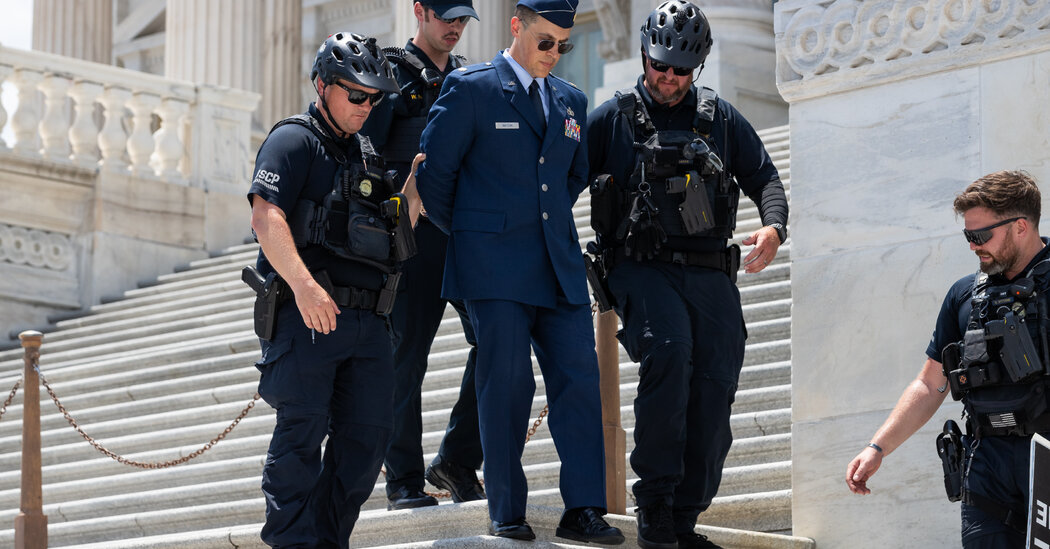
Maj. Jason Watson, a U.S. airman arrested after calling for President Trump’s removal over the Iran War, said on Monday that he was willing to accept punishment for his dissent.
An active-duty officer can be punished for “disloyal statements” or “contemptuous words” against the commander in chief and high-ranking government officials, an offense that can lead to dishonorable discharge, forfeiture of pay and a monthslong prison sentence.
“If I don’t put myself out there in a big way, then it’s just noise,” Major Watson said on Monday in an interview on CNN. “What is the highest price that I am willing to pay? And this is what I ultimately came up with.”
During the interview, Major Watson characterized the war in Iran as an act of American aggression and compared the U.S. military actions to Russia’s invasion of Ukraine. He said the president “chose” the war despite consternation and advice against it within his cabinet officials, calling it “unconstitutional.” Major Watson added that his public dissent was motivated by his “oath to the Constitution” and urged other Americans to do the same.
“You do not have to be somebody special to take action and reject this government,” he said on CNN.
The Department of Defense referred questions to the Air Force, which did not immediately respond.
In July, Major Watson was arrested at the U.S. Capitol after attending a news conference organized by the Removal Coalition, an activist group that has called for Mr. Trump’s impeachment, conviction and removal from office.
After the news conference that Representative Al Green, Democrat of Texas, also attended, the major stood on the Capitol steps holding signs calling for the president’s removal. The U.S. Capitol Police then arrested him for unlawfully protesting on the steps of the House.
The D.C. attorney general’s office decided not to prosecute Major Watson, but he was later taken into custody by the Air Force. Soon after his arrest, Troy E. Meink, the Air Force secretary, said on social media that his office would open an investigation into Major Watson’s conduct because it “takes allegations of misconduct seriously” including “any that might undermine the nonpartisan nature” of the military.
Mr. Watson said that he was not a member of the Democratic Party.
Military law, specifically Article 88 of the Uniform Code of Military Justice, mandates punishment against “any commissioned officer who uses contemptuous words” against the president, the vice president, Congress, civilian military leaders, any governor or state legislature. Article 134 punishes statements “made with the intent to promote disloyalty or disaffection toward the United States” by members of the military.
