


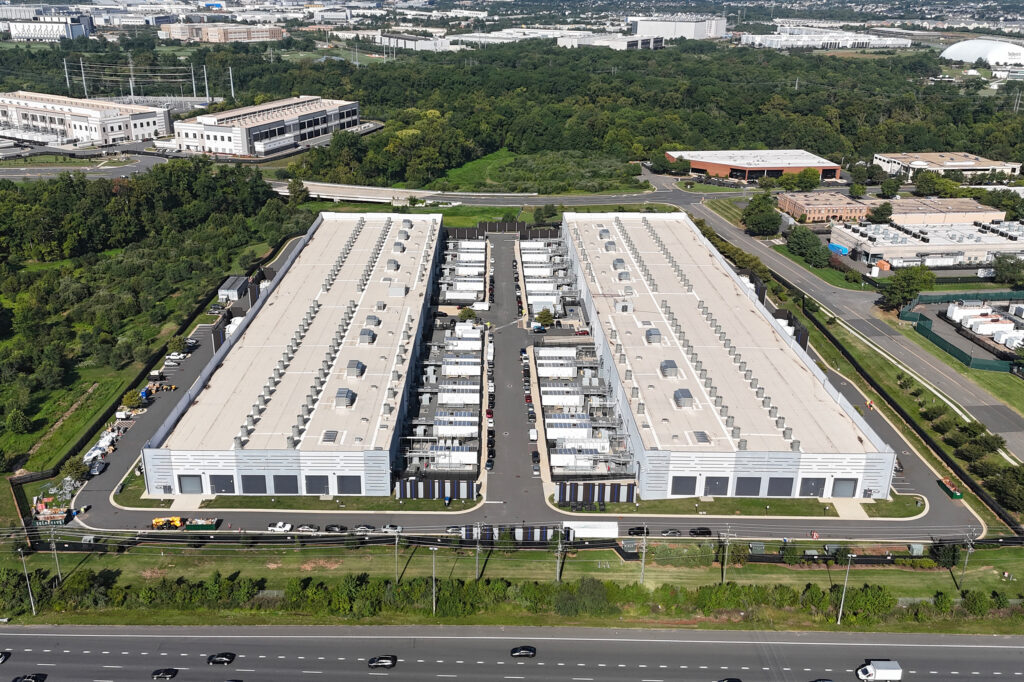
Data center developers and states see small modular nuclear reactors as one of the potential solutions for America’s increasing energy demand due to their smaller sizes and ability to provide steady energy generation. But nuclear energy experts say the main challenge is the timeline for their commercial deployment.
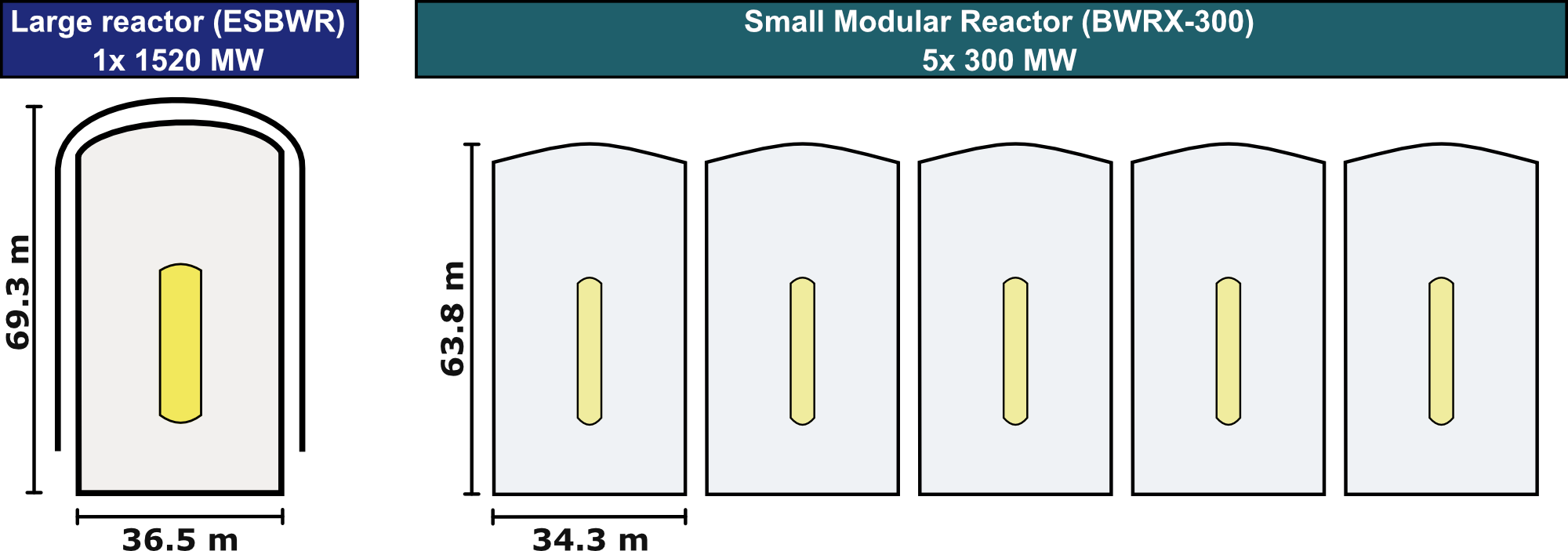
The U.S. Energy Information Administration describes small modular reactors (SMRs) as nuclear reactors designed to generate from 70 to 350 megawatts of power. According to the think tank Third Way, 22 SMR designs are under development in the country and two—both from NuScale Power Corporation—have received approval from the Nuclear Regulatory Commission for deployment in the U.S. market.
As of August, there are no fully deployed commercial SMRs in the United States.
While a 300-megawatt reactor can power around hundreds of thousands of average American homes, this is still much less than the 1,000 MW typical larger reactor designs can achieve. But for data centers, the answer lies in their smaller sizes, allowing for many reactors to fit in just a couple buildings and leaving enough space for the growth of the data center itself, said Brad Tietz, Midwest director of government affairs at the Data Center Coalition, an industry membership organization.
It’s also appealing when considering reliability and emissions.
“It all comes back to the same principles of nuclear energy, which is that it’s firm energy, it’s available when you need it,” said Patrick White, fusion energy safety and regulation expert at the Clean Air Task Force, a clean energy nonprofit advocacy organization. “It’s clean energy, so we know that it’s helping to meet our climate goals. It’s higher reliability, so it meets the needs of the different customers, and it has a small footprint.”
But even though some experts downplay concerns about nuclear waste, noting that some of the fuel can be re-processed significantly to reduce waste volume, the new reactors will still produce it.
The preferred model for the deployment of SMRs with data centers is co-location—close to the center, with power still going back to the electrical grid but removing the need to invest in additional transmission and distribution infrastructure, Tietz said. But setting that system up won’t begin any time soon.
“These technologies are not widely available yet or deployable at this point,” Tietz said. “You’re looking at a multi-year process for regulatory approvals, and then the time it can be needed to scale and make more efficient. It’s a huge opportunity, I think, in the future. We’re just not there yet.”
While the price for an SMR unit might vary from project to project, the best evidence for its cost comes from the Darlington Project in Ontario, Canada, said Jonas Kristiansen Nøland, professor at the department of electric energy of the Norwegian University of Science and Technology.
The Ontario government projects the construction of four GE Vernova Hitachi Nuclear Energy’s BWRX-300 SMRs at $140 per megawatt-hour for the first reactor and the other three at around $80 per megawatt-hour, Kristiansen Nøland said. This is still more expensive than wind and solar energy’s levelized cost of electricity (LCOE), ranging from under $40 to $86 per megawatt-hour, according to data from the financial advisory group Lazard.
The LCOE is based on a formula that takes into account the total cost of building and operating a power plant over its lifetime, as well as its energy production. It gives developers the minimum price that electricity must be sold to break even over the life of the plant.
Kristiansen Nøland said SMRs and their potential to continuously provide energy look more appealing as off-grid gas turbines have been met with increased societal resistance. Elon Musk’s xAI data centers in Mississippi and Tennessee, running 27 unpermitted gas turbines, recently became the target of a lawsuit brought by a coalition of environmental organizations, who claim the facilities are in violation of the Clean Air Act.
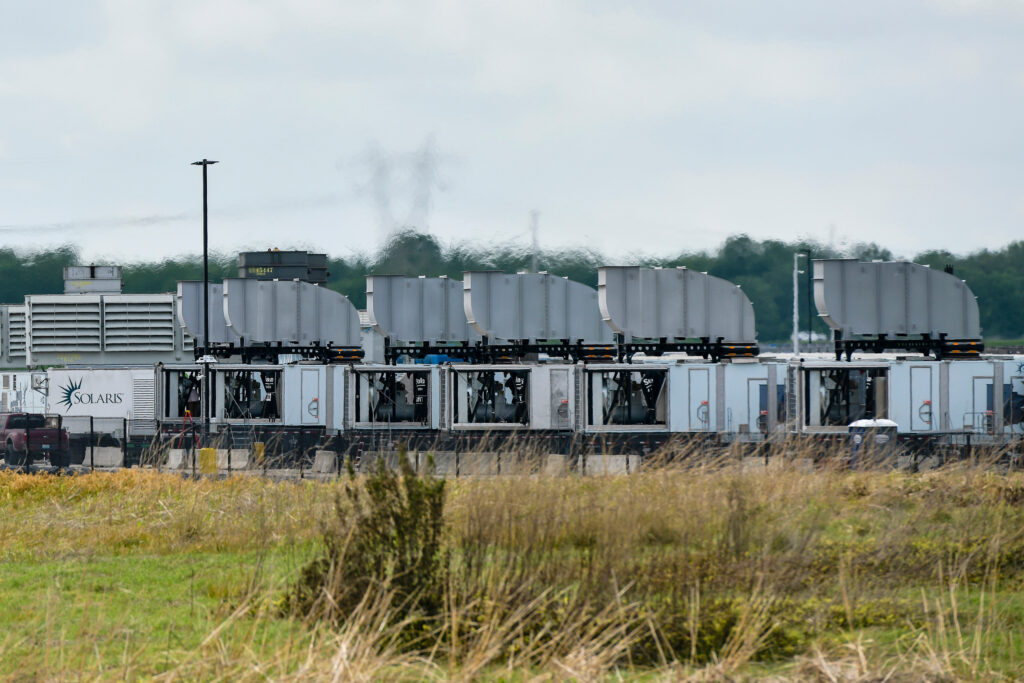
After Texas Governor Greg Abbott ordered a pause on approvals for data centers in early August because of a lack of energy and water, John Hopkins, chief executive officer of NuScale, said in a second-quarter earnings call a day after Abbott’s order that his company’s SMRs were an answer to such concerns. He said NuScale deepened their partnership with large-scale data centers but provided no specifics about the agreements.
“We’re positioning ourselves to move forward as quickly, so it’s really the timing of the customer and when they need their energy,” Hopkins said.
But some nuclear experts doubt NuScale’s ability to make its design viable commercially.
While the tech industry is famous for the ability to “fail fast,” nuclear startups don’t want to fail at all, said Adam Stein, director of the Nuclear Energy Innovation program at the Breakthrough Institute. He said that while NuScale has been around for 15 years, they have yet to find a solid customer.
Edwin Lyman, director of nuclear power safety at the Union of Concerned Scientists, said NuScale developments are “just talk” and that investors are starting to catch on to that.
“They’ve been promising for years now that they have deals right around the corner, and nothing happens,” Lyman said. “They had the first project that was close to actually happening, and it collapsed because the cost was too high. It’s not clear they’ve done anything to improve the economic viability of their reactors.”
In November 2023, NuScale’s project with the Utah Associated Municipal Power Systems for the construction of 12 reactor modules capable of generating 600 MW fell through as costs kept increasing since its inception date of 2015. NuScale also announced a partnership with the Tennessee Valley Authority in September 2025 for a 6 GW SMR deployment program intended to increase the seven-state service region’s energy capacity, but further details have yet to be released.
Different from tech and software startup products, nuclear technologies are much harder to achieve a minimally viable product, White said.
“You can’t just bang out a nuclear reactor in your garage and put it out on the street after six weeks,” White said.
Small modular reactor companies tend to make longer-term bets on the deployment of their technology and, as they go public, investors are asked to be patient while the companies try to outline their pathway to commercialization and profitability, he said.
Some states are encouraging SMR development to address increasing energy demands, which is affecting consumer utility bills. In the Mid-Atlantic region, within PJM Interconnection’s capacity market, a big part of that increase is attributable to data centers, said Clara Summers, campaign director at the energy watchdog Consumers for a Better Grid.
This story is funded by readers like you.
Our nonprofit newsroom provides award-winning climate coverage free of charge and advertising. We rely on donations from readers like you to keep going. Please donate now to support our work.
New Jersey Governor Mikie Sherrill signed a bill in July aimed at getting the state to meet its growing energy needs by investing in advanced nuclear energy. The term covers new nuclear reactors, like SMRs and other projects currently under review by the NRC, that come in a range of shapes and sizes.
But SMRs might not play a role for PJM in the short term, given how few are currently running, said Jon Gordon, senior director of the energy and transportation solutions association Advanced Energy United.
And if nuclear energy is to have an impact on meeting U.S. load growth, there needs to be an investment into its manufacturing capacity, said Victor Ibarra Jr., senior manager for nuclear energy at the Clean Air Task Force. He said the amount of issues along the supply chain are creating problems for SMR commercialization and the companies’ ability to make money.
That financial pressure for quickly deploying SMRs might encourage developers to cut costs on the safety and security of their reactors and jeopardize public health, safety and the environment, Lyman said. He believes co-locating data centers and nuclear reactors is not a realistic model, given the potential impacts of a radiological release.
Currently, there is insufficient validation that the proposed SMR designs are safe enough for the Nuclear Regulatory Commission to be willing to give the developers the benefit of the doubt, Lyman added. He said that fast-tracking the safety process is a dangerous development, as the justification for the lack of safety features is based on hypothetical reactor designs.
“I think the [nuclear] industry has really fine-tuned their PR machine,” Lyman said.
About This Story
Perhaps you noticed: This story, like all the news we publish, is free to read. That’s because Inside Climate News is a 501c3 nonprofit organization. We do not charge a subscription fee, lock our news behind a paywall, or clutter our website with ads. We make our news on climate and the environment freely available to you and anyone who wants it.
That’s not all. We also share our news for free with scores of other media organizations around the country. Many of them can’t afford to do environmental journalism of their own. We’ve built bureaus from coast to coast to report local stories, collaborate with local newsrooms and co-publish articles so that this vital work is shared as widely as possible.
Two of us launched ICN in 2007. Six years later we earned a Pulitzer Prize for National Reporting, and now we run the oldest and largest dedicated climate newsroom in the nation. We tell the story in all its complexity. We hold polluters accountable. We expose environmental injustice. We debunk misinformation. We scrutinize solutions and inspire action.
Donations from readers like you fund every aspect of what we do. If you don’t already, will you support our ongoing work, our reporting on the biggest crisis facing our planet, and help us reach even more readers in more places?
Please take a moment to make a tax-deductible donation. Every one of them makes a difference.
Thank you,

Fellow
Gabriel Matias Castilho is an Inside Climate News fellow reporting on the Washington, D.C. area. Previously, he worked for Capitol News Illinois, covering environmental policy, energy and utilities across the state. He is currently a master’s student at Northwestern University.
