


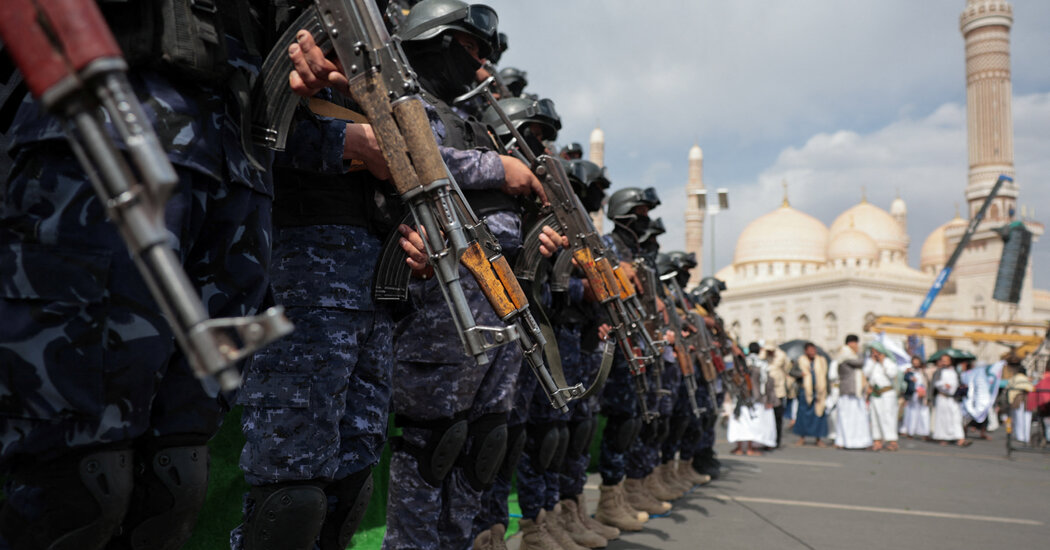
As the Trump administration considers attacking Iranian-backed Houthi forces in Yemen, U.S. forces in the Middle East are being stretched thin by nearly two weeks of daily airstrikes against Iran.
The Houthis claimed this week that they had targeted two Saudi oil tankers with missiles and drones in the Red Sea, after announcing a blockade aimed at Saudi Arabia.
President Trump has said he would hold Iran responsible for any further attacks by the militants, and threatened to expand the war to include the group itself. It would be the first major action against the Houthis since Operation Rough Rider — the Pentagon’s 52-day bombing campaign in Yemen — more than a year ago.
Former U.S. commanders say that a two-front war would present formidable challenges, including the availability of U.S. combat forces.
“It really depends on how much we throttle up our Iran operation,” said Kevin Donegan, a retired Navy vice admiral who was a top Navy commander in the Middle East. “Right now, it is not at full throttle.”
The United States has more than a dozen warships, including two aircraft carriers, in the Arabian Sea, and scores of warplanes in the region. The Pentagon is sending more F-16 strike planes from Germany and stealthy F-35s from Britain to the Gulf region, military officials said this week.
Mr. Trump had already threatened to dramatically escalate his war against Iran by targeting more bridges, power plants and other civilian infrastructure that also has some military use. That kind of escalation combined with additional strikes against the Houthis would challenge U.S. air power.
“The big question is: Should the U.S. resume airstrikes against the Houthis, and why?” said Adam Clements, a retired U.S. Army attaché for Yemen. “What does the administration think it will achieve?”
He added: “I don’t think new strikes would achieve much other than short, tactical gains and embolden the group to fight back.”
Regional specialists were skeptical that the Houthis would escalate fighting with the United States.
“My sense is the Houthis will want to stay below the threshold of U.S. intervention,” said Admiral Donegan, who cautioned that “the Houthis are hard to predict.”
Secretary of State Marco Rubio told reporters earlier this week that the Houthis had been smart to stay out of the war. “I hope that will de-escalate, because I think the Houthis, frankly, got snookered into this thing by the Iranians,” Mr. Rubio said. “They should stay out of it.”
There is only one U.S. warship in the Red Sea right now, the destroyer U.S.S. Gonzales. During past hostilities with the Houthis, the Navy had an entire carrier strike group offshore composed of an aircraft carrier, its complement of warplanes, and destroyers carrying missiles for air defense and targets on land.
U.S. Central Command, which directs military operations across the Middle East, hosts the Combined Maritime Forces, which can assemble allied warships on short notice for security operations in the Red Sea.
The Pentagon’s war against Iran has consumed much of the U.S. supply of cruise missiles and other advanced precision-guided munitions. It has also led to shortages of the kinds of weapons that would be needed for an extended campaign against the Houthis in Yemen.
The Houthis began attacking merchant ships in the Red Sea in solidarity with Hamas shortly after it launched a surprise attack on Israel on Oct. 7, 2023.
During a 10-hour battle in the Red Sea on Oct. 19 that year, the destroyer U.S.S. Carney shot down 15 one-way attack drones and four cruise missiles launched by Houthi forces in Yemen. The Navy called it “the most intense combat engagement by a U.S. Navy warship since World War II.”
The pace of attacks and reprisal strikes jumped just over a month later, after a Houthi strike on a commercial vessel, the Galaxy Leader, in the Red Sea.
In January 2024, U.S. forces were joined by Australia, Bahrain, Britain, Canada and Netherlands in a series of attacks on Houthis ashore in Yemen.
The Pentagon has called it the Battle of the BAM, short for Bab al-Mandab, the narrow waterway where the Red Sea meets the Gulf of Aden in the southwest corner of Yemen. The Houthis control territory near the coastline.
The same group of countries participated when fighting resumed on Feb. 1, 2024, with the addition of Denmark and New Zealand in support. Two days later, U.S. and British warplanes again struck targets in Yemen.
By the time a Navy aircraft carrier strike group left the Red Sea in June that year, its ships had launched 155 air-defense missiles, 135 Tomahawk cruise missiles and about 60 air-to-air missiles, according to the Navy. It had also dropped 420 weapons from the air.
U.S. attacks in Yemen continued in October 2024, including four strikes on Sanaa, the capital of Yemen, according to Yemeni news media.
During Operation Rough Rider, which began in March 2025, U.S. forces struck more than 1,000 targets, severely degrading Houthi missile, radar and drone capabilities. But by early April last year, it was apparent that the Houthis maintained a vast arsenal of missiles, drones and launchers.
Mr. Trump declared the operation a success.
“We hit them very hard and they had a great ability to withstand punishment,” the president said after announcing a cease-fire with the group in May 2025. “You could say there was a lot of bravery there.”
He added that “they gave us their word that they wouldn’t be shooting at ships anymore, and we honor that.”
