


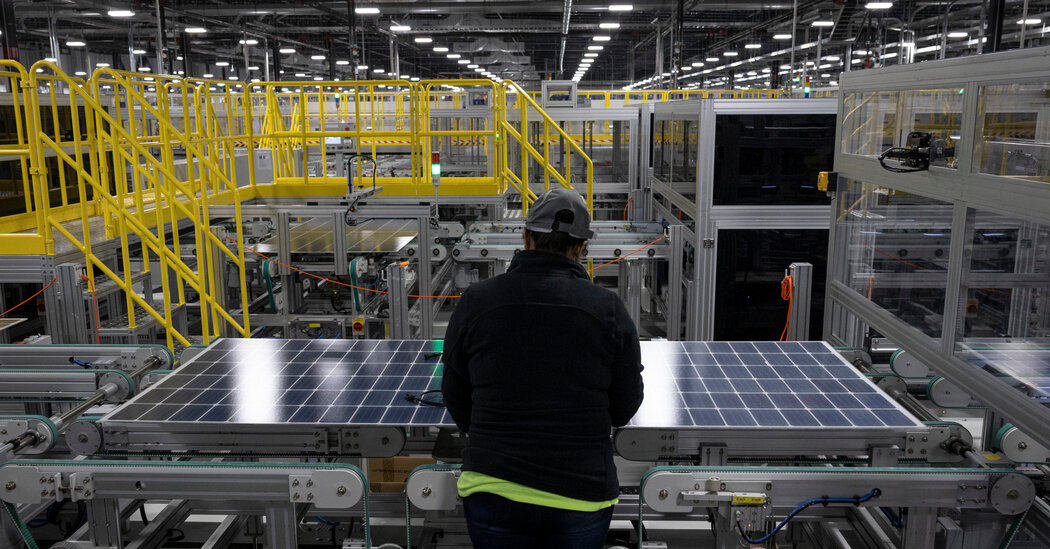
President Trump on Thursday signed a proclamation that would create a minimum price for imports of polysilicon and impose a 15 percent tariff on products made with the material, in an effort to support domestic production of a key component in semiconductors and solar panels.
The tariffs will go into effect in early December. By setting a minimum import price for polysilicon and products made with it, the administration will block any products priced below those levels from entering the U.S. market. That will allow U.S.-based manufacturers to sell their products at prices where they can be profitable. The administration said the move would help create a protected domestic market free from global distortions, and may be adjusted for countries that have trade agreements with the United States, the order said.
Mr. Trump also ordered Commerce Secretary Howard Lutnick to establish an incentive program for companies that build or expand factories to produce polysilicon or its derivatives in the United States.
The proclamation said that domestic polysilicon production was essential for national security because it is a key ingredient for semiconductors used in a variety of electronics and defense systems such as radar and communication systems as well as control systems for missiles and drones.
Polysilicon is a widely used raw material in solar photovoltaic panels as well as in semiconductors for computer chips and other electronics. The United States was once a world leader in production of the material, but China has since become the world’s dominant producer after funding domestic manufacturers. Today, China produces roughly 90 percent of the world’s supply, while the U.S. produces less than 2 percent.
While Mr. Trump’s order emphasized the importance of polysilicon for electronics and defense purposes, the solar industry is by far the biggest consumer of the material and some U.S. manufacturers of solar components have pushed for protections against Chinese imports.
U.S. solar manufacturers have repeatedly won trade cases against foreign competitors related to unfair subsidization and pricing, resulting in the U.S. government putting tariffs on solar panels and polysilicon from specific countries. But Chinese manufacturers, which dominate solar production, have quickly found ways to sidestep those rules by expanding globally and exporting to the United States from new countries that do not face restrictions.
The pattern has resulted in waves of exports and tariffs being imposed on China, Taiwan and Southeast Asia. In May, eight domestic solar companies filed a request for the government to investigate solar products assembled in Ethiopia with Chinese-origin components, saying the country had become the latest export platform to help circumvent U.S. tariffs.
The domestic companies said they had seen similar trends in the Philippines, the Middle East and countries in Africa, including Egypt and Nigeria. U.S. firms have complained that the country-based tariffs are inefficient and result in high legal expenses for American manufacturers.
Jon Toomey, the president of the Coalition for Prosperous America, a trade group that supported the tariffs, said the new global tariffs would “solve the endless game” of Whac-a-Mole that polysilicon and solar manufacturers had been fighting for decades.
“For the first time, the United States is protecting the entire solar supply chain with a single action,” he said.
The Trump administration has tried to use tariffs to build a protective wall around U.S. industries. Last month, it imposed duties on imports from more than 80 countries, in an effort to resurrect the tariffs that were struck down earlier this year by the Supreme Court. Those tariffs used a legal provision known as Section 301, which deals with unfair trade practices.
The polysilicon tariffs were issued under another national-security-related provision called Section 232, which the administration has also used to impose tariffs on foreign steel, aluminum, cars, copper and pharmaceuticals, among other products.
There are currently just two companies that produce polysilicon in the United States, Hemlock Semiconductor and Wacker Chemie. In 2024, REC Silicon attempted to restart polysilicon production in Moses Lake, Wash., but closed the facility later that year.
Although a large number of U.S.-based factories now assemble solar panel modules, many of the underlying components are still imported from abroad, including silicon wafers and photovoltaic cells. Last year, Republicans in Congress phased out tax credits rewarding solar developers that installed domestically made panels, but kept in place a credit to encourage U.S. solar factories.
While the new tariffs have the potential to increase the cost of installing solar power — which is currently the fastest-growing source of electricity in the United States — some solar manufacturers with U.S.-based operations, including Hanwha QCells and T1 Energy, praised the move.
“Today’s decision from the White House balances the reality of where America’s solar energy manufacturing is today while advancing our collective ambition to onshore the entire supply chain from polysilicon to finished panels in the U.S.,” Andy Park, global chief executive of Hanwha Qcells, a South Korean company that operates large solar manufacturing facilities in Georgia.
