


Unlock the White House Watch newsletter for free
Your guide to what Trump’s second term means for Washington, business and the world
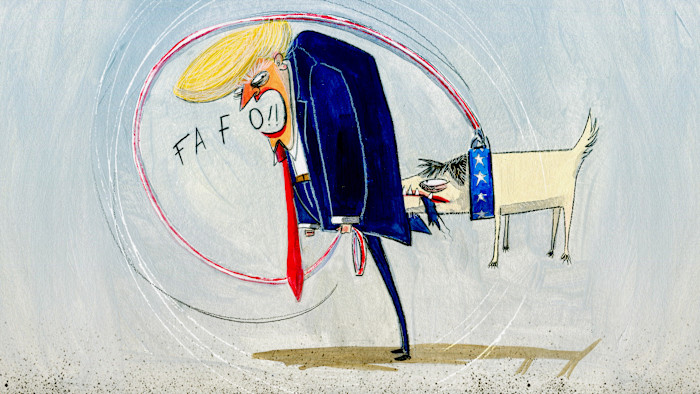
Donald Trump likes a four-letter acronym. The most famous is Maga. He and his team are also fond of Fafo. Shortly after the US capture of former Venezuelan president Nicolás Maduro, the White House posted an image of a stern-looking Trump — with the Fafo acronym emblazoned beneath it.
When Pete Hegseth assembled senior American military commanders last September, he told them: “Should our enemies choose foolishly to challenge us, they will be crushed by the violence, precision and ferocity of the War Department. In other words, to our enemies, Fafo. If necessary, our troops can translate that for you.” For those FT readers who do not have an American soldier nearby, Fafo stands for “Fuck around and find out”.
Just a few months after Hegseth’s speech, the world witnessed a perfect expression of the Fafo doctrine. Fed up with inconclusive diplomacy with Iran, Trump lost patience. The result was the joint US-Israeli attack on Iran on February 28. The supreme leader of the Islamic republic and many of his aides and family were killed or wounded.
But, some months later, the Fafo slogan has rebounded on the Trump administration. Despite frequent claims of total victory from the president, the reality is that his war has gone badly wrong. Iran controls the Strait of Hormuz and is determined to impose tolls on shipping passing through it. Senior Iranian leaders are now making new and even more ambitious demands — including the payment of reparations by the US and the withdrawal of American troops from the vicinity of Iran. The Iranians may calculate that, while those demands seem far-fetched, the US could eventually make far-reaching concessions to get out of Trump’s war.
These malign developments flow directly from the amateurish and hubristic way in which Trump made the decision to go to war. The US president allowed himself to be convinced by Benjamin Netanyahu, Israel’s leader, that regime change in Iran was within reach. Trump waved away warnings from his own staff that the Iranians might close the Strait of Hormuz. He failed to carry out what should have been routine consultations with regional and European allies.
And here we are. Fafo indeed.
The only real surprise is that it has taken so long for Trump’s flaws to catch up with him. The president’s critics used to be accused of suffering from Trump derangement syndrome when they suggested that a decision-making style based on vanity, vengeance, vibes and self-dealing would end in disaster. But the reckoning seems to have finally arrived.
However the current crisis is resolved, there are likely to be long-term consequences for US foreign and security policy. Previous administrations guarded American “credibility” jealously. They insisted that when a president spoke, the world must take his words seriously. But Trump shreds American credibility on a daily basis. He is stuck in a loop in which he threatens to devastate Iran one day, before announcing shortly afterwards that peace is at hand and that Iran is “begging” for a deal.
The credibility problem is not just about the erratic rhetoric of the president. It is an open secret that the US has badly depleted key munitions — such as cruise missiles and Patriot missile interceptors. Even if the Trump administration were to decide to follow through on the president’s threats, it might have difficulty sustaining high-intensity military operations against Iran. Gaps in missile defence also mean that the US has no real way of protecting the key infrastructure of its Gulf allies from Iranian attacks. Some American allies are thinking about new ways to secure themselves. Saudi Arabia, Turkey and Pakistan have just announced a new defence pact.
The effect of Trump’s rhetoric and erratic decision-making extends beyond security into economics. I was startled recently to hear an Asian money manager say that she increasingly thought of Trump’s America as an emerging market. When I challenged her, she pointed to sudden and arbitrary changes in policy, a fear that foreign investors may be discriminated against and the deep involvement of the president’s family and friends in business. All of this, she suggested, might make foreign investors warier of holding US assets.
In response to that kind of critique, the Trump administration can point to the fact that — in the roughly 18 months since he returned to the White House — foreign investors have continued to pour money into US equities and assets. The depth of US financial markets remains unparalleled. And the American economy continues to grow much faster than the Eurozone.
But there are warning signs. The dollar is the world’s reserve currency. And yet the US is still running a budget deficit of roughly 6 per cent of GDP a year — and it needs foreigners to buy its debt. Even Greece — which until recently was a byword for fiscal incontinence — now borrows more cheaply than the US.
The annual cost of servicing America’s federal debt exceeds the Pentagon’s budget and it is rising fast. But the Trump administration seems to have no serious plan to bring the situation under control.
At some point, there will surely be a reckoning here too. Debt and deficits is one subject where Fafo is the right slogan.
