


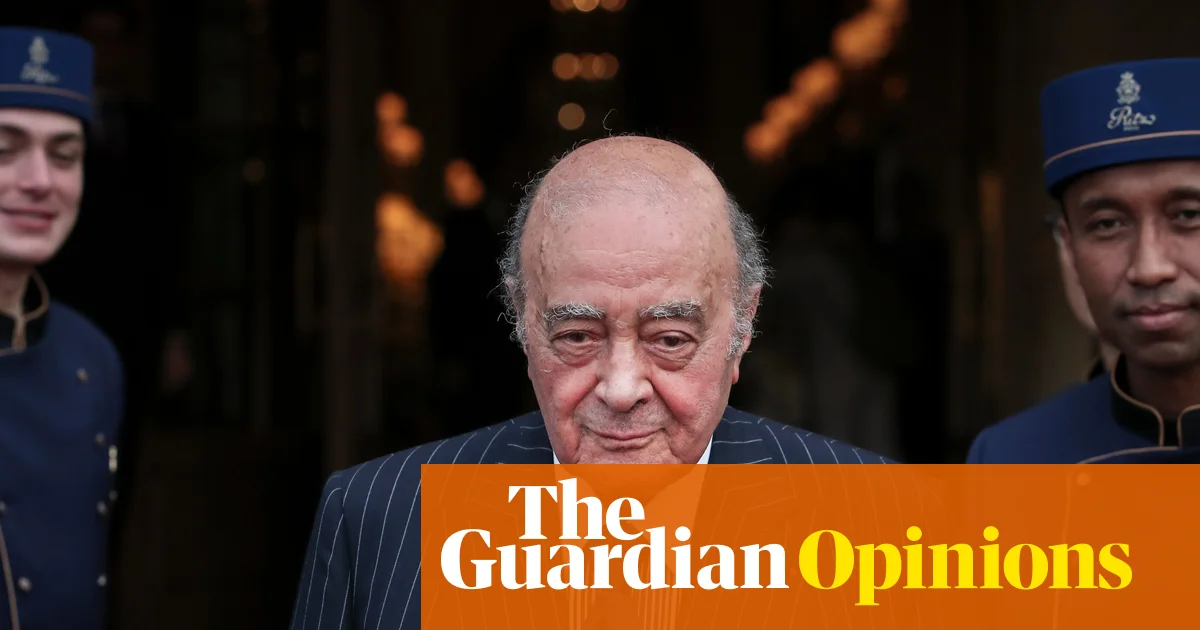
How reassuring to learn that police investigating claims of sexual assault against Mohamed Al Fayed have handed a file to the Crown Prosecution Service, a mere three years after the former Harrods owner’s death at the age of 94, and just decades after the first survivors made reports of abuse. The CPS has said it won’t provide a timescale for any decision, to which we might remark: no shit. With this case, the one thing you could never accuse any of the authorities of is being bound by anything approaching a timescale.
The story does, however, certainly have scale. So far, more than 400 allegations including rape, sexual assault, sexual exploitation and human trafficking have been made against Al Fayed by at least 156 women – abuse he got away with, having died without any charges ever being brought against him. The claims span the years 1977 to 2014. At least 21 women came forward while he was alive, and there have been extraordinary rundowns in news articles and documentaries about all the alleged enablers of his wicked behaviour, from lawyers to mouthpieces to security henchmen to the doctors who carried out “purity examinations” on his young female PAs.
So, not to be a Debbie Downer – because any movement on this case is better than none – but perhaps that sense of scale is not immediately discernible from the file that has been sent to the CPS, which relates to a male suspect in his 80s and two indecent assaults on two women in London. The investigation remains ongoing, the Met confirms.
Of course, other under-prosecuted criminal networks are available. During the full-spectrum coverage of the Jeffrey Epstein case, many asked how on earth so many blind eyes could be turned by so many people to so much flagrant abuse by someone who was known to have served prison time for soliciting prostitution from a minor. People marvelled at the vast collective silence – yet anyone who couldn’t quite believe how it could happen should have been reassured that other vast collective silences were very much ongoing. Peter Mandelson’s now notorious message of commiseration to his friend Jeffrey shortly before his 2008 incarceration – “it just could not happen in Britain” – always seems to me ironically resonant. Perhaps his lordship was right, though not in the way he meant.
As the Epstein furore raged on earlier this year, several Al Fayed survivors wrote to me asking why this one case was dominating everything while another, still unresolved one – and so much closer to home – seemed to lack the turbocharge of outrage that pushes something from the places our society would rather forget into the ones where we have our (always belated) reckonings. The answer to that question is normally that significant numbers of people and institutions have a deeply vested interest in not getting to the bottom of it.
after newsletter promotion
It would feel unwise to conclude anything other than that in this case. There has been no equivalent political pressure to let daylight in on Al Fayed’s activities. No one has got wall-to-wall news coverage for asking how he was able to operate an alleged criminal fiefdom in the centre of Knightsbridge, when allegations were repeatedly made and the rumours in rarefied circles were more than deafening. It was, it seems, just the way things were.
And as indicated, for things to be that way for so long, there needed to be whole armies of enablers and hangers-on who facilitated abuse, or looked away, or closed down or ridiculed or trashed those who stepped out of line and said anything about it, including the alleged victims. Only one of Epstein’s helpers, Ghislaine Maxwell, has ever been brought to justice. Typically, no one bar the kingpin in what I think of as the sex-case industrial complex even faces so much as a charge – they simply melt back into society, into other jobs, into the ongoing conspiracy of silence.
Today, the Al Fayed survivors’ group No One Above issued a statement pointing out that: “Survivors have spent decades either not being believed or being told that Fayed and those around him were too powerful and that nothing could be done – but today is an important reminder that the passage of time does not, by itself, put accountability beyond reach.” Yet with the best will in the world, the passage of time doesn’t exactly help, does it? Al Fayed himself died unscathed, and we all know that once things tip conveniently into the “historical” file, they are so much harder to prove.
But there are things the public can get behind right now. What Al Fayed’s survivors want is the trafficking investigation they have been requesting for almost two years. As they point out, this was not one bad man, nor some form of corporate abuse. It was, they allege, a trafficking network involving multiple perpetrators and enablers and backed by the global movement of illicit funds. At least five survivors have already been confirmed by the Home Office as victims of modern slavery. Yet the Met has been accused of having failed in its legal duty to offer the victims a referral to the national referral mechanism (it’s understood the police didn’t believe they were obligated to), which identifies modern slavery victims. Yet again, all the running is being made by a survivors’ group. No One Above wants confirmation that human trafficking and modern slavery are the primary framework of the Al Fayed investigation, and to know that financial investigators are being utilised to determine how the network was funded and concealed.
It remains to be seen if any belated percentage of justice will be served in this case. Even if it is, we can expect all manner of blind-eye institutions to immediately resort to their happy place and trot out some trite platitude like “never again”. In fact, it would be more accurate to conclude the opposite. Always again. Always again, until society has the courage to realise that it so often takes a village to do bad things, as well as good ones.
