


A lot of this week’s trouble starts with something trusted doing exactly what it was allowed to do.
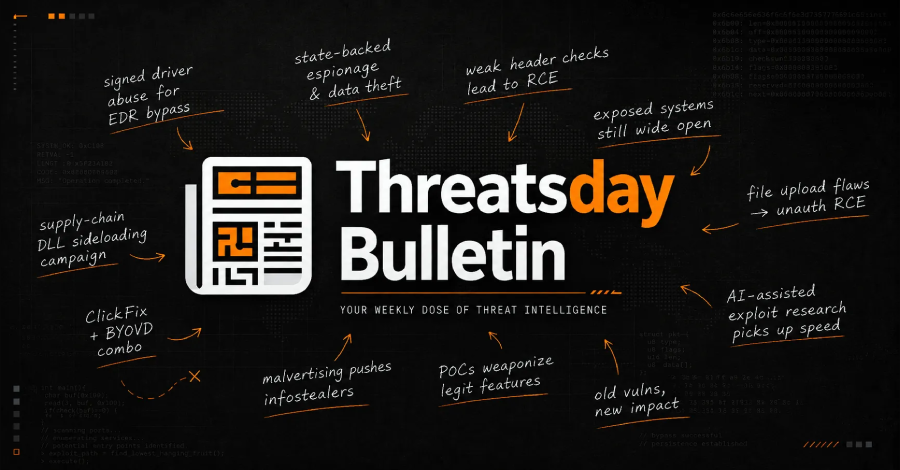
Signed drivers get turned against defenses. Legitimate apps help malware blend in. A weak header check opens a path to code execution. Elsewhere, exposed systems, old bugs, odd hiding tricks, and AI-assisted exploit research keep lowering the effort needed to cause damage.
Nothing here needs much decoration. The small gaps are doing enough work already.
The threats change every week. Subscribe, and we’ll alert you when each new ThreatsDay Bulletin is out.
-
Signed driver abuse
In new research, Check Point has reverse engineered Microsoft Defender’s Defender Boot-Time Removal driver (“BTR.sys”) and demonstrated that it’s possible to repurpose the signed remediation driver as a universal kernel operation engine to bypass endpoint security solutions by exploiting a “golden window” between system start and user mode initialization without having to rely on the bring your own vulnerable driver (BYOVD) method. “Because BTR.sys is a legitimate Microsoft-signed component, signature-based blocking is ineffective,” security researcher Jiří Vinopal said. “Furthermore, a well-crafted weaponization tool (like BTR_CLI) intentionally mimics the operational footprint of the legitimate Windows Defender remediation process.”
-
$10 million reward
The U.S. Department of Justice (DoJ) has charged 17 members of the Mabna Institute, an Iran-based company that, since at least 2013, has conducted a coordinated campaign of cyber intrusions into computer systems for 144 U.S.-based universities, 178 foreign universities, at least 42 U.S.-based private sector companies, at least 11 foreign private sector companies, at least five U.S. federal and state government agencies, and at least two non-governmental organizations (NGOs). The Mabna Institute has been accused of stealing more than 31 TB of academic data and intellectual property from these universities, as well as the email accounts of employees at the private sector companies, government agencies, and NGOs. In all, the Mabna Institute targeted more than 100,000 accounts of professors around the world, successfully compromising approximately 8,000 of them. The defendants carried out these intrusions on behalf of Iran’s Islamic Revolutionary Guard Corps (IRGC). The Mabna Institute was founded by Gholamreza Rafatnejad and Ehsan Mohammadi around 2013. “The campaign started in approximately 2013, continued through at least December 2017, and broadly targeted all types of academic data and intellectual property from the systems of compromised universities,” the DoJ said. “In addition to stealing academic data and login credentials for the benefit of the Government of Iran, the defendants also sold the stolen data through two websites, Megapaper.ir (Megapaper) and Gigapaper.ir (Gigapaper).” The U.S. Department of State is offering a $10 million reward for information about five of the defendants, or associated individuals or entities. “Mabna represents the privatization of state espionage: a contractor selling stolen research to whoever’s paying, with the IRGC as an anchor client rather than a sole owner,” Shmuel Gihon, Security Research Team Lead of Exposure Management at Check Point, told The Hacker News. “That’s the trend to watch: capable, deniable, commercially-run crews doing state-level work at industrial scale, with universities as the perfect target. They offer enormous IP value, thin identity controls, and an open-access culture that phishing exploits directly. We’ve seen this blurring of cyber-criminal and state-sponsored activity before, but historically it’s been more associated with Russian-speaking crews. What this case shows is that Iran and the IRGC are increasingly playing the same game.”
-
DLL sideloading campaign
A new Grandoreiro malware campaign has been found abusing the legitimate Duplicate Files Finder (DFF) application to run malicious code via DLL sideloading. According to telemetry data from Acronis, Grandoreiro activity remains concentrated in Latin America, with Mexico, Spain, Peru, and Argentina accounting for the lion’s share of infections. “The initial sample incorporates extensive anti-analysis functionality, including sandbox detection, virtual machine artifact checks, process blacklisting and environment profiling designed to evade automated analysis systems,” Acronis said. “These checks are performed before any attempt to contact the command-and-control (C2) infrastructure, suggesting that avoiding analysis is a high priority for the operators.”
-
ClickFix meets BYOVD
ErrTraffic-generated ClickFix campaigns have been observed attempting to deliver Cruciferra, which, in turn, employs a legitimate but vulnerable driver (“DCRCVDrv.sys”) as part of a BYOVD attack to escalate privileges and terminate security processes. ErrTraffic, sold by a threat actor named LenAI, is a malware-as-a-service (MaaS) framework and a traffic distribution system (TDS) that’s designed to distribute multiple threats through compromised WordPress websites, ClickFix social engineering, and EtherHiding. In recent months, ErrTraffic has been used to deliver Remus Stealer, Vidar Stealer, Okobot, LegionLoader, OnionDrop-related payloads, and BabaDedaLoader, per WatchGuard. “Victims land on compromised WordPress sites injected with an obfuscated ErrTraffic-generated JavaScript loader,” eSentire said. “The loader resolves its C2 domain by querying a Polygon smart contract, then sends a request to the C2 to retrieve the next stage to serve a ClickFix lure.” The end goal of the attack is to launch Remus Stealer via process hollowing.
-
Private AI processing
OpenAI has announced a privacy-centric safety approach to monitoring model misuse. The company said it’s previewing a new service to select customers that it calls Private Safety Processing, which keeps tabs on potential abuse without retaining customer data. “For ZDR deployments, customer content remains on infrastructure the customer controls,” OpenAI said. “We are also developing an option in which content is stored on OpenAI infrastructure, encrypted with keys controlled by the customer. In both cases, automated systems can identify potential misuse and return limited safety signals without exposing the underlying prompts or responses to OpenAI personnel.” The system clearly takes aim at rival Anthropic, which has a 30-day retention policy for business customers who want to use its Mythos-class models. In a related development, Google has showcased Homomorphic Encryption Intermediate Representation (HEIR), which enables cryptographically secure private AI inference on encrypted inputs. “HEIR (Homomorphic Encryption Intermediate Representation) is an open-source compiler toolchain and development platform for homomorphic encryption,” Google said. “In particular, HEIR can convert pre-trained AI models that operate on unencrypted data to operate on encrypted inputs.”
-
Guardrail-free AI
A new AI-powered service called Kriminal AI offers paying customers a way to get answers about everything, without any of the filters or guardrails that are typically implemented by AI platforms. “Kriminal.AI gives you raw, uncut intelligence — the questions other AIs refuse to touch,” the website claims. The service claims to have more than 2,300 users. Kriminal AI follows WormGPT, FraudGPT, and Xanthorox into a market that has expanded quickly to attract users who may be frustrated by safety, security, and ethical safeguards embedded into widely used models. Subscriptions for Kriminal AI start at $12.99/month and go all the way to $99.00/month. The most concerning aspect is that the service is not lurking in the dark web. It’s accessible on the clearnet, and comes with a tagline: “No filters. No guardrails. No “I can’t help with that.” Kriminal.AI gives you raw, uncut intelligence — the questions other AIs refuse to touch.” According to ThreatDown, the service appears to make use of Grok for primary inference; Google Cloud and Cloudflare for hosting; Anthropic’s Claude for a long-context model layer; Llama routed through OpenRouter for certain specialized tasks; Tavily for live search; NowPayments for cryptocurrency checkout (no KYC included, apparently); and Cloudflare/Let’s Encrypt for DNS and TLS.
-
ATT consent changes
Apple has agreed to make changes to its App Tracking Transparency (ATT) feature in Germany, after the Federal Cartel Office, or FCO, found the feature gave its own apps more favorable consent prompts than those of third-party developers. Apple has four months to implement the changes after. According to a statement issued by Apple, the changes will apply in almost all European Union countries. “The differences between the consent request used for Apple’s own offerings and the consent request predefined by Apple for third-party apps exceeded what could be justified based on differences in types of data processing,” FCO said. “The wording, design and selection options of the request used for Apple’s own offerings had the potential to encourage users to give their consent, whereas they had the potential to discourage consent for third-party apps. In addition, third-party apps in some cases had to request consent several times even when users had already given data protection law-compliant consent.” Apple was fined €98.6 million (then $116 million) in December 2025 by Italy’s antitrust authority after finding that ATT restricted App Store competition.
-
Refrigeration controllers exposed
Claroty’s Team82 has discovered 23 vulnerabilities in Copeland XWEB Pro controllers, including those that can be chained to bypass security mechanisms and achieve root-level remote code execution. A compromised controller could be used to remotely manipulate refrigeration equipment, including cooling fans and compressors, and conceal the resulting temperature increase while silently allowing the food to spoil. Multiple vulnerabilities have also been disclosed in Danfoss AK-SM 800A refrigeration controllers, including a “hidden ‘code-of-the-day’ authentication mechanism that could be abused to bypass normal authentication, a command-injection vulnerability leading to remote code execution.” A second flaw allowed authenticated users to inject arbitrary Nginx configuration directives, which could be abused to manipulate web traffic and trigger a denial-of-service condition. All the identified vulnerabilities have been fixed by the respective vendors.
-
C2 hidden in whitespace
A hand-written Windows backdoor has been found to store its C2 domain as the number of trailing spaces in a fake desktop.ini file. The 12 KB backdoor was discovered by Gen Digital on a single corporate workstation while hunting for unusual WMI persistence. “The malware was small, had a limited command set and disguised itself as legitimate Realtek software,” Gen said. “Its most unusual feature was its configuration: the address of its command-and-control server was not stored as readable text or encrypted data, but encoded in the number of spaces on each line of a Windows ‘desktop.ini’ file. To a user, and to many automated inspection systems, the file would appear almost empty. To the malware, those spaces spelled out its server address.” There is no evidence connecting the backdoor to a known threat actor. The absence of related samples indicates that it may have been a deliberately targeted operation.
-
Maximum-severity RCE
A maximum-severity security flaw in Gogs (CVE-2026-52813, CVSS score: 10.0) could be exploited to achieve remote code execution through Git hooks. “Organization names containing path traversal sequences (../) are accepted by Gogs, and repositories under them are written to paths following these path traversals,” according to a June 2026 advisory. “This allows storing/retrieving data for repositories at arbitrary locations on the filesystem. By creating a nested structure of Git repositories, one can overwrite the other’s hooks configuration to result in Remote Code Execution (RCE).” The issue was addressed in version 0.14.3, alongside patches for CVE-2026-52810 (a logic bug to write on read-only repositories) and GHSA-6vxv-wg6j-5qwp (an XSS flaw in the outdated version of “jsvine/notebookjs” used to render Jupyter notebook files). Aikido Security has been credited with discovering and reporting the flaws.
-
Memory leak via PostScript
Details have emerged about a now-patched out-of-bounds read flaw in Apple macOS Spotlight (CVE-2026-43774, CVSS score: 5.5) that could be exploited by a malicious app to access sensitive user data. The vulnerability was patched by the iPhone maker in late July 2026. “The vulnerability is in the Spotlight PostScript plugin,” Iru researcher Csaba Fitzl said, adding an attacker can use a specially crafted .ps file to trigger the vulnerability. It requires three conditions to be met: (1) The file is at least 4000 bytes, (2) A DSC comment keyword (e.g., %%Creator:) appears somewhere in the first 4000 bytes, and (3) The bytes following the keyword, up to byte 4000, contain no control characters.
-
Unauthenticated CI/CD takeover
A critical security flaw has been disclosed in @circleci/mcp-server-circleci that could result in remote code execution by means of a specially crafted request. “With one well-placed request, an attacker achieves an unauthenticated RCE in your CI/CD pipeline, taking full control of your build secrets and cloud identities,” Remedio said. The attack takes advantage of the fact that the Host and Origin headers associated with an HTTP request used to block browser-based attacks can be set by a network-adjacent threat actor. “Send a simple HTTP request that says Host: localhost in the HTTP header with no Origin, and you get right through,” Remedio said. “Once in, you can freely communicate with connected tools. Call the “run pipeline” tool, hand it the pipeline configuration you wrote, and add a step to run your commands. CircleCI executes it using the organization’s token.” The vulnerability has been fixed in version 0.19.2 of the npm package.
-
Workflow-to-RCE chain
A critical vulnerability in n8n, an open-source workflow automation platform, can allow an authenticated user with permission to create or modify workflows to exploit a prototype pollution vulnerability in the XML and the GSuiteAdmin nodes and achieve remote code execution on the n8n instance. The issue (CVE-2026-33696, CVSS score: 9.4) has been fixed in versions 2.14.1, 2.13.3, and 1.123.27. Security researcher Simon Koeck, who discovered the Flaw, said the prototype pollution alone is serious enough to crash the entire n8n instance, but can be chained to obtain full code execution and allows the attacker’s command to be run as the n8n process user.
-
Cable cut stopped intrusion
In late 2024, reports emerged of a Salt Typhoon campaign that targeted T-Mobile and other major U.S. telecommunications companies as part of a cyber espionage effort to gain access to valuable customer data. Although the activity was caught before the Chinese cyber spies could siphon any data from T-Mobile’s networks, the company has now revealed to Bloomberg that its staff spent months looking for suspected intruders without much success, only to eventually trace unusual behavior on one of its systems coming from a Chicago router belonging to a different telecom company. Jeff Simon, T-Mobile’s chief information officer, said he and three others drove to the data center that housed the compromised device and “pulled out a pair of scissors” to cut the cable.
-
AI exploitation gains
Chinese AI startup Z.ai has released GLM-5.3, a new AI model that it said is better suited for complex coding and long-horizon tasks. “GLM-5.3 is state of the art on CyberGym for vulnerability discovery, and its gains are largest further up the exploitation chain, where it more than doubles GLM-5.2 on exploitation benchmarks,” it said. “GLM-5.3 did not simply become better at identifying isolated flaws: it began to reason across multiple stages of exploitation, forming coherent plans for complete exploitation chains,” Z.ai said it has been working with several security teams in China to run its open-source models against real-world codebases, identifying 2,436 vulnerabilities across 269 projects, including 1,097 medium-to-high severity issues. “The findings span system kernels, operating systems, browser engines, open-source infrastructure, web applications, and network protocols,” it said. “Many had remained unnoticed for years or even decades, with the oldest dating back roughly 40 years.” Despite these advances, benchmarks show that GLM-5.3 lags behind Anthropic Mythos 5 in converting discovered flaws into working attacks.
The useful part of weeks like this is that the attacks rarely begin with magic. They begin with trust, exposure, weak assumptions, and things nobody thought worth abusing.
That leaves plenty to fix. Tighten what gets trusted, question the defaults, and keep looking at the boring edges. Attackers clearly are.
