


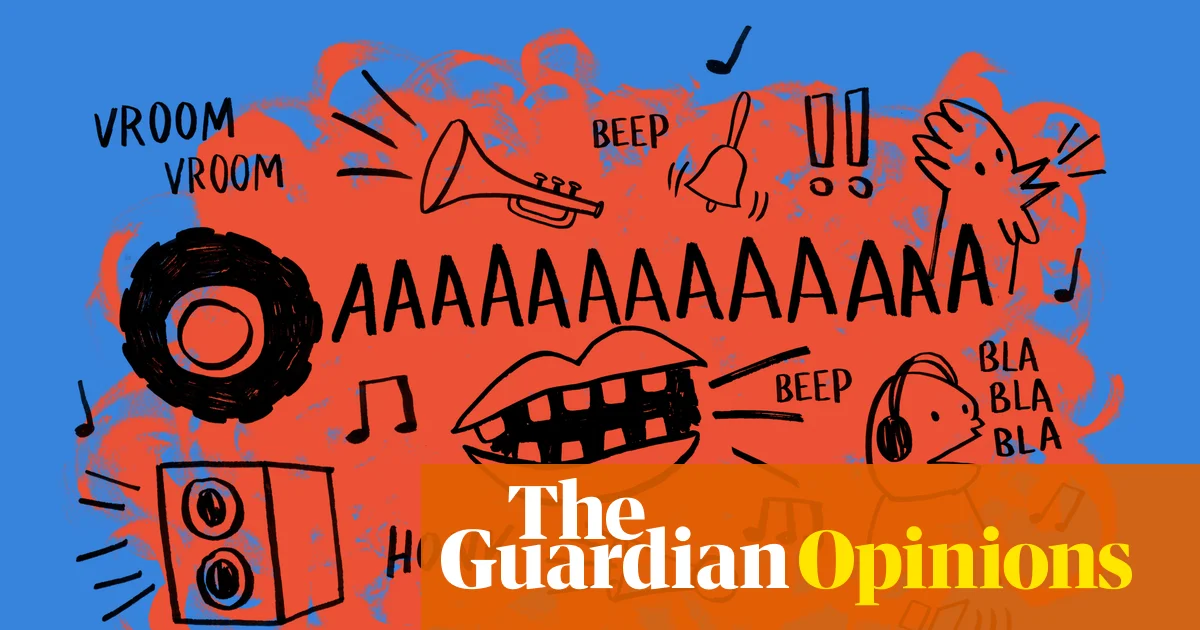
‘Interesting cities can’t be quiet”, runs one of grime DJ and music industry thinker Elijah’s epigrams – and in its essential spirit, he is right. Silent, tidy, prim cities should be treated with suspicion. Any such atmosphere denotes that something has gone wrong at a macro level: either you’ve wound up in an authoritarian regime or, worse, Switzerland.
But not all urban sounds are created equal, and some are more unwelcome than others. Take the tide of (Instagram, TikTok, YouTube) reels crashing on the shores of our collective attention on public transport, thanks to the astonishing number of grown adults who think it’s OK to surf the slopwave without headphones.
These rotters are accompanied by people taking their phone or video calls out loud on speakerphone. In the early days of mobile phones it was a widely agreed social truism that the white-collar worker unselfconsciously bellowing “I’m on the train!” into their BlackBerry was a grade-A public nuisance, plausibly worthy of throwing in the stocks. Well, at least then we were only being subjected to one end of the conversation.
The spread of 5G across the country is making such unsolicited noise more possible and more common: “loudcasting”, the BBC called it in a recent in-depth look at the phenomenon. A public backlash is suddenly mounting. Never one to miss an opportunity for free press coverage, last week Wetherspoons boss Tim Martin banned it from his pubs.
It’s funny how social pressure points like this fade in and out of public view, as the technology that touches our lives evolves: 19 years ago, the same practice was christened “sodcasting” by Pascal Wyse in this newspaper – at that point there were no reels, no AI drivel, no streaming video calls, no such thing as an Instagram influencer, nor Instagram either. The moral panic back then was about tinny MP3s being played aloud from much more basic mobile phones – and the purported juvenile delinquency that had surely led to such a crisis.
I probably annoyed a lot of Guardian readers that year, writing more than 2,000 words in defence of sodcasting: more precisely, in defence of teenagers playing music on their phones on the bus, the train or otherwise in public. There was something qualitatively different about that iteration, I would argue. It was a necessary claiming of public space by people who are often bullied out of it: adults-in-training, still working out how to exist in the outside world as independent beings, still learning to navigate their own social lives, and (an underrated asset, this) learning to enjoy music together, as a group activity. For the rest of us, this form of sodcasting amounted to an occasional, brief and usually joyful burst of alfresco music – and we could all do with hearing Crazy Cousinz and Giggs more often anyway.
The 2010 furore about sodcasting followed a decade of punching down by Britain’s power-wielding adults against its most marginalised young people – the “chavs” and “hoodies” against whom New Labour and the tabloids collectively went to war, driven by the reactionary moralism of what was risibly called “the respect agenda”. A time of asbos, public spaces protection orders and curfews for young people.
Interestingly – and admittedly anecdotally; this stuff isn’t easy to measure – sodcasting 1.0 seemed to disappear as a phenomenon after a year or two. New social behaviours that emerge in response to new popular technologies tend to do so: things settle down as a new consensus on how we should all use them is slowly reached, and reached collectively.
Let’s hope that happens again, because what we are all hearing on buses and trains thanks to sodcasting 2.0 is measurably more antisocial and individualistic: for one thing, 2010’s groups of teen sodcasters weren’t changing songs every 10 seconds. For another – warning, more anecdotal analysis incoming – these days it always seems to be full-grown adults rather than teenagers taking calls on speakerphone or watching reels with no headphones. It is maddening behaviour to anyone who has experienced it: like being on a bus or a train with someone who is flicking TV channels, constantly.
So, as Lenin once asked of matters of similarly grave importance: what is to be done? Last year, the Lib Dems proposed a £1,000 fine for sodcasting – an amusingly illiberal policy to make one of their centrepieces. For what it’s worth, I don’t think a fine is very useful, realistic or enforceable – though, God bless the ironclad French state, for it managed to find a way to do exactly that, fining a man €200 (£170) for taking a call on loudspeaker on a station platform.
after newsletter promotion
The truth is that we have more sane and effective options for shaping public behaviour in the form of nudge messaging. Transport for London has a strong history of this, via adverts on its trains, tubes and buses. In 2008, its Considerate Travel campaign seemed to help quieten down the mobile phone DJs and its current Act Like a Friend and Travel Kind campaigns aim to address hate crime, misogynistic creeps and encourage others to help passengers who may be unwell. Sodcasting 2.0 pisses me off no end, too, but I think people can change with a little nudging.
Stefan Stern made an excellent case in these pages recently that we should all remove our headphones – and turn off the content altogether – to hear and more fully participate in the noisy, messy city around us. Hopefully we can achieve this via social consensus, gentle persuasion, and without the soundtrack of someone broadcasting AI monkey videos. And if all else fails, well, sod it: let’s nudge the culprits into the stocks.
