


Twenty-five years after 9/11, two pieces of journalism, describing two different phenomena in contemporary New York, tell us a great deal about a city, and indeed a world, caught between two eras. In one, New York Magazine dives into “Habibi City”, a New York where a “cultural shift is underway, led by a generation of New Yorkers coming into its own”. This new generation is labelled as originating in “SWANA” – south-west Asia and north Africa, a region that “includes countries from Palestine to Iran to Sudan”. In the other, Vanity Fair describes calls for Zohran Mamdani to not attend the 9/11 memorial ceremony as partly founded in “inchoate, emotional” impulses, that see “the city’s first Muslim mayor as a stand-in for the 19 Muslims who hijacked four planes and turned them into deadly weapons, part of the ‘them’ who attacked ‘us’.”
Together they capture what has changed over a generation, and what remains stubbornly the same. Members of a diaspora of Muslim background are indeed breaking through and accumulating, as New York Magazine says, “clout”. They are no longer simply a fixture of bodegas and halal carts, but of Saturday Night Live, upmarket dining, entertainment and politics too. Mamdani is both the expression of that cohort and the catalyst of its recognition as an emerging force. They care deeply for their local communities but also for those in Gaza and beyond.
I use the descriptor “of Muslim background” rather than “Muslim” because this diasporic identity is a diverse one that is rooted in a religion but expands to encompass everyone from the practising to those for whom Islam is a cultural totem.The capaciousness of this heritage is demonstrable in its integration – without compromise – into mainstream American society. Mamdani and the Democratic Senate nominee for Michigan, Abdul El-Sayed, recuse themselves from the rote fealty to American glory and dare to point out both US support for Israel and the calamitous outcomes of the “war on terror” in the Middle East.
This is the result of this new generation of Americans coming from an immigrant background that has cultivated a less parochial and supremacist view of the US. There is something historically inevitable in this. Immigration from countries and backgrounds against which the US has waged military and ideological war eventually yields not a cowed assimilation, but a sort of political cosmopolitanism – kryptonite for American exceptionalism.
Growing up in the shadow of Islamophobia is another formative experience that ironically forced many to identify in terms of religious background rather than race or national origin. “In a way,” said American comedian Ramy Youssef, in a now legendary standup comedy segment, “9/11 made me more Muslim. Cos I was told it was my fault.” This is a profoundly recognisable story for many, including myself, for whom a casual religious identity became a sharp political one during the “war on terror” years.
At the same time as this new generation found their political and social power, the Islamophobia that began in 2001 has only further burrowed into the fabric of American society. Pew research found that, a quarter of a century after 9/11, “public attitudes toward Islam have become more ‘negative’ and more ‘partisan’” than they were in the wake of the attack. In March 2002, 25% of US adults believed that Islam “is more likely than other religions to encourage violence”. Today that figure has doubled to 51%. That is why Mamdani can be seen as a representative of hijackers (despite the fact that he was nine years old on 9/11) and El-Sayed can be called a “terrorist” by Senator Tommy Tuberville. Congresswoman Nancy Mace said that “every single Muslim holding public office in America” is a “threat to both national security and our republic”. “Jihadists”, said Donald Trump, were “being elected all over the place”.
Rozina Ali, the author of Seasons of Fury, a study of the history of Islamophobia in the US, tells me that contemporary Islamophobia cannot be separated from a wider failure of American politics at home and abroad. The “war on terror” turned into a foreign quagmire. At home, a financial crisis saw millions of people lose their homes and savings. One of the reasons Islamophobia has been used by the right is that “a lot of these things can be explained by so called invasions from foreigners or a foreign culture like Islam”. The right, she said, simply “doesn’t have an effective vision for this country that can actually solve a lot of the ills”.
after newsletter promotion
The problem for this approach is not only that Muslims are no longer keeping their heads down, but that they represent a broader progressive politics. Political candidates as well as cultural figures are mobilising large blocks of voters and backers because their worldview has been informed by profound marginalisation. They can root their politics in material concerns about standards of living as well as unpopular foreign policy, in addition to humanising the toll of the political backlash against Muslims and making it a part of the American story. They can unite a broad coalition of people because they too experience being on the losing side against a political establishment.
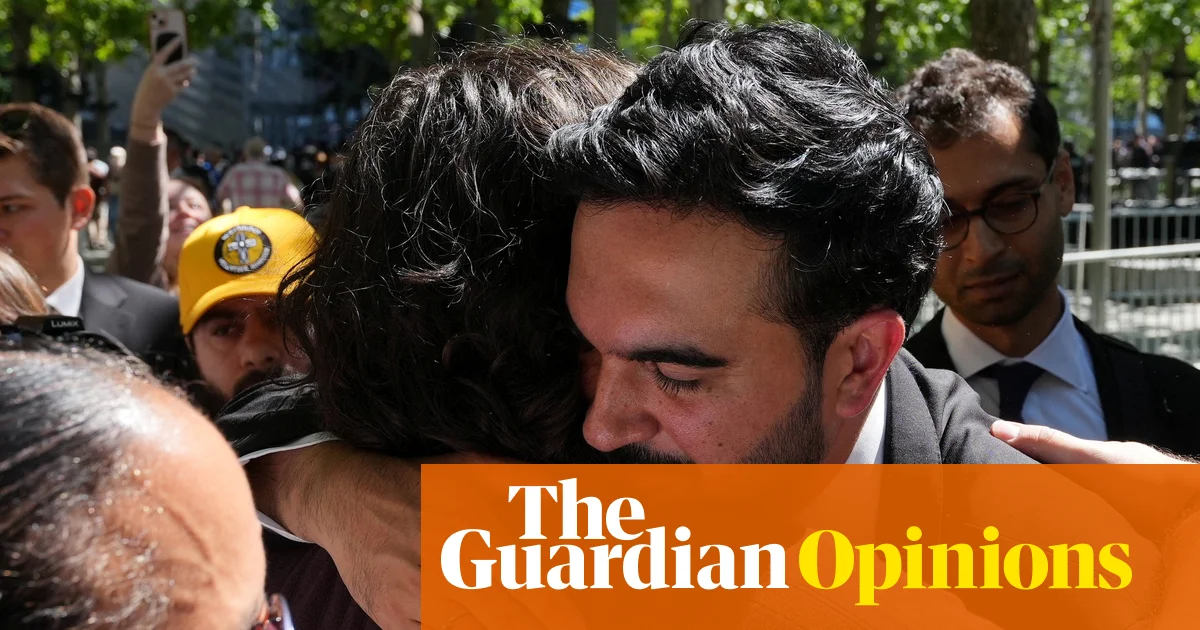
Despite all the vitriol from the right, anti-Muslim propaganda has not prevented these connections being formed. At the 9/11 commemorative ceremony this past weekend, Mamdani soberly and graciously shook the hand of Rudy Giuliani, the man who was mayor of New York on 9/11, and who had called for Mamdani not to attend. One man was the past, and the other was the future.
